Skip to content
Portafilter Co

Grinders · Coffee Grinders

The best grinders for the Gaggia Classic

The Classic has no grinder and no factory PID, which makes the grind your main variable. Six grinders that genuinely suit it — from a hand grinder under a hundred dollars to a 64mm flat burr — ranked by how well they feed a 58mm basket.

By Stephen V.Updated How we pick
#ad

We earn a commission when you buy through our Amazon links, at no extra cost to you. It never changes a verdict, and we say so when the cheaper product is the better buy. How this works.

For most Gaggia Classic owners the right grinder is the Baratza Encore ESP: forty stepped settings re-geared so they land inside the espresso range, grind-on-demand straight into the portafilter, and a price that stays proportionate to the machine. If money is tight, the Timemore Chestnut C3 ESPhand grinder makes shots just as good for a fraction of that and costs you a minute of cranking. If you want the grinder that actually raises this machine's ceiling, go stepless: the DF54 for single-dosing, or the Eureka Mignon Notte if you want a hopper and near-silence.

The Gaggia Classic Evo Pro ships without a grinder, and unlike the Barista Express that is not an omission to work around — it is the whole design. You buy a Classic because it is the cheapest honest route to a genuine 58mm commercial portafilter, a lead-free brass boiler and a single-piece stainless body you can open and service for years. The machine is a platform. Which grinder you bolt to it decides, more than anything else you can spend money on, how good the coffee coming out of it actually is.

What makes a grinder a good Classic partner is narrower than "is it a good grinder", and it is a different list from the one we use on the best grinders for the Breville Bambino page. Four things matter here.

Adjustment resolution inside the espresso range.The Classic has no PID from the factory. Brew temperature moves around as the thermostat cycles, and you manage it by timing the heat-up light — the technique everyone calls temperature surfing. The practical consequence for grinder shopping is that temperature is a variable you can only partly control, so grindhas to be the variable you control precisely. A grinder with three usable steps between "gushing" and "choked" makes dialing in guesswork. One with forty steps, or no steps at all, turns it into a loop you can close.

Dose precision around 18-20g. A 58mm basket is the commercial standard, and the stock Gaggia double takes a genuine 18g comfortably, with most aftermarket precision baskets specified 18-20g or 18-22g. That is more coffee than a 54mm Breville basket holds, which matters when you are reading grinder advice written for Breville machines. It also means a grinder that cannot deliver a repeatable 18g by weight will quietly change your recipe every time you change beans.

Retention.Grounds left inside a grinder are yesterday's coffee in today's shot, and they are also the reason a grind adjustment can seem not to work: you turn the dial, but the next dose is still mostly coffee ground at the old setting. A Classic owner is weighing doses anyway, so single-dosing fits the workflow naturally, and a low-retention grinder makes each adjustment land on the very next shot.

Price proportion.There is a widely repeated rule that you should spend as much on the grinder as on the machine, and on a Classic it is closer to true than on most machines — because the Classic's hardware is already better than its price suggests, and the grinder is the thing holding it back. But "as much as the machine" is not a law. A Classic fed by a well-chosen two-hundred-dollar grinder makes genuinely good espresso. What it cannot do is make good espresso fed by a blade grinder or a supermarket bag of pre-ground, because espresso is uniquely sensitive to grind uniformity and there is no setting on the machine that compensates for it.

One more thing before the picks, because it is the mistake we see most often. If you are choosing between a Classic plus a cheap grinder and a cheaper machine plus a good grinder, take the second option. The Classic is a wonderful machine to grow into, but it is also the machine that most ruthlessly exposes a bad grinder — no pressurized dual-wall basket is hiding anything, and there is no automation smoothing the result. Our best espresso setup under $500 page splits a fixed budget across the whole kit rather than spending it all on the machine, and do you need a grinder for espresso explains why pre-ground is a dead end on a machine like this one.

The short answer

Quick picks

#ProductBest forScorePrice
01
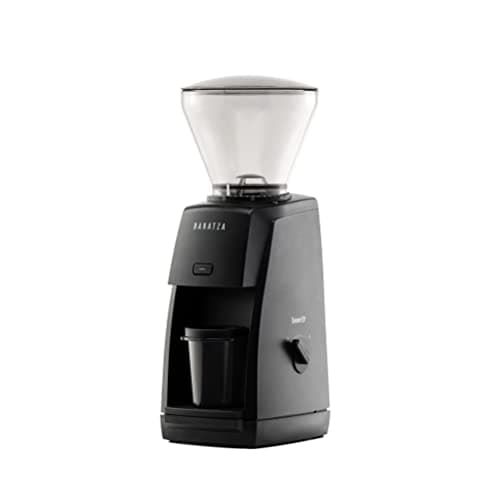
Baratza Baratza Encore ESP
Baratza Encore ESP

The default answer, and the one we would buy without agonizing. Baratza re-geared the Encore's 40 stepped settings so they land inside the espresso range instead of clustering at the coarse end, which is exactly what a machine without a PID needs: you move the grind one click and watch the shot time move a couple of seconds. It grinds on demand straight into a 58mm portafilter, Baratza's parts and repair support is the best in the category, and it costs about what a Classic costs — the right proportion for a machine whose whole selling point is that you keep it.

Best overall for a Gaggia Classic
8.2
$199.95Amazon
02
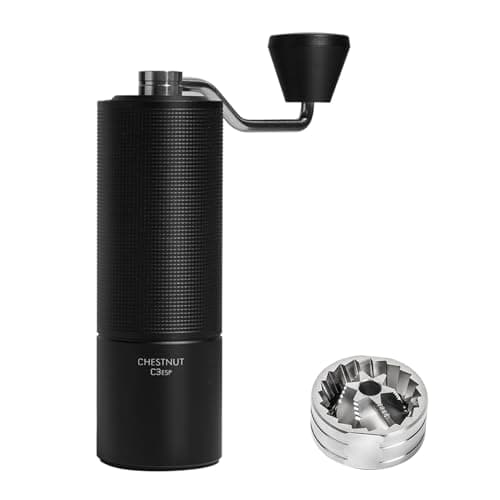
Timemore Timemore Chestnut C3 ESP
Timemore Chestnut C3 ESP

The budget answer that does not compromise the cup. The C3 ESP is the espresso-geared version of Timemore's standard hand grinder: 38mm S2C conical burrs and an external stepped dial at roughly 0.023mm per click, which is finer resolution than most electrics at three times the money. The trade is honest and physical — you crank for about a minute per double. If budget is the binding constraint on a Classic build, buy this, buy a decent basket, and put what is left into beans.

Best budget pairing
8.2
$99.00Amazon
03
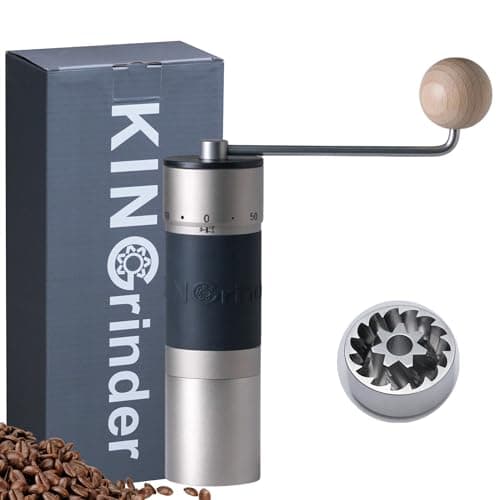
KINGrinder KINGrinder K6 Manual Coffee Grinder
KINGrinder K6 Manual Coffee Grinder

The hand grinder for people who want numbers. The K6 puts its adjustment on an external numbered dial at roughly 16 microns per click with around 240 settings available, which is finer and far more repeatable than anything else at this money — you can move a fraction of a step and genuinely taste it. Its 48mm heptagonal burrs are larger than the Timemore's, so it grinds an 18g dose faster too. It is the more capable of the two budget hand picks; the Timemore is the better-finished object.

Best hand grinder for precise dialing in
8.4
$92.65Amazon
04
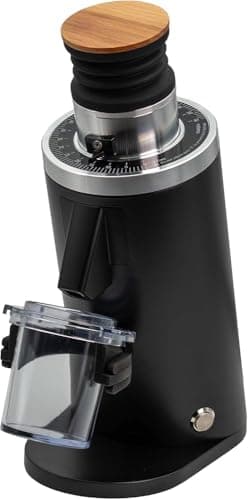
DF DF54 Single Dose Coffee Grinder
DF54 Single Dose Coffee Grinder

The step up that changes the coffee rather than the convenience. The DF54 puts 54mm stainless flat burrs and a stepless micrometric adjustment behind a single-dose hopper with sub-0.1g retention and an anti-static ionizer, which means two things a Classic owner feels immediately: grind adjustments land on the very next shot, and the espresso tastes cleaner and more separated than any conical here can make it. This is the first pick on the page we would call a genuine upgrade to the machine.

Best step up for single-dosing
9.0
$260.00Amazon
05
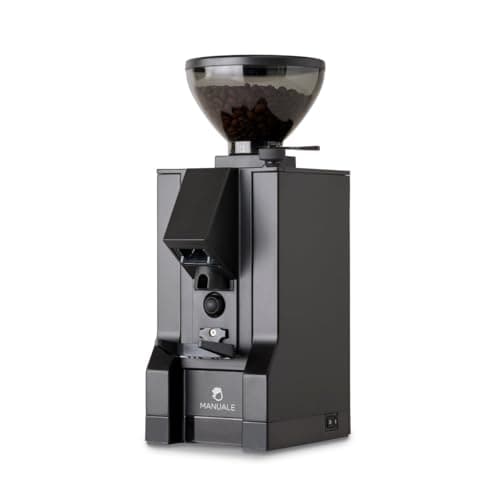
Eureka Eureka Mignon Notte
Eureka Mignon Notte

The hopper grinder we would put next to a Classic. The Notte pairs 50mm flat steel burrs with a genuinely stepless dial, so you get flat-burr uniformity and infinite adjustment while keeping the fill-and-forget convenience a single-dose grinder gives up. It is also the quietest grinder here by a wide margin, which matters more than spec sheets admit in a kitchen at six in the morning. Italian-built, compact, and the pick that makes the fewest demands on how you work.

Best stepless hopper grinder
8.2
$299.00Amazon
06
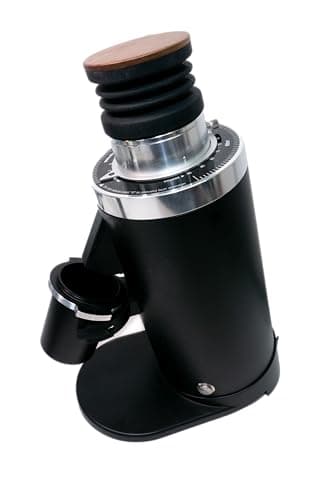
DF DF64 Gen 2 Single Dose Coffee Grinder
DF64 Gen 2 Single Dose Coffee Grinder

The most grinder you can sensibly put on a Classic, and arguably more than the machine needs. 64mm flat burrs, stepless adjustment and a low-retention single-dose design give you the cleanest, most uniform espresso grounds on this page — the kind of grind that makes a 58mm single-wall basket behave. The honest caveat is proportion: this costs several times what a Classic does, and at that point you are building a grinder-first setup that a future machine will benefit from more than this one.

Best for a grinder-first setup
8.4
$389.00Amazon

#ad · Live prices from the Amazon Product API, as of October 7, 2026. Where we have no verified live price, we show none — a gap beats a number that has rotted.

In detail

The picks, in full

01
Baratza Baratza Encore ESP

Best overall for a Gaggia Classic

Baratza Encore ESP

40mm conical steel burrs40 stepped settings, re-geared for espressoGrinds into the portafilterBaratza parts + repair support
8.2/10

The default answer, and the one we would buy without agonizing. Baratza re-geared the Encore's 40 stepped settings so they land inside the espresso range instead of clustering at the coarse end, which is exactly what a machine without a PID needs: you move the grind one click and watch the shot time move a couple of seconds. It grinds on demand straight into a 58mm portafilter, Baratza's parts and repair support is the best in the category, and it costs about what a Classic costs — the right proportion for a machine whose whole selling point is that you keep it.

Espresso adjustment
8
Grind quality
8
Workflow with a Classic
9
Retention
7
Value
9

Pros

  • Enough usable steps inside the espresso range to dial in by taste and shot time alone
  • Grinds on demand into a 58mm portafilter — no dosing cup or transfer step needed
  • Baratza's spare parts and service network is the longest-lived in home coffee
  • Narrow footprint that fits beside a Classic without taking over the counter
  • Price stays proportionate to the machine, which is the point on this platform

Cons

  • Hopper retention means the first grams of a session carry stale coffee unless you single-dose
  • Louder than a flat-burr grinder with a slower motor
  • Stepped, not stepless — occasionally the setting you want sits between two clicks
  • 40mm conical burrs are the smallest here; the flat-burr picks below grind more uniformly

Don't buy this if…

…you also want to grind for a French press most mornings. It will, but the ESP gearing is biased toward espresso, so the standard Baratza Encore is the better all-rounder if filter is your main brew.

The reason this grinder suits this machine specifically is the feedback loop. On a Barista Express you have a dosing display and a grinder Breville chose for you. On a Classic you have a 58mm basket, a scale, a thermostat light and your tongue. Forty steps across the espresso range turns that into something workable: pull, taste, move one click, pull again, and the change is small enough that you converge instead of oscillating.

Pair it with a single-wall 58mm basket rather than the pressurized dual-wall basket in the box, because the Encore ESP is finally a grinder good enough to use one. Our Encore ESP review covers the grinder on its own, and Encore vs Encore ESP explains what the re-gearing changes if you are tempted by the cheaper original.

The one alternative at the same money worth a look is the Fellow Opus 2, which trades the Encore's numbered settings and repair support for a stepless dial, faster grinding and an included 30g dosing cup specified to fit a 58mm portafilter. Take the Encore ESP if repeatable numbers and serviceability matter to you; take the Opus 2 if stepless adjustment and a single-dose routine do.

$199.95View on Amazon

Price as of October 7, 2026. Prices change — Amazon's at checkout is the one that counts.

#ad · we may earn a commission from this link to Baratza Encore ESP

02
Timemore Timemore Chestnut C3 ESP

Best budget pairing

Timemore Chestnut C3 ESP

38mm S2C stainless conical burrsExternal stepped dial ~0.023mm/click30 clicks per rotationManual / hand grinder
8.2/10

The budget answer that does not compromise the cup. The C3 ESP is the espresso-geared version of Timemore's standard hand grinder: 38mm S2C conical burrs and an external stepped dial at roughly 0.023mm per click, which is finer resolution than most electrics at three times the money. The trade is honest and physical — you crank for about a minute per double. If budget is the binding constraint on a Classic build, buy this, buy a decent basket, and put what is left into beans.

Espresso adjustment
8
Grind quality
8
Workflow with a Classic
5
Retention
10
Value
10

Pros

  • Grind resolution at espresso fineness that beats most electrics under $200
  • Effectively zero retention — every adjustment lands on the very next shot
  • Nothing to go wrong: no motor, no electronics, no mains cable
  • Costs a fraction of any electric here, which frees budget for a basket and a scale
  • Travels — the same grinder works with a manual lever or a portable maker

Cons

  • About a minute of cranking per double shot, and espresso fineness is the hardest grind to turn
  • Grinding for three or four milk drinks back to back genuinely gets old
  • You grind into a cup and transfer, so you want a dosing funnel to avoid spilling into a 58mm basket
  • No grind-on-demand convenience — this is the pick that costs you time instead of money

Don't buy this if…

…you make more than two drinks most mornings, or anyone in the household has wrist or grip problems. Hand grinding espresso is real physical work, and the Classic is a machine people often buy precisely because they drink a lot of espresso.

The thing people get wrong about hand grinders is assuming they are the compromise option. At this price they are the opposite: a hand grinder spends its entire budget on burrs and bearings because it has no motor, no housing and no electronics to pay for. The C3 ESP's external dial is numbered and stepped, so you can write down the setting that worked for a bag of beans and return to it exactly — which is more than some electric grinders at twice the money will let you do.

The honest limit is throughput, not quality. Our Timemore C3 ESP review covers it in full, and hand vs electric grinders lays out the trade without the marketing.

$99.00View on Amazon

Price as of October 7, 2026. Prices change — Amazon's at checkout is the one that counts.

#ad · we may earn a commission from this link to Timemore Chestnut C3 ESP

03
KINGrinder KINGrinder K6 Manual Coffee Grinder

Best hand grinder for precise dialing in

KINGrinder K6 Manual Coffee Grinder

48mm heptagonal stainless burrsExternal numbered dial, 16µm/click~240 numbered settings~25-30g single-dose capacity
8.4/10

The hand grinder for people who want numbers. The K6 puts its adjustment on an external numbered dial at roughly 16 microns per click with around 240 settings available, which is finer and far more repeatable than anything else at this money — you can move a fraction of a step and genuinely taste it. Its 48mm heptagonal burrs are larger than the Timemore's, so it grinds an 18g dose faster too. It is the more capable of the two budget hand picks; the Timemore is the better-finished object.

Espresso adjustment
10
Grind quality
8
Workflow with a Classic
5
Retention
10
Value
9

Pros

  • 16-micron clicks give finer adjustment than most electric espresso grinders
  • Numbered external dial means a written-down setting is genuinely repeatable
  • 48mm burrs grind an 18g dose faster than a 38mm hand grinder does
  • Single-dose capacity comfortably covers an 18-20g 58mm basket
  • Near-zero retention, like every hand grinder

Cons

  • 240 settings is more resolution than most people can use, and it makes the first dial-in slower
  • Fit and finish is a step below Timemore's — the tolerances are good, the feel is plainer
  • Still a hand grinder: about a minute of cranking per double, and no grind-on-demand
  • Listings and colorways change often, so check you are buying the K6 and not a nearby model

Don't buy this if…

…you want to spend less time thinking about grind, not more. The K6's resolution is its reason to exist, and if a numbered dial with hundreds of positions sounds like a chore rather than a tool, the Timemore C3 ESP's 30 clicks per rotation will make you happier.

A Classic without a PID rewards fine grind control more than almost any other machine, and that is exactly what the K6 sells. Sixteen microns per click is small enough that one step moves a shot by a second or two rather than ten, so you can chase a target without overshooting it. Write the number on the bag and you can come back to it a month later on the same beans.

Our KINGrinder K6 review goes through the burr set and the dial in detail, and K6 vs Timemore C3 settles the choice between the two budget hand grinders here.

$92.65View on Amazon

$109.0015% off

Price as of October 7, 2026. Prices change — Amazon's at checkout is the one that counts.

#ad · we may earn a commission from this link to KINGrinder K6 Manual Coffee Grinder

04
DF DF54 Single Dose Coffee Grinder

Best step up for single-dosing

DF54 Single Dose Coffee Grinder

54mm stainless steel flat burrsStepless micrometric adjustmentSub-0.1g retention, ionizer anti-staticEspresso-first, brew-capable
9.0/10

The step up that changes the coffee rather than the convenience. The DF54 puts 54mm stainless flat burrs and a stepless micrometric adjustment behind a single-dose hopper with sub-0.1g retention and an anti-static ionizer, which means two things a Classic owner feels immediately: grind adjustments land on the very next shot, and the espresso tastes cleaner and more separated than any conical here can make it. This is the first pick on the page we would call a genuine upgrade to the machine.

Espresso adjustment
10
Grind quality
9
Workflow with a Classic
8
Retention
10
Value
8

Pros

  • Flat burrs produce a more uniform espresso grind than any conical on this page
  • Stepless adjustment means there is no setting you cannot reach
  • Sub-0.1g retention — an adjustment affects the next shot, not the one after it
  • Built around single-dosing, which is how a Classic owner already weighs coffee
  • Ionizer keeps static-clumped grounds out of the dosing cup

Cons

  • Single-dosing is a workflow commitment: you weigh beans for every shot, every time
  • Costs more than a Gaggia Classic Evo Pro typically does, which some buyers will balk at
  • No hopper means it is the wrong grinder for a household making six drinks before work
  • Stepless adjustment has no numbers to write down — you learn the feel of your own grinder

Don't buy this if…

…you want to fill a hopper on Sunday and not think about it again. The DF54's advantages all come from the single-dose, low-retention design, and if that workflow does not appeal, a hopper grinder like the Mignon Notte will make you happier for similar money.

This is the pick where the Classic stops being the limiting factor. A 58mm single-wall basket fed by uniform, flat-burr grounds is what the machine was designed around, and the difference is not subtle — shots get more separated and sweeter, and the channeling that makes beginners blame the machine largely goes away. The 54mm burr set sits in the sweet spot where flat-burr clarity arrives without a 64mm grinder's footprint, noise or price.

Our DF54 review covers it in full, DF64 Gen 2 vs DF54 explains whether the bigger burrs are worth it, and single dosing explained covers the workflow before you commit to it.

$260.00View on Amazon

Price as of October 7, 2026. Prices change — Amazon's at checkout is the one that counts.

#ad · we may earn a commission from this link to DF54 Single Dose Coffee Grinder

05
Eureka Eureka Mignon Notte

Best stepless hopper grinder

Eureka Mignon Notte

50mm flat steel burrsStepless dialElectric, hopper-fedQuiet operation
8.2/10

The hopper grinder we would put next to a Classic. The Notte pairs 50mm flat steel burrs with a genuinely stepless dial, so you get flat-burr uniformity and infinite adjustment while keeping the fill-and-forget convenience a single-dose grinder gives up. It is also the quietest grinder here by a wide margin, which matters more than spec sheets admit in a kitchen at six in the morning. Italian-built, compact, and the pick that makes the fewest demands on how you work.

Espresso adjustment
9
Grind quality
9
Workflow with a Classic
9
Retention
6
Value
8

Pros

  • Stepless adjustment tunes grind by the smallest increment you can feel
  • 50mm flat burrs give clean, uniform espresso grounds with a hopper's convenience
  • Notably quiet — a real advantage in an open-plan kitchen or an early morning
  • Compact Italian build that feels like equipment rather than an appliance
  • Grinds straight into a 58mm portafilter held in its cradle

Cons

  • Hopper retention is real: adjustments take a purge to take full effect
  • Costs more than the Classic does, with no numbered settings to record
  • Beans sit in daylight in the hopper, which is not how you keep coffee fresh
  • A stepless dial can drift if knocked, and there is no number to return to

Don't buy this if…

…you rotate between several bags of beans. Hopper grinders punish variety — you either purge between bags or accept blending them, and a single-dose grinder like the DF54 is simply the right tool for that habit.

Stepless is the headline, and on a machine without a PID it earns the billing: there is no setting between two clicks that you cannot reach, so the shot time you are chasing is always available. The quietness is the underrated part. A Classic takes a few minutes to come up to temperature and you will often be grinding while the house is asleep, and the Notte is the only electric here we would describe as polite.

Our Mignon Notte review covers the burr set and the dial, and Notte vs Specialita settles the step up inside Eureka's own range.

$299.00View on Amazon

Price as of October 7, 2026. Prices change — Amazon's at checkout is the one that counts.

#ad · we may earn a commission from this link to Eureka Mignon Notte

06
DF DF64 Gen 2 Single Dose Coffee Grinder

Best for a grinder-first setup

DF64 Gen 2 Single Dose Coffee Grinder

64mm flat burrsStepless adjustmentSingle-dose, low-retention designEspresso to filter
8.4/10

The most grinder you can sensibly put on a Classic, and arguably more than the machine needs. 64mm flat burrs, stepless adjustment and a low-retention single-dose design give you the cleanest, most uniform espresso grounds on this page — the kind of grind that makes a 58mm single-wall basket behave. The honest caveat is proportion: this costs several times what a Classic does, and at that point you are building a grinder-first setup that a future machine will benefit from more than this one.

Espresso adjustment
10
Grind quality
10
Workflow with a Classic
7
Retention
9
Value
6

Pros

  • 64mm flat burrs are the most uniform espresso grind here, by a clear margin
  • Stepless adjustment with enough range to cover filter as well as espresso
  • Low-retention single-dose design, so adjustments land immediately
  • The grinder you keep when you eventually replace the machine

Cons

  • Costs several times what a Gaggia Classic does — the proportion is genuinely lopsided
  • Large and loud next to a compact semi-automatic
  • Single-dose in practice, so every shot starts with weighing beans
  • More grinder than a non-PID single boiler can fully exploit

Don't buy this if…

…the Classic is the machine you intend to keep. A DF54 or a Mignon Notte gets you most of the way for much less, and the remaining difference is easier to hear on a machine with temperature stability this one does not have.

We include this pick because a real group of Classic owners buy grinder-first on purpose: the plan is a better machine in two years, and the grinder is the part that carries over. If that is you, the DF64 Gen 2 is a sound long-term purchase and the Classic will show you more of it than any pressurized-basket machine could.

If it is not you, be honest about diminishing returns. Our DF64 Gen 2 review and best flat burr grinders cover the tier, and best electric espresso grinders under $500 places it against the field.

$389.00View on Amazon

Price as of October 7, 2026. Prices change — Amazon's at checkout is the one that counts.

#ad · we may earn a commission from this link to DF64 Gen 2 Single Dose Coffee Grinder

What a Gaggia Classic actually needs from a grinder

A grinder recommendation only means something relative to a machine. The Classic Evo Pro has a genuine 58mm commercial portafilter, a lead-free brass boiler, a 15-bar Ulka vibratory pump and — crucially — no PID from the factory. Those facts set the criteria below. Specs are the manufacturers' published figures for the exact listings above.

GrinderBurrsAdjustmentRetentionWho it suits
Baratza Encore ESP40mm conical, electric40 steps, geared for espressoHopper (moderate)Most Classic owners
Timemore C3 ESP38mm S2C conical, manualStepped, ~0.023mm/clickEffectively noneTight budgets, one or two drinks a day
KINGrinder K648mm heptagonal, manual~240 steps, 16µm/clickEffectively nonePrecise dialing in on a budget
DF5454mm flat, electricStepless micrometricSub-0.1g (single dose)People who weigh every dose
Eureka Mignon Notte50mm flat, electricSteplessHopper (moderate)Convenience with flat-burr quality
DF64 Gen 264mm flat, electricSteplessLow (single dose)Grinder-first builds

No PID: why grind resolution matters more on this machine

On a machine with a PID, brew temperature is held to within a degree or so and you can treat it as a constant. The Classic Evo Pro does not do that from the factory — a thermostat switches the heating element on and off around a set point, so the water temperature at the group drifts through a cycle. Owners manage it by timing the shot against the heat-up light, which is the technique everyone calls temperature surfing, and it works well once learned.

What that means for grinder shopping is simple. You have two main levers on shot quality — temperature and grind — and one of them is partly out of your hands. So the grind lever needs to be fine. A grinder with coarse steps forces you to compensate with dose or tamp, which are worse variables to lean on; a grinder with forty steps or none at all lets you change one thing at a time. This is also the strongest argument for fitting a PID kit later: do that, and every grinder on this page gets easier to dial in. Our how to dial in espresso guide covers the loop, and espresso grind size covers which way to turn the dial and why.

Dose: why 58mm changes the number

A great deal of grinder advice is written for 54mm Breville baskets and 18-19g doses. The Classic's 58mm basket is the commercial standard: the stock double takes a genuine 18g comfortably, and aftermarket precision baskets are commonly specified 18-20g or 18-22g. Dose by weight, start at 18g, aim for roughly 36g in the cup in 25-30 seconds, and change the grind rather than the dose when the shot runs wrong. Our 58mm portafilter accessories page covers which baskets, tampers and funnels fit, and best precision baskets covers the single cheapest upgrade to go with any grinder here.

One Gaggia-specific note. The Classic ships with a pressurized dual-wall basket, which manufactures crema by forcing the shot through a pinhole and is designed to make pre-ground coffee look acceptable. It also hides everything a good grinder does. The moment you own any grinder on this page, switch to a single-wall basket — otherwise you have paid for grind quality the basket is actively concealing. Our pressurized vs unpressurized baskets guide explains the mechanism.

Hopper or single dose?

A hopper holds a week of beans and asks nothing of you each morning; it also means some of yesterday's grind is in today's shot, your beans sit in daylight, and a grind adjustment takes a purge to fully arrive. Single-dosing is slower and fresher, and it fits the way a Classic owner already works, because you are weighing doses anyway. Neither is wrong. If you drink one or two shots a day and rotate between bags, single dose. If you make coffee for a household on a schedule, take the hopper and purge a few grams first. Our best single dose grinders page covers that tier on its own terms.

What not to buy for a Gaggia Classic

A blade grinder — it chops rather than grinds and cannot produce a uniform espresso grind at all, at any price. A cheap no-name "espresso" burr grinder with a single coarse adjustment collar: the steps are so large that your shot jumps from fifteen seconds to fifty with nothing usable in between, and you will blame the machine. And pre-ground coffee from a bag, which is both too coarse and too stale, and is the most common reason a new Classic owner concludes their machine is broken.

We would also steer you away from spending Classic money on a grinder whose built-in portafilter cradle is sized for 54mm Breville baskets, for the obvious reason. Our best espresso grinders page ranks the field without reference to a particular machine, and our Gaggia Classic Evo Pro review covers the machine these grinders are for, including the mods worth making.
How we picked

We did not lab-test this gear

Everyone in this category says they tested twenty machines. We have not pulled shots on every product here, and we say so. What we did instead: compiled the published specifications, cross-checked the manufacturer manuals, computed the running cost (wattage to energy, grams-per-shot to cost-per-cup), weighed aggregated owner reports, and scored each product against a published rubric. The scores are judgments from documented research — not measurements we took, because we do not have a test lab and we will not pretend we do. Where hands-on time would tell you more than a spec sheet, we flag it. Where a number came from someone else's work, we name them in Sources.

Questions

Frequently asked

What is the best grinder for a Gaggia Classic?
The Baratza Encore ESP for most people: forty stepped settings re-geared into the espresso range, grind-on-demand into a 58mm portafilter, and a price proportionate to the machine. On a tight budget, the Timemore C3 ESP or the KINGrinder K6 hand grinders; for a real upgrade, the stepless flat-burr DF54. Live prices are in the table above.
Does the Gaggia Classic come with a grinder?
No. The Gaggia Classic Evo Pro has no built-in grinder and no grinder in the box, which is why this page exists. If you want the grinder built into the machine, our best espresso machines with a built-in grinder roundup covers that category instead.
How much should I spend on a grinder for a Gaggia Classic?
Roughly what the machine costs is a sound target, and it is closer to right on a Classic than on most machines, because the Classic's hardware is already better than its price and the grinder is what holds it back. Spending less than about half the machine's price usually means coarse adjustment steps that make dialing in guesswork. Spending several times the machine's price is a grinder-first build — valid, but understand that is what you are doing.
Can I use a hand grinder with a Gaggia Classic?
Yes, and the grind quality is genuinely competitive, because a hand grinder spends its whole budget on burrs. The limit is throughput: expect about a minute of cranking per double shot, and espresso is the hardest grind to turn. For one or two drinks a day it is a great pairing. For a household making four milk drinks before work, buy an electric.
Do I need a PID before I upgrade the grinder?
Grinder first. A PID makes the temperature you already have repeatable; a better grinder changes how uniformly the water can extract the coffee at all, and no temperature control compensates for an uneven grind. Fit the PID afterwards and every grinder here becomes easier to dial in. Our Gaggia Classic Evo Pro review covers the mod path.
How many grams should I dose in a Gaggia Classic basket?
Start at 18g in the stock 58mm double and aim for about 36g out in 25-30 seconds. Aftermarket precision baskets are commonly specified 18-20g or 18-22g if you want more headroom. Swap the pressurized dual-wall basket for a single-wall one as soon as you own a real grinder — see pressurized vs unpressurized baskets.
Will these grinders work with other 58mm machines?
Yes. Nothing on this page is Gaggia-specific — the criteria are a 58mm basket, an 18-20g dose and fine adjustment, which describes the Rancilio Silvia, the Breville Dual Boiler and most prosumer machines too. The pairing logic changes for 54mm Breville machines, which is why we keep a separate page for the Bambino.

Keep reading

Same gear, other pages

We cover this gear elsewhere too

Receipts

Sources

We do not run a testing lab, and we do not pretend to. Where a measured number came from someone else's work, we name them and link them. Where we could not verify something, we say so on the page rather than quietly leaving it out. Read our full method.