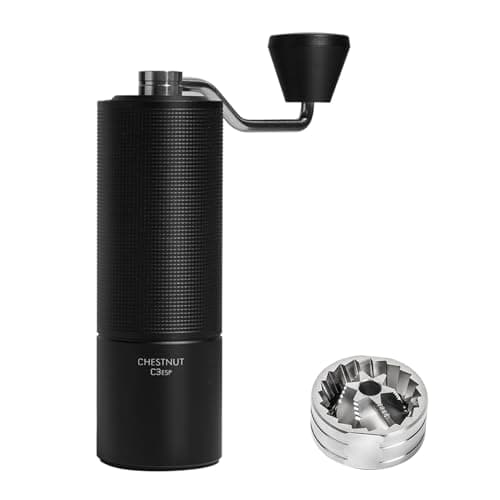
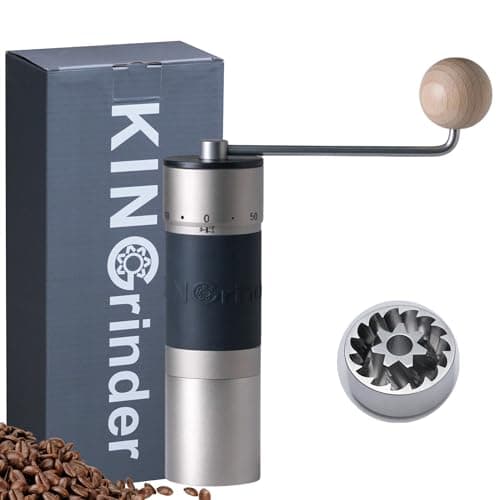
The KINGrinder K6 and the Timemore Chestnut C3 ESP are the two grinders that keep coming up whenever the question is “what is the cheapest hand grinder that can actually pull espresso?” Both clear the bar that matters — each adjusts finely enough, in small enough steps, to land inside the hair-thin espresso window and dial a shot repeatably — and both cost a fraction of an electric that grinds as cleanly. So this is not a comparison of a good grinder against a bad one. It is a comparison of two genuinely good budget espresso grinders that made different choices about burr size, how you read the dial, and how small they pack. Both sit near the top of our best hand grinders roundup, and either one will out-grind the electric next to it at the same price.
The differences are narrow but real, and they fall into two camps. The KINGrinder K6 is the one built around adjustment and burr size: a large 48mm heptagonal burr set that clears a dose quickly, and an external numbered dial that moves in roughly 16-micron clicks — the finest steps of any grinder in this budget conversation — with every setting readable straight off the outside. The Timemore Chestnut C3 ESP is the compact favorite: a smaller 38mm S2C burr set in an all-metal body that is lighter and cheaper, with a fine stepped dialof about 0.023mm per click that you set by counting from a reference point rather than reading a number. That is the whole decision in miniature — bigger burrs and a readable dial versus the smallest, cheapest package. If you want each grinder on its own terms first, read the Timemore C3 ESP review alongside this head-to-head.
So the question is refreshingly narrow. Do you want the finer, more readable adjustment and the faster grind of the bigger-burred K6, or the smaller, lighter, lowest-price footprint of the C3 ESP? Answer that honestly and the winner is clear. This page walks through the burrs, the two styles of dial, the speed and capacity trade, and the build and value, then tells you exactly who each grinder is for. Both are cornerstones of our best coffee grinders under $200 shortlist, and both are the kind of tool that makes a good grinder the first thing you buy for espresso, not the last.
The burrs: 48mm heptagonal vs 38mm S2C
Start with the burrs, because they set the ceiling on speed and, partly, on grind quality. The K6 uses a large 48mm heptagonal stainless burr set; the C3 ESP uses a smaller 38mm S2C stainlessset. Both are well-cut conical burrs that grind evenly, and in the cup the difference in consistency is subtle. Where the 10mm of extra diameter genuinely tells is speed: a bigger burr clears a dose in fewer turns, so the K6 grinds a fine espresso dose noticeably faster than the C3 ESP. That matters more than it sounds when you are cranking by hand, because a fine espresso grind is the most effortful setting there is — the finer you go, the more turns and resistance — and a few fewer revolutions per shot adds up over a week. If you grind more than one drink at a sitting, the K6's larger burrs are the more comfortable tool. If you make one cup at a time, the C3 ESP's smaller burrs cost you a little time you may never notice.
Adjustment: 16 microns and numbered vs ~23 microns and counted
This is the difference that decides most buyers, because adjustment resolution — not burr size or brand — is the single thing that makes a hand grinder espresso-capable, and the two grinders take different routes to clearing that bar. The K6 adjusts on an external numbered dial in roughly 16-micron clicks across around 240 settings, so espresso lives at a number you read straight off the outside and return to exactly. The C3 ESP adjusts on an external stepped dialof about 0.023mm — 23 microns — per click, tight enough to land inside the espresso window, but with no printed numbers, so you track a setting by counting clicks from a reference point. Two things follow. First, the K6's steps are finer, which gives you more usable settings inside the narrow espresso window and a little more room to chase the very finest light-roast shots, where the C3 ESP's steps reach their limit. Second, the numbered dial makes returning to a setting and switching between espresso and filter effortless, where the C3 ESP asks you to remember and count. Neither is hard once you learn the routine — but the K6 removes the routine. Our guide to dialing in espresso explains why that repeatability is what turns a lucky shot into a consistent one.
Speed, capacity and your arm
Both are single-dose, hand-cranked tools, and that shapes everything about living with them. The C3 ESP holds roughly 20-25g in the throat and the K6 roughly 25-30g — either is one espresso dose or one cup's worth of filter at a time, not a batch for a group. Neither is the grinder for filling a French press for four or pulling back-to-back shots for a crowd; that is where a bigger-burr grinder or an electric earns its keep. Between the two, the K6's larger burrs and slightly bigger throat make it the quicker of the pair for a fine dose, while the C3 ESP's smaller, lighter body is the easier one to throw in a bag. Expect roughly a minute of cranking per espresso shot from either, give or take, depending on the beans and how fine you go — a pleasant ritual for one or two drinks and real labor for a whole household. If that effort is the deciding factor, our hand versus electric guide works through when an electric is the better call.
Build, brand and value
Both grinders punch above their price on build. Each uses an all-metal aluminum body over a dual-bearing axle — the important detail, because two bearings keep the burrs aligned so the grind stays even, which is the floor a serious hand grinder has to clear. The C3 ESP is the more established of the two: Timemore is a well-known name with a long track record and a wide service presence, and the standard Chestnut C3 it is based on has a devoted following. KINGrinder is a younger brand, with a shorter track record and a thinner parts-and-service network to lean on years down the line, though the K6's hardware is solid. On price, the C3 ESP is the cheaper of the two and one of the cheapest espresso-capable grinders made, which is the heart of its value case; the K6 costs a little more and spends that money on bigger burrs and a finer, numbered dial. Both are strong value — the C3 ESP wins on pure price and pedigree, the K6 on what the extra buys. Neither quotes a price we cannot verify; the live price for each renders from our pipeline with the date it was checked, as our methodology explains.
Which one to buy
- Buy the KINGrinder K6 if espresso is your main brew and you want the finest, most readable adjustment and the faster grind. Its 48mm burrs, 16-micron steps and numbered external dial make dialing in and switching brew methods easiest, and it is the pick for the most adjustment per dollar. It is our best-for-espresso value standout among hand grinders.
- Buy the Timemore C3 ESP ifyou want the smallest, lightest and absolute cheapest hand grinder that still makes real espresso, and you do not mind counting clicks to set it. It is the value benchmark and the easiest of the two to travel with — the full case is in our Timemore C3 ESP review.
- Consider an electric instead ifyou grind for a household every morning and the minute of cranking per shot would wear thin — a push-button grinder like the Baratza Encore ESP keeps up with back-to-back drinks, at the cost of grind quality per dollar.
- Consider stepping up ifyou want a numbered dial, an included travel case and a longer brand track record in one do-everything grinder — the 1Zpresso K-Ultra offers all three at a clear step up in price.
What we did not test
We have not run either grinder for months on a bench, and we do not claim to. This comparison compiles KINGrinder's published specifications for the K6 and Timemore's for the Chestnut C3 ESP — the 48mm heptagonal burrs and 16-micron numbered dial on one, the 38mm S2C burrs and ~0.023mm stepped dial on the other — cross-checks them against each other and against our own hand-grinder research, and weighs aggregated owner reports against our scoring rubric. We do not own a particle analyzer, and any site that implies it measured micron distributions on a kitchen table is not being straight with you. The specification claims come from each maker's own materials, listed in Sources. Where hands-on time would tell you more than a spec sheet — exactly how each dose feels for your grip, or how each burr set holds its edge after a year — we say so rather than invent a figure. Prices are never quoted from memory; the live price for each grinder renders from our pipeline with the date it was checked.