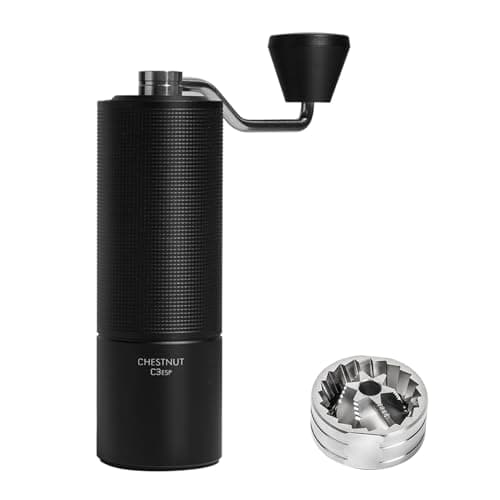
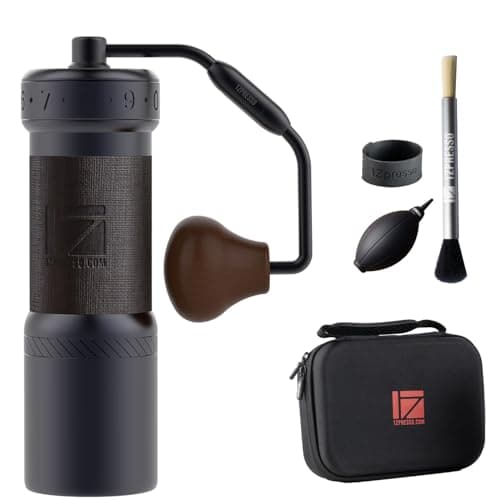
These two hand grinders sit at opposite ends of the same shelf. The 1Zpresso K-Ultra is a premium do-everything all-rounder: big 48mm burrs that clear a dose fast, an external numbered dial that turns switching from espresso to French press into a few repeatable clicks, and a carry case in the box. The Timemore C3 ESP is the value benchmark: a smaller, slower single-dose grinder with genuinely espresso-capable adjustment and excellent stainless burrs, at the lowest sensible price for a hand grinder you can pull real shots on. Both grind beautifully. The choice is really about how many ways you brew and how much you want to spend.
We pulled both from our hand grinder roundup, where the K-Ultra is our best overall and the C3 ESP our best value, and put them head to head because they are the two most common cross-shops in manual grinding: the do-everything premium pick versus the do-the-essentials value pick. Neither is a compromise. The K-Ultra earns its price with speed, range and a dial you can return to exactly; the C3 ESP earns its reputation by giving up almost nothing that changes the cup for a fraction of the money. Below we break the decision into the four things that actually separate them — adjustment, speed and size, build, and price — and, because espresso is where hand grinders live or die, we lean on our espresso grind size guide throughout.
Where these two actually split
Start with the honest headline, because it decides most buyers. Both grinders make excellent espresso and excellent filter coffee — the burrs are good enough on each that the cup is not the thing separating them. What separates them is how you get there: the K-Ultra is bigger, faster and built to swap between brew methods in a repeatable few clicks, while the C3 ESP is smaller, slower and single-minded, and costs a fraction as much. If you brew several ways and value speed and repeatability, you are paying up for the K-Ultra. If espresso is the point, the budget is tight, and one grinder living on one shelf suits you, the C3 ESP is the pick and it is not close on value.
Adjustment: both dial espresso, one is easier to repeat
Adjustment resolution is the number that decides whether a hand grinder can make espresso at all, because a shot lives in a hair-thin slice near the fine end of the range. Both of these clear that bar. The C3 ESP's whole reason to exist is its fine external stepped dial — tuned tight toward the espresso end — which is precise enough to nudge a shot by a hair. The K-Ultra adjusts finely too, and its steps are ample for its filter-leaning all-rounder role, though they lean a touch coarse for chasing the very finest espresso. So we score them even here for capability.
The real difference is repeatability. The K-Ultra's dial is numbered, so you note the exact setting for espresso, for pour-over, for French press, and return to each one by reading a number — which is what makes it so painless to brew three ways from one grinder. The C3 ESP's stepped dial has no numbers, so you track a setting by counting clicks from a reference point. It is perfectly repeatable once you learn the routine; it just asks a little more attention if you move around the grind range a lot. If you want to understand what "fine enough" means before you buy, our espresso grind size guide walks through it.
Speed, size and single-dosing
This is where you feel the price gap in daily use. The K-Ultra's 48mm burrs clear a dose in noticeably fewer turns than the C3 ESP's 38mm set, so it grinds faster and takes less arm — a real advantage for anyone making back-to-back drinks or grinding a full filter dose. The C3 ESP is slower and its single-dose cup is small, sized for one shot or one cup at a time. Both grinders are single-dose by nature — you grind what you brew, with almost no retention — but the K-Ultra's bigger burrs make that single dose quicker to produce. The flip side: the C3 ESP is the smaller, lighter grinder, which makes it easy to pack, while the K-Ultra answers portability with a foldable handle and an included carry case rather than a smaller body.
Build and feel
Neither feels cheap. The C3 ESP is all-metal with a dual-bearing axle that keeps the burrs aligned, and it punches above its price in the hand. The K-Ultra is a clear step up in fit, finish and the solidity of the dial mechanism, and it ships with the carry case and accessories that make it feel like the premium product it is. Both use conical stainless burrs on properly supported shafts, which is the floor for a grinder worth buying — the K-Ultra simply spends more of your money on polish, size and the numbered dial.
Price is the honest deciding factor
There is no way around it: the K-Ultra costs several times what the C3 ESP does. That premium buys real things — speed, a numbered dial, range, and travel kit — and for someone who brews espresso one morning and pour-over the next, those things earn their keep. But if you are espresso-first and price-sensitive, the C3 ESP delivers the part that actually changes the cup — fine, shot-capable adjustment and good burrs — for a fraction of the outlay, which is exactly why it is our value benchmark. We did not lab-test either grinder; our methodology explains how we judge, using published manufacturer specs and aggregated owner reports rather than a particle analyzer we do not own.
Which one is right for you
- Buy the 1Zpresso K-Ultra ifyou brew more than one way, you want to grind a dose fast, and you value a numbered dial you can return to exactly — it is the do-everything grinder, and the carry case makes it travel well. Read the full K-Ultra review.
- Buy the Timemore C3 ESP ifespresso is the point, the budget comes first, and you are happy with one grinder on one shelf making one or two drinks at a time — it gives up almost nothing that matters in the cup for far less money. Read the full C3 ESP review.
Plenty of people would be delighted with either. The short of it: the C3 ESP wins on value by a wide margin, the K-Ultra wins on capability and speed, and both make espresso you can be proud of. Pick on your budget and how many ways you brew, not on which one grinds "better" — because at these two, that is close to a wash.