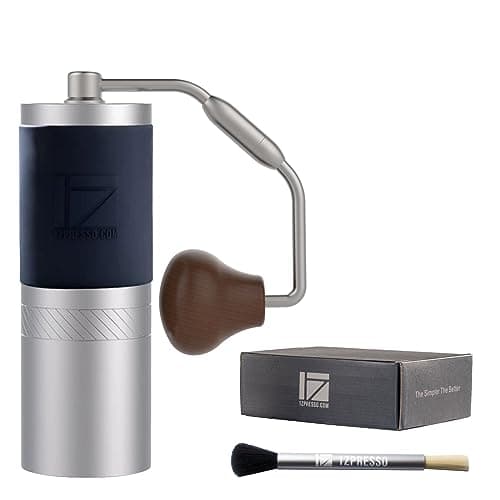
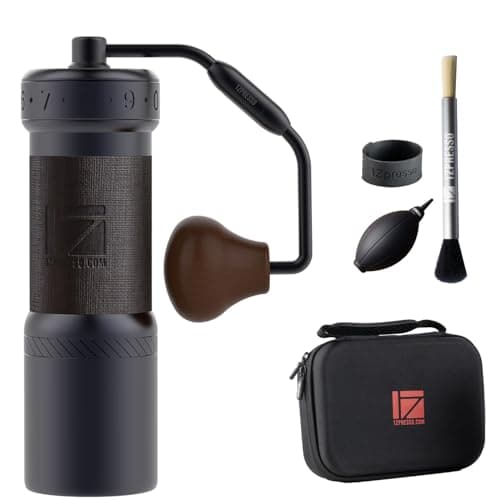
A hand grinder is the best-kept value in coffee gear. Strip out the motor and every dollar goes where it changes the cup — into the burrs and the adjustment mechanism — so a manual grinder gives you the same burr consistency an electric charges three or four times as much for. It is silent, it retains almost no coffee, and it needs no outlet, which is why a hand grinder is the natural partner for a manual or portable espresso maker on a countertop, a campsite or a boat. The one thing it asks in return is about a minute of cranking per dose.
That minute is the whole trade. Grinding fine espresso by hand is genuine work — the finer the grind, the more turns and the more resistance — so a household that pulls four drinks before breakfast will feel it, while a one-or-two-cup drinker never will. What you get back is grind quality that punches well above the price, a grinder small enough to travel, and a tool with no electronics to fail. Every model below is a real, currently-purchasable manual burr grinder with a conical burr set and an adjustment mechanism precise enough to take seriously.
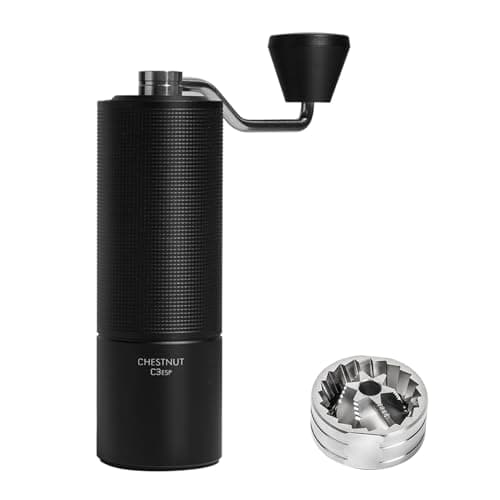
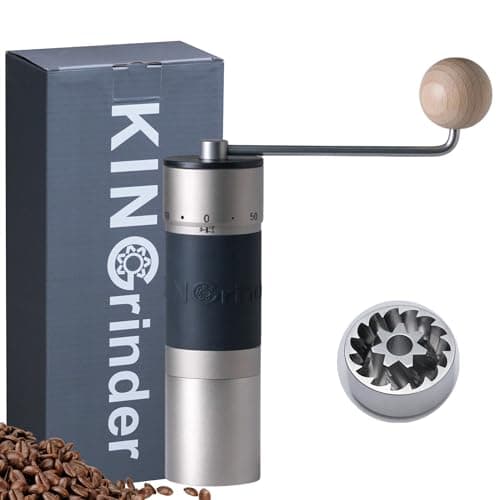
The honest line that reorders this category is adjustment resolution, because it — not burr size or brand — decides whether a hand grinder can actually make espresso. Espresso lives in a hair-thin slice of the grind range, so what matters is how small a step you can make near the fine end. Grinders with fine external stepping, like the Timemore C3 ESP and KINGrinder K6, land in the espresso zone and stay repeatable; models tuned around coarser, filter-leaning steps grind a beautiful pour-over but fight you on a shot. We say which is which on every card. If espresso is your only goal, our best grinders for espresso roundup cross-checks these against electrics.
If a hundred dollars is the ceiling rather than a preference, three of the grinders above sit inside it and our best coffee grinders under $100 page ranks that bracket on its own — including the one electric we are willing to recommend at the price. And if you are weighing two 1Zpresso grinders against each other, 1Zpresso J vs K-Ultra explains why the same 48mm burrs behave so differently depending on where the adjustment dial lives.
How we picked
Every grinder here is a real, currently-purchasable manual burr grinder with a conical burr set and an adjustment mechanism precise enough to take seriously. We ranked on five things, in this order.
- Adjustment resolution near the fine end. This is the criterion that reorders the category. A hand grinder can only make espresso if it moves in small enough steps where espresso lives; a grinder that adjusts in fine, closely spaced clicks dials a shot, and one built around coarse filter detents does not. We weight this above everything else.
- Grind quality and burr size. Bigger, well-cut conical burrs grind faster and, generally, more evenly. A 48mm burr set clears a dose in fewer turns than a 38-40mm set, which matters more than it sounds when you are cranking by hand.
- Build and mechanism. Dual-bearing axles keep the burrs aligned so the grind stays consistent, and a metal body survives being knocked around a kitchen or a backpack. We note where a grinder trades polish for a lower price.
- Portability. The point of a hand grinder is that it goes anywhere — so a foldable handle, a magnetic catch cup and, ideally, a carry case are real advantages for anyone grinding away from a counter.
- Value. Hand grinders are where your money buys the most grinder, so we judged each on what its burrs and adjustment deliver relative to the price, not on features you will never use.
We did not lab-test these grinders — we do not own a particle analyzer, and any site that implies it measured micron distributions on a kitchen table is not being straight with you. Our scores come from published manufacturer specs, decoded manuals and aggregated owner reports, and our methodology pagespells out exactly how. Specifications come from the makers' own product pages, all listed in Sources.
Espresso vs filter: the adjustment that decides it
Here is the mechanism the whole category turns on. Filter brewing — pour-over, French press, cold brew — happens across a wide, forgiving band of grind sizes, so a grinder only needs to land roughly in the coarse-to-medium range. Espresso is the opposite: it extracts in a hair-thin slice near the fine end, and a fraction too fine chokes the shot while a fraction too coarse lets it gush. So the number that decides espresso capability is not the burr diameter or the brand on the body — it is how small a step the adjustment makes near the fine end.
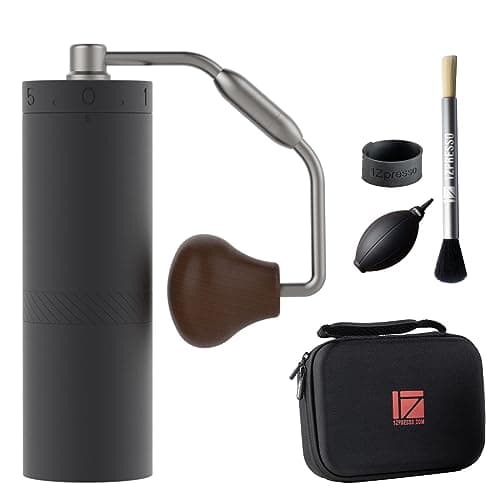
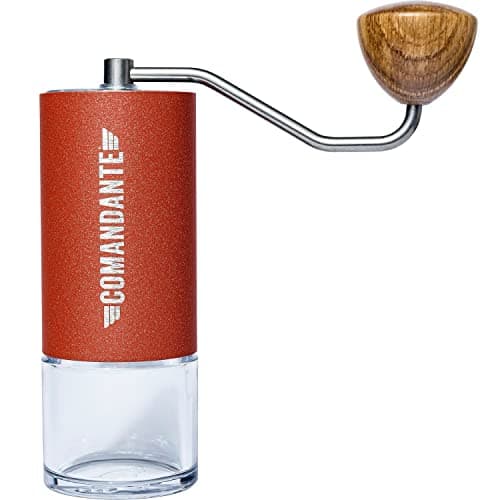
That is why the grinders with fine external stepping — the KINGrinder K6 at 16 microns a click, the 1Zpresso X-Ultra at 12.5, the Timemore C3 ESP tuned tight for a shot — dial espresso precisely, while the filter-leaning picks do not. The Comandante's stepped detents and the 1Zpresso J's internal ring are built for clarity in a coarser brew and grind a beautiful pour-over, but they fight you when you try to nudge a shot by a hair. Burr shape matters less than most buyers think: every grinder here uses a conical burr, and the differences between a 48mm heptagonal set and a 39mm Nitro Blade set are real but secondary to the steps between clicks. If you want to understand what "fine enough" means before you buy, our espresso grind size guide walks through it, and do you need a grinder for espresso covers why this is the tool that decides the cup.
Hand vs electric — when a hand grinder is the right call
At any given price, a hand grinder out-grinds the electric next to it, because there is no motor eating the budget — every dollar goes into burrs and adjustment. It is also silent, retains almost no coffee, and needs no power, which makes it the right tool for travel, for an early start you do not want to broadcast, and for pairing with an off-grid or manual espresso maker. The cost is your arm: grinding a fine espresso dose is a minute of real work, and it gets slow past a drink or two. An electric buys that time back with push-button speed. If you make one or two drinks a day, or value the quiet and the portability, the hand grinder is the better buy; if you serve a busy household every morning, the calculus flips — our hand versus electric guide lays the trade out in full.
What we would skip
Blade grinders. A blade grinder is not a cheaper burr grinder — it is a different, worse tool. It chops beans into a random mix of dust and boulders with no way to set a size, which means it cannot make espresso at all and makes muddy, uneven filter coffee. No price makes it worth it. No-name mills.The market is full of look-alike hand grinders with vague "stainless steel burrs," no published step size and a wobbly single-bearing axle that lets the burrs drift out of alignment. They grind unevenly, will not hold a setting, and are the reason "hand grinder" has a bad reputation in some kitchens. The picks here all publish their burr geometry and step size and use dual-bearing shafts — that is the floor, not a luxury. And "20-bar" pressure numbers or bean-count marketing have nothing to do with a manual grinder; judge one on its burrs, its steps and its bearings.
Which hand grinder fits you
- Want one grinder that does everything well? The 1Zpresso K-Ultra — big fast burrs, a repeatable dial and a carry case.
- Want espresso-capable hand grinding for the least money? The Timemore C3 ESP.
- Want the finest espresso adjustment on a budget? The KINGrinder K6, with 16-micron steps.
- Refuse to choose between espresso and filter? The 1Zpresso X-Ultra, the most balanced pick here.
- Mostly brew pour-over or French press? The Comandante C40 MK4, for its clarity in the cup.
- Grind big filter batches for a household? The 1Zpresso J, for its 48mm burrs and larger capacity.
Whichever you pick, finish the setup with fresh espresso beans and, if you are pulling shots, a machine to match from our beginner espresso machine roundup. A great grinder fed stale supermarket coffee still makes a disappointing cup.