Skip to content
Portafilter Co

Grinders · Coffee Grinders

1Zpresso J vs K-Ultra: which hand grinder?

Two 1Zpresso hand grinders with the same 48mm burrs, separated by where the adjustment lives. That one difference decides whether you can dial in espresso — and it is why the cheaper one is not simply the worse one.

By Stephen V.Updated How we pick
#ad

We earn a commission when you buy through our Amazon links, at no extra cost to you. It never changes a verdict, and we say so when the cheaper product is the better buy. How this works.

Buy the 1Zpresso K-Ultra if espresso is in the picture at all. Both grinders carry 48mm stainless conical burrs, but the K-Ultra puts its adjustment on an external numbered dial you can see and repeat, and that is the single capability that makes dialing in a shot possible by hand. Buy the 1Zpresso J if you brew filter — pour over, French press, cold brew — and want the biggest dose capacity for the least money. It is not the worse grinder. It is the grinder with the cheaper mechanism for a job that does not need the expensive one.

These two are easy to confuse because the headline spec is identical. 48mm burrs is 48mm burrs: the same crushing area, the same throughput advantage over a 38mm grinder, the same reason both of these crank through a dose faster than a budget hand grinder. Where they diverge is the adjustment mechanism, and in hand grinders that is not a detail.

Internal ring versus external dial. The J adjusts on a numbered ring inside the body, below the burr. To change the grind you part the grinder, turn the ring to a number, and reassemble. Its steps are roughly 25 microns at 30 clicks per rotation. The K-Ultra has the dial on the outside: you turn a numbered collar with the grinder fully assembled, read the setting, and go.

For filter brewing this difference is close to irrelevant. You find a setting for pour over, you leave it there, and you might move it two clicks when you change beans. Twenty-five micron steps are far finer than any filter method needs. The internal ring is a mild inconvenience you encounter once a month.

For espresso it is decisive. Dialing in a shot is a feedback loop: pull, taste or time the result, move the grind a click or two, pull again. You might do that six times on a new bag. With an external dial that loop takes seconds per iteration. With an internal ring it takes a disassembly per iteration, and — worse — the step size the J offers is spaced for coarser brewing, so the moves you need in the espresso range are not available at the resolution you need them.

Capacity.The J holds roughly 30 to 35 grams, which covers a full pour over or a small French press batch in one grind. The K-Ultra's catch cup is magnetic and the handle folds, with a carrying case included — it is built to travel more than to batch. If your routine is a 500ml press every morning, the J's capacity is a genuine daily convenience, and it is the main practical reason to choose it beyond price.

What is the same.Burr diameter, burr material, grind speed in the same ballpark, 1Zpresso's build quality and parts availability, and the fact that both are large hand grinders that need two hands and a bit of table. Neither is a pocket grinder — that is the 1Zpresso Q2, which is a different product for a different purpose.

Price. The J undercuts the K-Ultra by a meaningful margin, and the live figures are in the table below. The question is whether what you give up for that saving is something you will use. If you will never pull a shot, the answer is no, and the J is the better buy. If you own an espresso machine or expect to, the saving buys you a grinder that fights you every time you touch it.

The short answer

Quick picks

#ProductBest forScorePrice
01
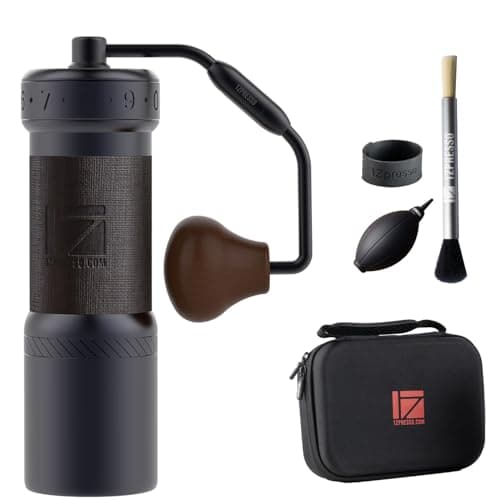
1Zpresso 1Zpresso K-Ultra Manual Coffee Grinder
1Zpresso K-Ultra Manual Coffee Grinder

The one to buy if espresso is in the picture, or if you want a genuine do-everything hand grinder. The large 48mm burrs grind noticeably faster than a smaller grinder, and the external numbered dial makes dialing in espresso the easiest of any hand grinder at this level — you can see the setting and repeat it exactly, with the grinder assembled. It handles filter grinds beautifully too, folds down with a carrying case for travel, and lands below the Comandante on price. A little more industrial than heirloom in feel, but as an all-rounder it is hard to beat.

Best for espresso, and the better all-rounder
8.2
$259.00Amazon
02
1Zpresso 1Zpresso J Manual Coffee Grinder
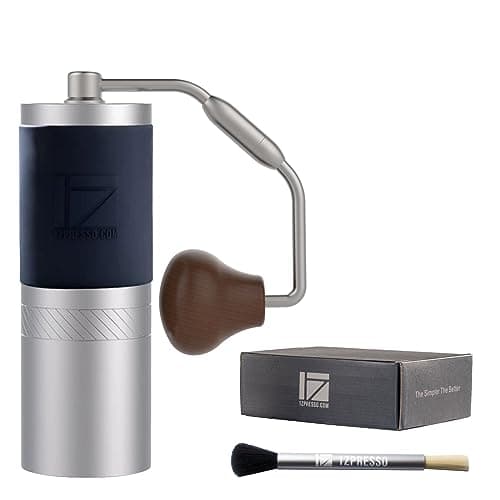
1Zpresso J Manual Coffee Grinder

A big-burr filter grinder that eats through a dose, and a smart buy if espresso genuinely is not coming. Large 48mm burrs and a 30-35g capacity mean it grinds a full pour-over or French press batch quickly, and the numbered internal adjustment ring returns to a filter setting reliably. But that internal ring and its roughly 25-micron steps favor coarser brewing — it is not built for chasing fine espresso, and dialing shots on it is slower and far less precise than on the K-Ultra.

Best for filter brewing and the largest dose capacity
7.2
$139.00Amazon

#ad · Live prices from the Amazon Product API, as of October 10, 2026. Where we have no verified live price, we show none — a gap beats a number that has rotted.

In detail

The picks, in full

01
1Zpresso 1Zpresso K-Ultra Manual Coffee Grinder

Best for espresso, and the better all-rounder

1Zpresso K-Ultra Manual Coffee Grinder

48mm stainless conical burrsExternal numbered adjustment dialFast grinding, foldable handleMagnetic catch cup + carrying case
8.2/10

The one to buy if espresso is in the picture, or if you want a genuine do-everything hand grinder. The large 48mm burrs grind noticeably faster than a smaller grinder, and the external numbered dial makes dialing in espresso the easiest of any hand grinder at this level — you can see the setting and repeat it exactly, with the grinder assembled. It handles filter grinds beautifully too, folds down with a carrying case for travel, and lands below the Comandante on price. A little more industrial than heirloom in feel, but as an all-rounder it is hard to beat.

Espresso capability
9
Grind quality
9
Adjustment usability
9
Capacity
6
Value
8

Pros

  • External numbered dial — change and record the grind without parting the grinder
  • Resolution and range cover espresso properly, which the J does not
  • 48mm burrs grind a dose quickly for a manual grinder
  • Folding handle and carrying case make it genuinely portable despite the size
  • Equally capable across espresso, pour over and French press

Cons

  • Costs meaningfully more than the J for the same burr diameter
  • Catch cup capacity is sized for single doses, not for batch brewing
  • Industrial rather than heirloom in feel next to a Comandante
  • Still a hand grinder: close to a minute of cranking for a fine espresso dose

Don't buy this if…

…you brew only filter and you brew it in volume. You are paying for an espresso mechanism you will never use, and the J gives you more capacity for less money.

The K-Ultra is the hand grinder we recommend most often, and the external dial is almost the entire reason. Hand grinders compete well on grind quality because the whole budget goes into burrs — but a grinder you cannot easily adjust is a grinder you stop adjusting, and an un-adjusted espresso grinder is a bad espresso grinder regardless of its burrs.

Read it on its own in our 1Zpresso K-Ultra review. Against the cheaper competition, KINGrinder K6 vs 1Zpresso K-Ultra is the closest-run fight at this level, and 1Zpresso vs Comandante covers the step up in money and feel.

$259.00View on Amazon

Price as of October 10, 2026. Prices change — Amazon's at checkout is the one that counts.

#ad · we may earn a commission from this link to 1Zpresso K-Ultra Manual Coffee Grinder

02
1Zpresso 1Zpresso J Manual Coffee Grinder

Best for filter brewing and the largest dose capacity

1Zpresso J Manual Coffee Grinder

48mm stainless conical burrsNumerical internal adjustment30 clicks/rotation ~25µm30-35g capacity
7.2/10

A big-burr filter grinder that eats through a dose, and a smart buy if espresso genuinely is not coming. Large 48mm burrs and a 30-35g capacity mean it grinds a full pour-over or French press batch quickly, and the numbered internal adjustment ring returns to a filter setting reliably. But that internal ring and its roughly 25-micron steps favor coarser brewing — it is not built for chasing fine espresso, and dialing shots on it is slower and far less precise than on the K-Ultra.

Espresso capability
5
Grind quality
8
Adjustment usability
6
Capacity
9
Value
8

Pros

  • Same 48mm burr diameter as the K-Ultra for noticeably less money
  • 30-35g capacity covers a full pour over or a small press in one grind
  • Numbered internal ring still returns to a filter setting reliably
  • 25-micron steps are far finer than any filter method requires
  • 1Zpresso build quality and parts availability at the lower price

Cons

  • Internal adjustment ring means parting the grinder to change the setting
  • Step spacing favors coarse brewing — the espresso range is not properly served
  • Dialing in a shot is slow and imprecise compared with an external dial
  • No carrying case or folding handle in the box

Don't buy this if…

…you own an espresso machine, or think you might within a year. The internal ring makes the dial-in loop painful and the step spacing does not give you the fine moves shots need. Buy the K-Ultra.

The J is a good grinder with a narrow, honest brief. If your coffee life is a V60 or a French press and you have no interest in espresso, you are being asked to pay extra for the K-Ultra's external dial purely so you can skip a disassembly you would perform once a month. That is a bad trade, and the J is the right answer.

Where to start with settings: filter wants the middle-to-coarse part of the range, and French press grind size and coffee-to-water ratio cover the recipe side. Our best hand grinders page ranks the whole manual field if you want to see where both of these land against the competition.

$139.00View on Amazon

Price as of October 10, 2026. Prices change — Amazon's at checkout is the one that counts.

#ad · we may earn a commission from this link to 1Zpresso J Manual Coffee Grinder

Specs side by side

Figures below are 1Zpresso's published specifications for the exact listings above. Prices come from the live price layer with the "as of" date in the quick picks table.

1Zpresso K-Ultra1Zpresso J
Burrs48mm stainless conical48mm stainless conical
Adjustment locationExternal numbered dialInternal numbered ring
Step resolutionFine, espresso-capable range30 clicks/rotation, roughly 25µm
CapacitySingle-dose catch cup30-35g
EspressoYes — this is the point of the dialPossible, but slow and imprecise
FilterExcellentExcellent
TravelFolding handle, carrying case, magnetic cupNo case or folding handle
Who it suitsEspresso, or one grinder for everythingFilter only, in volume, for less money

Why the dial position matters so much on a hand grinder

On an electric grinder, adjustment is a knob on the outside by default, so nobody thinks about it. On hand grinders it is a genuine design choice, because the adjustment can sit either on the burr shaft under the grinding chamber — cheap, protected, invisible — or on an external collar, which needs more machining and a way to keep the setting from drifting as you crank.

The consequence shows up only in espresso, and only because of how dialing in works. Espresso is the one brew method where a grind change of a few tens of microns visibly changes the result: the same dose that ran 36g in 28 seconds yesterday can gush in 15 seconds today on a different bag. Correcting that means iterating, and iterating means touching the adjustment repeatedly in a short session. An internal ring turns six iterations into six disassemblies, and most people simply stop before they have found the right setting. How to dial in espresso walks through the loop in full.

Filter brewing has no equivalent pressure. A pour over that runs slightly fast is still good coffee, the useful range is wide, and you are not chasing a 30-second window. So the internal ring costs you nothing you will notice.

Capacity: the J's real advantage

It is worth not underselling this, because the comparison is usually framed as "the J is the cheap one". The J holds 30 to 35 grams. A full 500ml French press at a standard ratio is around 30 grams of coffee; a large V60 is in the low twenties. That means one fill, one grind, done. Single-dose grinders sized for an 18-gram shot make you grind twice for the same brew, which on a hand grinder is not a trivial annoyance.

If your household brews a press in the morning and nothing else, the J is the better tool in daily use and cheaper. That is a straightforwardly good outcome, and we would rather say so than steer everyone to the more expensive grinder.

Neither of these, if…

…you want a pocket grinder. Both of these are full-size. The 1Zpresso Q2fits inside an AeroPress plunger and is the travel answer in this brand's line.

…you make four drinks a morning. Hand grinding espresso is close to a minute a dose and it is hard work at fine settings. At that volume buy an electric — best electric espresso grinders under $500 covers the field, and hand vs electric grinders covers the trade.

…your budget is tighter than this. The KINGrinder K6 has 48mm burrs and an external numbered dial at roughly 16 microns a click for less than either of these, which is why it keeps appearing in our recommendations. Our best coffee grinders under $100 page goes lower still.
How we picked

We did not lab-test this gear

Everyone in this category says they tested twenty machines. We have not pulled shots on every product here, and we say so. What we did instead: compiled the published specifications, cross-checked the manufacturer manuals, computed the running cost (wattage to energy, grams-per-shot to cost-per-cup), weighed aggregated owner reports, and scored each product against a published rubric. The scores are judgments from documented research — not measurements we took, because we do not have a test lab and we will not pretend we do. Where hands-on time would tell you more than a spec sheet, we flag it. Where a number came from someone else's work, we name them in Sources.

Questions

Frequently asked

Is the 1Zpresso J or the K-Ultra better?
The K-Ultra if espresso matters to you, because its external numbered dial makes dialing in a shot practical and the J's internal ring does not. The J if you brew only filter and want the largest dose capacity for the least money. The burrs are the same 48mm diameter in both, so this is a decision about the adjustment mechanism, not about grind quality.
Can the 1Zpresso J grind for espresso?
It can reach espresso grinds, but it is not built for it. The adjustment ring is internal, so every change means parting the grinder, and the roughly 25-micron step spacing is arranged for coarser brewing rather than for the fine moves a shot needs. You can make it work; you will not enjoy it. See how to dial in espresso for why the iteration speed matters.
Do the J and K-Ultra use the same burrs?
Both use 48mm stainless conical burrs, which is why grind speed and filter quality are so close. 1Zpresso's own specifications are the source for both figures; the difference between the two grinders is the adjustment mechanism and the capacity, not the burr diameter.
Which has more capacity?
The J, at roughly 30-35 grams — enough for a full pour over or a small French press batch in one grind. The K-Ultra's magnetic catch cup is sized for single doses, which suits espresso and travel but means grinding twice for a large press.
Is the K-Ultra worth the extra money?
If you pull shots, yes, without much hesitation — it is the difference between a grinder you adjust and one you avoid adjusting. If you only brew filter, no: you would be paying for a mechanism you will use once a month. Our best hand grinders page shows where both sit against the wider field.
How long does it take to hand grind with a 48mm burr grinder?
Faster than with a 38mm grinder, which is most of what you buy with the larger burrs: roughly 30 seconds for a filter dose and closer to a minute for a fine espresso dose. The finer the setting, the harder the handle turns — that is physics, not a flaw in either grinder.

Keep reading

Same gear, other pages

We cover this gear elsewhere too

Receipts

Sources

We do not run a testing lab, and we do not pretend to. Where a measured number came from someone else's work, we name them and link them. Where we could not verify something, we say so on the page rather than quietly leaving it out. Read our full method.