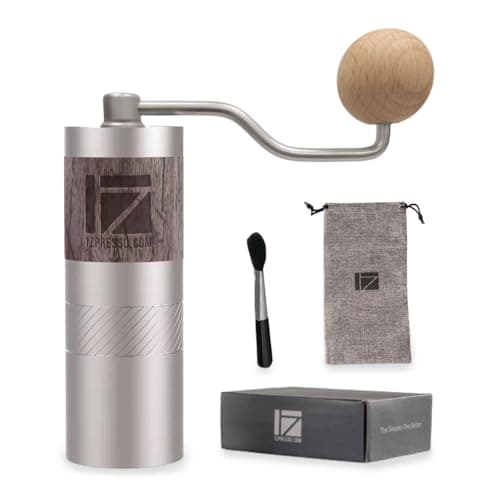
The 1Zpresso Q2 is the hand grinder you buy because it goes everywhere. It is the entry point to 1Zpresso's manual line and its smallest grinder — a body smaller than a soda can, around 465 grams, that slips inside an Aeropress plunger and disappears into a bag. If your reason for wanting a hand grinder is a campsite, a hotel room or a desk drawer, the Q2 is purpose-built for exactly that life. It grinds a clean, consistent cup for drip, pour-over and other filter methods, it retains very little coffee, and it needs no power at all. See how it sits among the alternatives in our best hand grinders roundup.
What makes it easy to live with is the adjustment. The Q2 uses an internal numbered dial— ten numbers on the dial and 30 clicks per rotation — so you can note a setting for pour-over, another for a coarser press, and return to each one quickly rather than guessing. It rides on a dual-bearing, triaxial axle that keeps the heptagonal stainless burrs aligned, which is what gives that small burr set its even grind. For filter brewing, where the grind band is wide and forgiving, this is genuinely all the resolution you need, and the numbered dial makes it quick to reset between methods. If you brew mostly filter and want to understand what the grinder is really doing, our single-dose grinder overview covers the wider world of one-drink-at-a-time grinding it belongs to.
The honest limit is that the Q2 is a filter grinder first. Its internal adjustment is tuned toward the coarser end, so while it can pull off an espresso in a pinch, its fine-end resolution is limited compared with a grinder built for the job — and its 15-20g capacity is one drink's worth of beans at a time. If espresso is your main brew, a dedicated espresso hand grinder with fine external stepping will dial a shot far more precisely for similar money; we make that case in our Timemore C3 ESP review and rank the espresso-first field in best grinders for espresso. Buy the Q2 for what it is: the best pocket filter grinder in 1Zpresso's range.
Why the Q2 is a travel grinder first
The whole point of the Q2 is that it goes anywhere. 1Zpresso built its Q series around portability, and the Q2 is the clearest expression of it: a body smaller than a soda can, roughly 14.5 x 16 x 4.6 cm, weighing about 465 grams, that fits inside an Aeropress plunger so your whole travel brew kit nests into one piece. It ships in a drawstring pouch rather than a rigid case, which keeps the packed size down further. For a one-or-two-cup drinker on the move — a hotel room, a campsite, a boat, a desk — a hand grinder is the natural tool because it is silent, retains almost no coffee and needs no outlet, and the Q2 is the smallest, easiest one 1Zpresso makes to throw in a bag. If portability is your first requirement, this is the grinder built for it.
The internal numbered dial and what it is tuned for
Adjustment on the Q2 happens on an internal numbered dial— ten numbers with three clicks between each, 30 clicks per rotation — rather than the external dial 1Zpresso puts on its espresso-focused grinders. That is a meaningful design choice. Filter brewing lives across a wide, forgiving band of grind sizes, so an internal dial with numbered stops is all the resolution a pour-over or drip drinker needs, and the numbers make it quick to note a setting and come back to it. But an internal ring is slower to change than an external dial, and the Q2's adjustment is tuned toward the coarser filter end, so it does not offer the tiny, closely spaced steps espresso wants near the fine end. That is why the Q2 grinds a beautiful cup and a passable shot rather than the other way around — the mechanism is built for filter. Our dialing-in guide explains why step size, not burr brand, is what decides espresso capability.
Can the Q2 make espresso?
It can, in a pinch, but that is not the reason to buy it. Espresso extracts in a hair-thin slice near the fine end of the grind range, and pulling a good shot depends on being able to move the grind by a fraction and land in that sliver repeatably. The Q2's internal, filter-leaning adjustment gives you less resolution there than a grinder designed for espresso, and 1Zpresso does not publish a microns-per-click figure for it, so we will not quote one or imply a precision the maker does not claim. If you occasionally want a shot on a trip, the Q2 will do it; if espresso is your daily drink, you will fight the grinder. The honest recommendation is to treat espresso as a bonus, not the brief — and if it is the brief, read our best grinders for espresso instead. For why the grinder matters more than the machine here, see do you need a grinder for espresso.
Q2 vs the Timemore C3 ESP and stepping up in 1Zpresso
At this price the grinder most people cross-shop is the Timemore C3 ESP, and the two answer different questions. The C3 ESP is tuned for espresso first, with fine stepped adjustment that reaches genuine espresso fineness, while the Q2 is tuned for travel and filter. If your priority is shots, the C3 ESP is the better tool for similar money; if your priority is packing light and brewing drip on the road, the Q2 wins. Within 1Zpresso's own range, the Q2 is the entry point, and the step up is a fine-external-dial grinder like the K-Ultra, which trades pocket size for bigger burrs and effortless method-switching — we cover that in our 1Zpresso K-Ultra review. Choose the Q2 when small and light beats everything else.
What we did not test
We have not run this grinder for months on a bench, and we do not claim to have. This review compiles 1Zpresso's published specifications for the Q2 and Q series — the heptagonal stainless burrs, the internal dial with ten numbers and 30 clicks per rotation, the 15-20g capacity, the ~465g body, the drawstring pouch and the Aeropress-plunger fit — and weighs aggregated owner reports against our scoring rubric. The specification claims come from 1Zpresso's own materials, listed in Sources. Because 1Zpresso does not publish a microns-per-click figure for the Q2, we do not quote one. Where hands-on time would tell you more than a spec sheet — exactly how fine it will go for espresso, or how the burrs hold up over a year — we say so rather than invent a number, and we never quote a price from memory; the live price renders from our pipeline with the date it was checked.