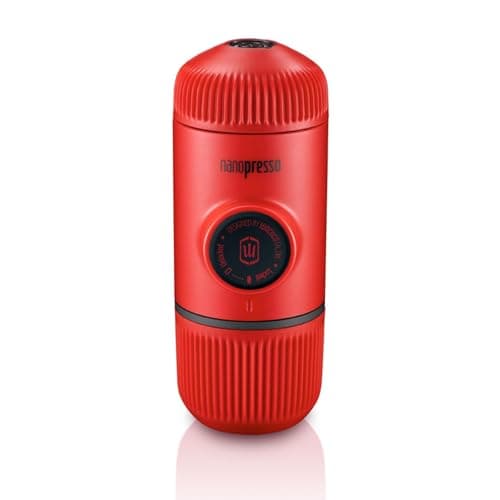
The Wacaco Nanopresso is the maker most people should buy first when they want real espresso away from a kitchen counter. It is small enough to vanish into a bag, it needs no electricity or battery, and it is the least expensive honest way into portable espresso — not a novelty that makes warm coffee, but a hand pump that builds genuine brewing pressure and pulls a small, intense shot with a real cap of crema on top.
Here is the whole idea in one sentence: you load finely ground coffee into a little basket, pour hot water from a flask or kettle into the reservoir, and work a spring-loaded hand pump that drives that water through the puck at a peak of around 18 bar. There is no plug, no charging, no moving to find an outlet. The pressure comes entirely from your hand, and the heat comes entirely from water you bring. That is why it works on a mountainside, in a hotel room, on a train or in an office where the nearest espresso is a bad vending machine — anywhere you can get water hot, you can pull a shot. It packs down to roughly the size of a small water bottle and weighs about as much as a phone and a half, so it lives in a rucksack or a glovebox without you noticing it is there.
Now the honest part, because a review that only sells you the romance is useless. The Nanopresso does not pour a countertop machine's shot. The stock basket takes a small, roughly eight-gram single, so you get one intense little espresso rather than a spec-chasing double, and the result leans more toward “strong, rich coffee with crema” than a competition-grade extraction. You also have to bring two things it cannot: hot water, and a proper fine grind. Feed it coffee ground too coarse and it will gush and taste thin; get the grind and your technique right and it genuinely surprises people. If you want the biggest dose or the outright best cup a portable can give, we point you at the alternatives in our best manual espresso makersroundup. For the value, the convenience and the sheer “I cannot believe this fits in my pocket” factor, though, the Nanopresso is still the one to beat.
How a hand pump makes real espresso pressure
The thing that separates the Nanopresso from every “travel coffee” gadget is that it actually generates espresso-level pressure, and it does it with your hand rather than a motor. You fold out a small lever on the side and pump it; a spring-loaded piston pressurizes the water in the chamber and forces it through the coffee puck at a peak of around 18 bar. Espresso is defined by that pressure — roughly nine bar at the puck is the classic target, and the Nanopresso's pump comfortably clears it — which is why the shot comes out as espresso with crema rather than as strong drip. The current pump is Wacaco's revised design and reaches that pressure with meaningfully less effort than the older Minipresso it replaced, so it does not feel like a workout. It is worth being clear-eyed about what “18 bar” means: it is a peak your hand can reach, not a regulated, held pressure like a countertop pump — but it is real pressure doing real extraction, and that is the whole point.
What the shot actually tastes like
Set your expectations to the dose. The stock basket holds a small single of about eight grams and yields a short, concentrated shot — think a rich, syrupy little espresso rather than a voluminous double. With fresh coffee and a good grind you get a proper layer of crema and a shot that drinks like espresso, not like an approximation of it. What you do not get is the body and the margin for error of a bigger dose in a wider basket; there is simply less coffee in the path, so the window between sour and bitter is narrower and the cup is smaller. Most owners drink it straight as a ristretto-ish shot, or top it with hot water for a small Americano, or with warm milk for a compact flat white. If a full, spec-forward double is what you are chasing, that is a reason to look at a larger-dose portable rather than to be disappointed by this one — the Nanopresso is doing exactly what it was designed to do.
You bring the hot water — and the grind
Two things the Nanopresso cannot supply, and both matter more than the machine itself. The first is heat: there is no boiler, so you pour in water you have already heated — a travel flask, a hotel kettle, a camp stove, whatever gets water hot. The second, and the one that quietly makes or breaks the shot, is the grind. Portable makers need coffee ground fine, in the espresso range, and pre-ground supermarket coffee is almost always too coarse; it will pass water too fast, gush, and taste weak and sour. Our guide to espresso grind sizewalks through what fine actually looks like and how to adjust when the shot runs wrong. Because the Nanopresso is a travel tool, the natural partner is a compact, espresso-capable hand grinder you can pack alongside it — see our best hand grinders for models that hold a fine, even grind on the road. Bring hot water and a fresh fine grind and the Nanopresso punches far above its size; skip either and no amount of pumping will save the cup.
Technique: the small things that make it click
None of this is hard, but a few habits move you from “drinkable” to “that was genuinely good.” Grind fresh and fine, level and lightly tamp the little basket so the water cannot find an easy edge to channel through, and pre-warm the metal parts with a splash of hot water before you brew so your shot does not lose heat to a cold chamber. Use water that is hot but off the boil, pump in smooth, full strokes rather than frantic short ones, and if the shot runs fast and thin, go finer next time; if it stalls and drips forever, back the grind off a touch. That is the entire learning curve, and it is a short one — the Nanopresso is one of the most forgiving makers to learn on, which is a big part of why it is the portable we most often hand to a first-timer. If you are buying your very first espresso setup of any kind, our best espresso machines for beginners puts it in context against countertop starters.
Where the Nanopresso sits — and when to size up
The Nanopresso wins on a very specific axis: the most real espresso for the least money and the least bulk. If your priority is a maker that disappears into a bag and costs little, this is the answer, full stop. But it is one point on a ladder, and it is worth knowing the rungs above it. If you want a full, cafe-style double in a commercial-depth basket while staying pocketable, thePicopressofrom the same brand is the natural step up — more dose, more body, more control, more fiddle. If you care less about packing small and more about pulling the outright best cup a manual can give, a lever maker such as a Flair is where the ceiling is highest. We line all of these up, with who each one is really for, in our best manual espresso makers roundup. Read it if you are torn: the honest truth is that most people are happiest starting with the Nanopresso and only sizing up once they know exactly which limit they have hit.
What we did not test
We have not run this maker on a bench for months, and we do not claim to have. This review compiles Wacaco's published specifications, cross-checks the pump, dose, weight and materials claims against the manufacturer's own documentation, and weighs aggregated owner reports against our scoring rubric. The pump pressure, basket dose, water capacity and weight come from Wacaco's own materials, listed in Sources. Where hands-on time would tell you more than a spec sheet — exactly how a given hand grinder pairs with it day to day, how the shot holds up over months of travel, how the pump effort feels to a smaller or larger hand — we say so rather than invent a number. Our scores are judgments from that documented research, not lab measurements; we do not have a lab, and our methodology says exactly that.