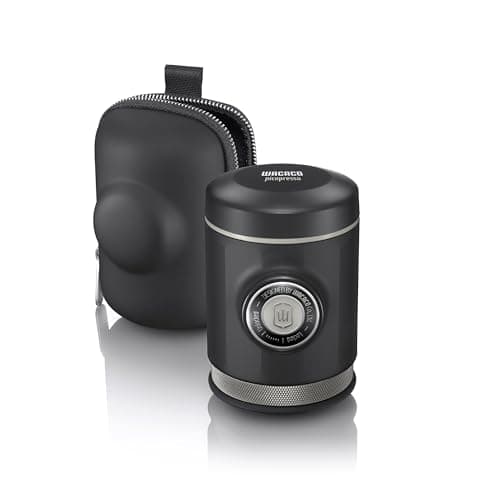
The Wacaco Picopresso is the first portable espresso maker that does not require an asterisk on the word espresso, and the reason is one design decision: it uses a real non-pressurized basket in a 52mm naked portafilter. Almost every other travel brewer — including Wacaco's own Nanopresso— uses a pressurized basket, which generates crema mechanically through a restrictor and therefore forgives a mediocre grind. The Picopresso removes that safety net. Water has to find its own resistance through the coffee bed, exactly as it does on a countertop machine, which means the shot can be genuinely good and can also be genuinely bad depending on what you put in it.
Wacaco's published figures: an 18 g double basket at Ø52 mm, 80 ml of water capacity, a hand pump rated to a maximum of 18 bar with roughly 9 to 12 bar during extraction, 71 × 78 × 106 mm and 350 g all in, built from aluminum, stainless steel and BPA-free plastics, covered by a two-year warranty. In the box: the double basket, a steel tamper, a distribution tool, a dosing funnel, a collapsible scoop, a brush, a shower screen with gasket, and the EVA hard case the whole thing nests inside. There is no heater and no battery — you supply boiling water, and you supply the pressure with your hand.
That parts list is the first honest warning. Brew Coffee Home counted around ten components out of the box; Home Coffee Expert puts the total at fourteen parts and admitted to reading the instructions despite being an espresso enthusiast. This is not a device you take out of a box and use correctly on the first try. If that sounds like a chore rather than a pleasure, the Nanopresso is the honest alternative and we say so plainly below.
What pulling a shot actually involves
The workflow, as documented by Brew Coffee Home's hands-on review, goes like this. Grind very fine — they used a quality hand grinder, specifically a 1Zpresso JX-Pro, and Home Coffee Expert makes the same point about needing a good manual grinder. Dose into the basket; the basket holds 16 to 20 g and their double used 18 g in for 36 g out, which is a textbook 1:2 ratio. Use the included funnel and distribution tool, then tamp. Boil water, preheat the brewer, fill the chamber, assemble, and start pumping at about one pump per second.
Here is the clever part, and the reason this brewer teaches you something. Because there is no pressure gauge, the pump count is your pressure gauge. Coffee should start appearing after roughly 8 to 12 pumps, followed by about ten seconds of pre-infusion. Too many pumps before anything emerges means the grind is too fine; liquid arriving almost immediately means it is too coarse. You are reading resistance with your hand instead of with a manometer, and after a dozen shots you will know by feel whether the grind is right before the first drop lands. Our espresso grind size guide covers the window you are aiming for, and how to dial in espresso covers the process.
The verdict from that same hands-on review is unambiguous: yes, it makes cafe-quality espresso, with clarity, dense flavor, thick crema and a creamy texture that works in milk drinks, and it compares favorably with machines costing several hundred dollars. We have not pulled shots on one ourselves and we are not going to pretend we have — but that assessment is consistent across the reviews we read, and it is mechanically plausible for the obvious reason: a real basket at real pressure with a real 18 g dose is the same physics a countertop machine uses.
The three honest problems
It will not be as hot as you expect. There is no boiler and no thermal mass, so the water starts at whatever your kettle gave it and loses heat to a 350 g metal and plastic body on the way through. Brew Coffee Home reported the espresso arriving at roughly 110°F (about 43°C)even with preheating — their view was that this does not hurt extraction but will not suit anyone who wants a very hot drink. Treat the exact number with some caution, since drink temperature depends heavily on the cup and the measurement method, but the direction is consistent with what owners report. Preheat thoroughly, warm your cup, and if you drink it with milk, heat the milk properly.
It needs a grinder you may not own.A non-pressurized basket is unforgiving by design. Blade-ground coffee will not work, pre-ground supermarket coffee will not work, and an entry-level burr grinder that cannot reach a true espresso fineness will not work either — which rules out a lot of grinders that are otherwise fine, including the standard Baratza Encore. Budget for the grinder as part of the purchase. Our best hand grinders page is the right list for a travel setup, and do you need a grinder for espresso answers the underlying question.
It is a cleaning commitment.Reviewers recommend cleaning after every use to maximize longevity: separate the top and base, brush or wipe out the debris, knock the puck out, rinse, and pump the leftover water through. That is a two-minute job and it is a two-minute job every single time — which is fine at home and genuinely annoying at a campsite with limited water. Compare that against a camping coffee maker you rinse once, and decide honestly which one you will keep using.
Picopresso or Nanopresso?
This is the real decision, since both are Wacaco hand pumps and the Nanopresso costs considerably less. The difference is not build quality or pressure — it is the basket. The Nanopresso's pressurized basket makes a small, forgiving, reliably crema-topped drink from almost any grind, and its standard capacity is a single rather than a double unless you add Wacaco's Barista Kit. The Picopresso's non-pressurized 52mm basket makes a full 18 g double that tastes like espresso from a real machine, and demands the grind and technique to earn it.
So: Nanopresso if you want coffee on a trip without a project; Picopresso if you own a good grinder, already pull shots at home, and the thing you miss when traveling is a proper double. Our best portable espresso makers page ranks the full field, and if you are willing to carry more for still better shots, the Flair Pro 2 is the lever-press tier above it.
Pressurized vs non-pressurized, and why it is the whole review
Every portable espresso maker falls on one side of this line, and it decides what the device can and cannot do more than brand or price does.
A pressurized baskethas a single small restrictor hole behind the filter plate. Water passes through the coffee at whatever resistance the grind happens to offer, then builds its pressure against that hole on the way out. Crema is generated mechanically by forcing liquid through the restriction, which means you get a decent-looking, decent-tasting drink from almost any grind — including supermarket pre-ground. The ceiling is lower, because the coffee bed was never the thing creating pressure, so the extraction is shallower and the flavor flatter than a real shot.
A non-pressurized basket— what the Picopresso uses, and what a commercial machine uses — is just a perforated plate. All the resistance comes from the coffee itself, which means the grind, the dose, the distribution and the tamp are doing real work. Get them right and the extraction is deep, the crema is real and the cup has the body and sweetness people mean when they say espresso. Get them wrong and water finds the path of least resistance, races through, and gives you sour water with a few bubbles on top. Our pressurized vs non-pressurized baskets guide covers this in depth, and it is the single most useful thing to understand before buying any espresso device.
The Picopresso goes further and uses a naked (bottomless) portafilter, which means you watch the extraction leave the underside of the basket. That is a genuine diagnostic tool: a clean shot forms one centered stream, while a shot that sprays sideways or drips from one edge is telling you the puck was uneven. Our bottomless vs spouted portafilter guide explains what you are looking at, and channeling covers the fault itself.
The grinder is not optional, and here is the threshold
"Needs a good grinder" is vague, so let us be specific about what disqualifies one. You need a burr grinder that can reach true espresso fineness — roughly 200 to 300 microns — with adjustment increments small enough to move a shot from fast to correct in a step or two. That rules out blade grinders entirely, rules out pre-ground coffee, and rules out a surprising number of competent burr grinders whose fine end simply stops short of espresso. The standard Baratza Encore is the canonical example: an excellent filter grinder whose range bottoms out around 250 microns with only a handful of steps down there, which is why Baratza sells a separate espresso-geared version.
For a travel setup specifically, a hand grinder is usually the right answer rather than a compromise. A good hand grinder puts the money into burrs instead of a motor, packs alongside the Picopresso, and needs no power — which matches a device that needs no power either. The reviewer whose brewing numbers we quote used a 1Zpresso JX-Pro; our 1Zpresso K-Ultra review and best hand grinderspage cover that class. If you already own an espresso-capable electric grinder at home and only travel occasionally, grinding before you leave works for a day or two and no longer — ground coffee goes stale fast, and this basket will notice.
Reading the pump: the one skill to learn
With no gauge, pump cadence and pump count are your instruments, and the numbers from the hands-on review are a genuinely useful calibration target.
| What happens | What it means |
|---|
| Coffee appears after 8-12 pumps | Grind is about right — proceed, then expect ~10 s of pre-infusion |
| Many more pumps before anything appears | Grind is too fine; the bed is choking |
| Liquid almost immediately, little resistance | Grind is too coarse; the shot will run fast and sour |
| Spraying or one-sided stream under the basket | Channeling — distribution or tamp, not grind |
Pump at about one per second rather than as fast as you can. Steady cadence is what keeps pressure in the 9 to 12 bar band Wacaco describes for extraction, and jerky pumping is a good way to disturb the puck mid-shot. Weigh the output if you can — 18 g in and 36 g out is the target, and a small scale removes the guesswork. Everything else is the same puck prep you would do on a countertop machine: our puck prep guide and WDT tools apply unchanged, and the included distribution tool is doing the same job as the ones on that page.
Who this is actually for
Buy itif you already pull shots at home with a real grinder, travel often enough to miss them, and would rather carry 350 g and do a two-minute ritual than drink hotel coffee. Buy it if the thing you want on a trip is a proper double rather than a small approximation. Buy it if the diagnostic pleasure of a naked basket appeals to you — plenty of owners use one at home purely because watching the extraction is informative.
Skip it if it would be your first espresso device, if your grinder is a filter grinder, if you want a hot drink more than you want a good one, or if you are buying for someone who will not clean it after every use. In every one of those cases the Nanopressois the better purchase and costs less, and there is no shame in that — a pressurized basket is the right engineering answer for a forgiving travel brewer.
Also consider the lever tier if weight is not your constraint. The Flair Pro 2 gives you a pressure gauge, more thermal mass and more leverage, at several times the packed volume. And if you are chasing espresso without a machine more generally, our how to make espresso without a machine guide covers every route including the ones that do not involve buying anything.
What we did not test
We have not pulled shots on a Picopresso. We have no lab and we say so on our methodologypage. Every specification above — basket diameter, dose, water capacity, pressure, dimensions, weight, materials, warranty and box contents — is Wacaco's own published figure. Every brewing observation — the pump counts, the pre-infusion window, the 18 g in and 36 g out, the roughly 110°F drink temperature, the parts count and the cleaning recommendation — is attributed to the named hands-on reviewers in Sources. We have not verified the temperature figure independently and have flagged it as one reviewer's reading rather than a specification, because drink temperature depends heavily on cup and method. The scores above are editorial judgments from documented research against a published rubric.