Skip to content
Portafilter Co

Machines · Espresso Machines

The best portable espresso makers

Six portable espresso makers ranked on shot quality, ease, packability, build and value — the hand-pump, lever and battery-heated makers that pull a genuine single shot away from a kitchen counter, chosen honestly, with a clear-eyed note on what you give up versus a countertop machine.

By Stephen V.Updated How we pick
#ad

We earn a commission when you buy through our Amazon links, at no extra cost to you. It never changes a verdict, and we say so when the cheaper product is the better buy. How this works.

A portable espresso maker does one genuinely useful thing: it pulls a real, pressurised single shot — crema and all — somewhere a plumbed countertop machine can never go. A campsite. A hotel room. A desk drawer at the office. The galley of a van or an RV with no counter and no water line. These are not novelty gadgets that make warm brown water; the good ones build genuine espresso pressure with your hand or a small pump, and with a fresh fine grind they surprise people who assumed “travel espresso” was a contradiction.

Here is the honest frame, and we will keep it front and centre the whole way down: a portable is a compromise on volume and consistency, not a replacement for a countertop machine. Most of these makers pull one small single at a time, from a basket that holds a fraction of what a full-size machine doses, and the shot-to-shot repeatability that a heated group and a regulated pump give you simply is not there. You are trading the big, effortless double for something that fits in a jacket pocket. That is a good trade for a lot of people and a bad one for others, and the whole point of this page is to tell you which you are before you spend. If a bigger dose, milk drinks all morning and set-and-forget repeatability matter more than packing small, you want a real machine — start with our best espresso machines for beginners or, at the other end of the spectrum entirely, the best dual-boiler machines for pulling and steaming at once.

Two more things decide almost everything about living with a portable, so get them straight before you read the picks. The first is how it makes pressure: a hand pump or a folding lever that you work by muscle, or a rechargeable battery pump. The second, and the one most buyers overlook, is whether it heats water. Nearly all of these makers do not — you pour in water you have already boiled from a flask, a kettle or a camp stove, and the maker only supplies the pressure. Exactly one pick here, the battery OutIn Nano, heats its own water from cold, which is the difference between “I can brew anywhere there is hot water” and “I can brew anywhere, full stop.” And every one of them needs a proper fine grind to work at all, so a compact grinder is part of the kit, not an optional extra. Keep pressure, heat and grind in mind and the right pick almost chooses itself.

The short answer

Quick picks

#ProductBest forScorePrice
01
Wacaco Wacaco Nanopresso
Wacaco Nanopresso

The portable most people should buy first, and our Best Portable Espresso Maker overall. A patented spring-loaded hand pump reaches a peak of around 18 bar with no electricity, no battery and no cables, it packs down to the size of a small water bottle, and it costs a fraction of anything else that pulls a genuine shot. The honest limits are small and clearly stated: the stock basket is an eight-gram single, so this is one intense little espresso rather than a full double, and you supply the hot water and a fine grind yourself. Accept that and, for travel, camping and the office, nothing beats it on price, packability or forgiveness. It wins the award not because it makes the best cup here — it does not — but because it is the best portable for the most people.

Best overall / best value
7.8
$64.90Amazon
02
Wacaco Wacaco Picopresso
Wacaco Picopresso

The portable for people who want a real cafe-style double, not a small single. Where the Nanopresso pulls eight grams, the Picopresso runs a proper 52 mm naked portafilter and an eighteen-gram-ish dose through a hand pump that reaches espresso pressure, so it can produce the kind of full, syrupy double you would recognise from a good counter machine — while still packing into a case the size of a large mug. The trade is that it is fussier: it wants distribution and a level tamp, it rewards a good grinder, and it is more money. This is the enthusiast's portable, and on cup quality it is the best on this page.

Best cup quality / a real double
7.7
$129.90Amazon
03
OutIn OutIn Nano Portable Espresso Machine
OutIn Nano Portable Espresso Machine

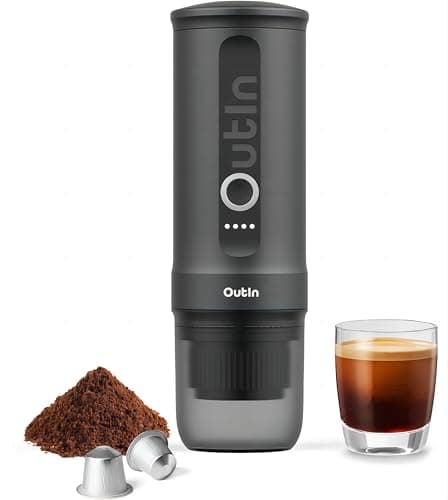
The one maker here that brings its own heat. The OutIn Nano is battery-powered and self-heating: pour in cold water, press the button, and it warms it and drives a 20-bar pump without a kettle, a flask or a stove in sight. That makes it the pick for a van, an RV, a car or anywhere hot water is the hard part, and it takes both ground coffee and Nespresso Original capsules, so it flexes to how much fuss you want on a given morning. The costs are real: it is the heaviest and priciest maker here, you have to keep it charged, and a cold-water fill only gets you a handful of brews per charge. But for genuine off-grid, no-kettle espresso, nothing else on this page does what it does.

Best self-heating (RV / van / car)
7.5
$149.99Amazon
04
Flair Flair 2GO (Grounds Model)
Flair 2GO (Grounds Model)

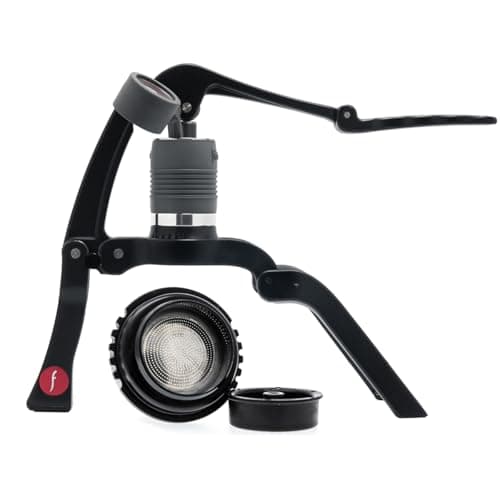
The portable lever, folded down to fit a bag. The Flair 2GO gives you the thing hand-pump makers cannot: a proper manual lever with a live pressure gauge, so you feel and see the pressure across the shot and can shape the extraction the way lever owners love. It is milled from aircraft-grade aluminum and stainless steel, folds flat on six pivots into a compact case, and pulls a clean, controlled shot that rivals the Picopresso for cup quality. The catch is that it is the biggest and heaviest kit here and the most technique-dependent, and like the others it does not heat water. This is the pick for someone who wants lever control on the road and does not mind the bulk.

Best lever / most control
7.2
$169.00Amazon
05
Wacaco Wacaco Minipresso NS
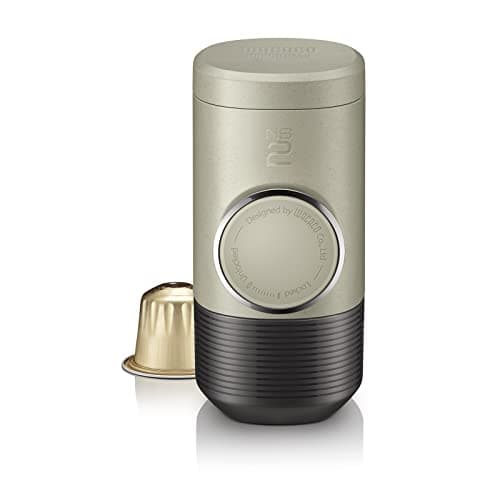
Wacaco Minipresso NS

The simplest portable here, because it skips the grinder entirely. The Minipresso NS takes Nespresso Original capsules: drop one in, add hot water, and press the piston a few times for a roughly 8-bar extraction and a quick single with crema. There is no grinding, no dosing, no tamping and almost no cleanup — the compromise the other makers ask of you simply disappears. The costs are just as clear: capsule coffee is a ceiling on quality, you are tied to the Nespresso Original ecosystem, and the pressure and body sit below the ground-coffee makers. For pure convenience travel, though, nothing here is easier.

Best for capsules / easiest
7.0
$46.90Amazon
06
Cafflano Cafflano Kompresso
Cafflano Kompresso

The lightest, most packable maker here. The Kompresso uses a hydraulic hand-press to hold a steady 9 bar or so on a small ground dose, and at 178 grams it weighs less than half of most of this field and nests into itself for the trail. No electricity, no capsules, no disposable filters — just a stainless portafilter and a squeeze. For a grams-counting backpacker or anyone who wants the absolute smallest real-espresso maker to carry, it is the answer. The honest limits are a modest cup, a body of bioplastic rather than metal, and a press that takes a firm, sustained squeeze to hold pressure.

Best ultralight / smallest
6.7
$59.99Amazon

#ad · Live prices from the Amazon Product API, as of Jul 30, 2026. Where we have no verified live price, we show none — a gap beats a number that has rotted.

In detail

The picks, in full

01
Wacaco Wacaco Nanopresso

Best overall / best value

Wacaco Nanopresso

18-bar hand pump (no battery)Ground coffee, 8 g dose80 ml tank, 336 gYou supply hot water
7.8/10

The portable most people should buy first, and our Best Portable Espresso Maker overall. A patented spring-loaded hand pump reaches a peak of around 18 bar with no electricity, no battery and no cables, it packs down to the size of a small water bottle, and it costs a fraction of anything else that pulls a genuine shot. The honest limits are small and clearly stated: the stock basket is an eight-gram single, so this is one intense little espresso rather than a full double, and you supply the hot water and a fine grind yourself. Accept that and, for travel, camping and the office, nothing beats it on price, packability or forgiveness. It wins the award not because it makes the best cup here — it does not — but because it is the best portable for the most people.

Espresso quality
7
Ease of use
8
Portability
9
Build quality
7
Versatility
7
Value
9

Pros

  • The cheapest honest route into real portable espresso by a wide margin
  • Patented hand pump reaches a peak of around 18 bar with roughly 15% less effort than the older Minipresso
  • Tiny and light at 336 g with nothing to charge or plug in — it lives in a bag, a glovebox or a desk drawer
  • The most forgiving portable to learn on, which is why it is the one we hand a first-timer
  • Pulls a real cap of crema on a small, intense shot when you bring a fine grind and hot water

Cons

  • Small 8-gram single-shot basket — a larger-dose barista kit exists but is sold separately
  • Less body and control than a bigger-dose maker like the Picopresso or a lever like the Flair
  • More plastic in the build than the metal lever makers
  • No boiler and no grinder on board — you bring the hot water and the fine grind

Don't buy this if…

you want a full cafe-style double or the outright best cup a portable can give — step up to the Picopresso or the Flair 2GO for dose and control, or a countertop machine if packing small is not actually a requirement.

The Nanopresso earns the top spot the way a good default always does: by being the right answer for the largest number of people who ask the question. It is the least expensive maker here that produces genuine espresso, it is the smallest and lightest to carry, and it is comfortably the most forgiving to learn on — grind fine, tamp the little basket level, pour in hot water and pump in smooth strokes, and it rewards you fast. The spring-loaded pump reaches a peak of roughly 18 bar, well clear of the pressure espresso actually needs, so the shot comes out concentrated with a real layer of crema rather than as strong drip.

What you are accepting for that price and packability is dose. The stock basket takes a small single of about eight grams, so you get one short, syrupy espresso rather than a voluminous double, and the window between sour and bitter is narrower simply because there is less coffee in the path. Drink it straight, lengthen it with hot water for a small Americano, or add warm milk for a compact flat white. If you want the whole story on the shot, the grind it demands and the technique that makes it click, our full Wacaco Nanopresso review goes deeper — but as a place to start portable espresso, this is the one to beat.

$64.90View on Amazon

Price as of Jul 30, 2026. Prices change — Amazon's at checkout is the one that counts.

#ad · we may earn a commission from this link to Wacaco Nanopresso

02
Wacaco Wacaco Picopresso

Best cup quality / a real double

Wacaco Picopresso

Hand pump, espresso pressure (no battery)52 mm naked portafilter, ~18 g80 ml tank, 350 gYou supply hot water
7.7/10

The portable for people who want a real cafe-style double, not a small single. Where the Nanopresso pulls eight grams, the Picopresso runs a proper 52 mm naked portafilter and an eighteen-gram-ish dose through a hand pump that reaches espresso pressure, so it can produce the kind of full, syrupy double you would recognise from a good counter machine — while still packing into a case the size of a large mug. The trade is that it is fussier: it wants distribution and a level tamp, it rewards a good grinder, and it is more money. This is the enthusiast's portable, and on cup quality it is the best on this page.

Espresso quality
9
Ease of use
6
Portability
8
Build quality
9
Versatility
7
Value
7

Pros

  • Runs a full 52 mm cafe-style basket and an ~18 g dose — a real double, not a small single
  • Naked (bottomless) portafilter lets you read your extraction and diagnose channeling
  • Best cup quality of any maker here when you dial the grind and puck prep in
  • Still genuinely portable — the whole kit nests into a compact protective case at 350 g
  • No electricity or battery to fail; all the pressure comes from your hand

Cons

  • Fussy — it wants proper distribution, a level tamp and a good grind, so the learning curve is real
  • Costs noticeably more than the Nanopresso for a maker that is still hand-powered
  • No boiler — you still bring the hot water yourself
  • The extra dose and control are wasted on anyone who just wants a quick, easy single

Don't buy this if…

you want the cheapest, most forgiving way to make coffee on the road — the Nanopresso is easier and lighter, and a capsule maker like the Minipresso NS is simpler still.

The Picopresso is what you buy when you already know you want a double and you are willing to work for it. The headline is that 52 mm naked portafilter: it is a real, cafe-depth basket that takes an espresso-machine-sized dose, and paired with a hand pump that clears espresso pressure it produces a full, heavy, properly crema-topped double that no small-basket portable can match. Because the portafilter is bottomless, you can watch the extraction pour and actually see channeling when it happens, which is a genuine feedback tool a Nanopresso does not give you.

The flip side is that it asks for the same care a countertop machine does. An eighteen-gram puck in a wide basket needs even distribution and a level tamp or it channels and tastes thin, and it is unforgiving of a bad grind — a consistent, espresso-fine grinder is not optional here, which is why we pair it with a good hand grinder for the road. Get those right and it is the best cup on this page by a clear margin; skip them and a simpler maker will treat you more kindly. It sits one deliberate rung above the Nanopresso, and we lay out exactly that ladder in our best manual espresso makers roundup.

$129.90View on Amazon

Price as of Jul 30, 2026. Prices change — Amazon's at checkout is the one that counts.

#ad · we may earn a commission from this link to Wacaco Picopresso

03
OutIn OutIn Nano Portable Espresso Machine

Best self-heating (RV / van / car)

OutIn Nano Portable Espresso Machine

20-bar electric pumpSelf-heating from cold (~200 F)7,500 mAh battery, USB-CGround coffee or NS capsules
7.5/10

The one maker here that brings its own heat. The OutIn Nano is battery-powered and self-heating: pour in cold water, press the button, and it warms it and drives a 20-bar pump without a kettle, a flask or a stove in sight. That makes it the pick for a van, an RV, a car or anywhere hot water is the hard part, and it takes both ground coffee and Nespresso Original capsules, so it flexes to how much fuss you want on a given morning. The costs are real: it is the heaviest and priciest maker here, you have to keep it charged, and a cold-water fill only gets you a handful of brews per charge. But for genuine off-grid, no-kettle espresso, nothing else on this page does what it does.

Espresso quality
8
Ease of use
8
Portability
6
Build quality
8
Versatility
9
Value
6

Pros

  • Heats its own water from cold — no kettle, flask or stove needed, which nothing else here can claim
  • 20-bar battery pump pulls a genuinely creamy shot comparable to countertop makers
  • Takes both ground coffee and Nespresso Original capsules, so you choose your effort level
  • Charges over USB-C or a 12V/24V car socket — purpose-built for a van, RV or road trip
  • The most convenient portable to actually operate: fill, press, brew

Cons

  • Heaviest maker here at about 670 g, and the bulkiest to pack
  • A cold-water fill only yields around five brews per charge — you plan around the battery
  • Most expensive pick on this page
  • More electronics and a battery to eventually fail than a simple hand pump has

Don't buy this if…

you already carry a flask or camp stove and want the lightest, cheapest, nothing-to-charge option — a hand-pump maker like the Nanopresso is smaller, cheaper and never needs power.

Every other maker on this page hands you the pressure and leaves the heat to you. The OutIn Nano is the exception, and it is the whole reason to buy it. A rechargeable battery drives a heating element and a 20-bar pump together, so you fill it with cold water, press one button, and a few minutes later it has warmed that water to brewing temperature and pulled a creamy shot — no kettle, no flask, no fire. In a van conversion, an RV galley, a car on a long drive or a hotel room with no working kettle, that turns espresso from a two-appliance production into a single self-contained gadget.

The compromises are the ones you would expect from packing a battery and a heater into a travel maker. It is the heaviest thing here at roughly 670 g, it is the most expensive, and because heating cold water is the battery's hardest job, a from-cold fill only nets you around five shots before it needs charging — feed it hot water instead and you get far more, but then you have given up the very feature you paid for. It also takes both ground coffee and Nespresso Original capsules, which is a real convenience: grounds when you want a better cup, a capsule when you just want caffeine with zero cleanup. If self-contained, no-kettle brewing is the problem you are solving, it is worth the weight and the price.

$149.99View on Amazon

Price as of Jul 30, 2026. Prices change — Amazon's at checkout is the one that counts.

#ad · we may earn a commission from this link to OutIn Nano Portable Espresso Machine

04
Flair Flair 2GO (Grounds Model)

Best lever / most control

Flair 2GO (Grounds Model)

Manual lever, brews 6-9 barLive pressure gaugeBottomless 2-in-1 portafilterFolds flat; aluminum + stainless
7.2/10

The portable lever, folded down to fit a bag. The Flair 2GO gives you the thing hand-pump makers cannot: a proper manual lever with a live pressure gauge, so you feel and see the pressure across the shot and can shape the extraction the way lever owners love. It is milled from aircraft-grade aluminum and stainless steel, folds flat on six pivots into a compact case, and pulls a clean, controlled shot that rivals the Picopresso for cup quality. The catch is that it is the biggest and heaviest kit here and the most technique-dependent, and like the others it does not heat water. This is the pick for someone who wants lever control on the road and does not mind the bulk.

Espresso quality
9
Ease of use
6
Portability
6
Build quality
9
Versatility
6
Value
7

Pros

  • A real manual lever with a pressure gauge — you see and control pressure across the whole shot
  • Cup quality rivals the Picopresso and beats every hand-pump maker here
  • Milled aircraft-grade 6061 aluminum and stainless steel — the most solid build on the page
  • The only foldable lever maker: six pivots collapse it into a compact travel case
  • Bottomless 2-in-1 portafilter lets you brew with or without a spout and read your extraction

Cons

  • The biggest and heaviest kit here — the packed case is the least pocketable option
  • Lever technique and puck prep take practice, so the learning curve is the steepest of the six
  • No boiler — you still supply the hot water yourself
  • Priciest hand-powered maker on the page

Don't buy this if…

you want something that truly disappears into a jacket pocket or that a beginner can nail on day one — the Nanopresso is smaller and far more forgiving, and the Minipresso NS is simpler still.

A lever is a different way to make espresso: instead of a pump forcing water at a fixed pressure, you drive the piston yourself and shape the pressure curve by hand — a gentle pre-infusion, a build to peak, a controlled decline. The Flair 2GO puts that experience in a case you can pack, and adds a live pressure gauge so you are not guessing. For anyone who likes the craft of the shot, that control is the appeal, and the reward is a clean, well-extracted cup that trades blows with the Picopresso for the best on this page.

What you give up is packability and patience. Folded, it is still the largest and heaviest kit here, so it suits a checked bag or a van shelf more than a coat pocket, and the lever rewards practice — puck prep, a good grind and a feel for the gauge all matter, which makes it the least beginner-friendly of the six. It also does not heat water, so a flask or stove is still part of the kit. If you want the fullest expression of manual espresso you can carry and you are happy to learn it, this is it; if you want easy, look higher up the list. It is the natural travel companion to the bench levers in our best manual espresso makers guide.

$169.00View on Amazon

$199.0015% off

Price as of Jul 30, 2026. Prices change — Amazon's at checkout is the one that counts.

#ad · we may earn a commission from this link to Flair 2GO (Grounds Model)

05
Wacaco Wacaco Minipresso NS

Best for capsules / easiest

Wacaco Minipresso NS

Hand piston, ~8 barNespresso Original capsules70 ml tank, 350 gNo grinder, no battery
7.0/10

The simplest portable here, because it skips the grinder entirely. The Minipresso NS takes Nespresso Original capsules: drop one in, add hot water, and press the piston a few times for a roughly 8-bar extraction and a quick single with crema. There is no grinding, no dosing, no tamping and almost no cleanup — the compromise the other makers ask of you simply disappears. The costs are just as clear: capsule coffee is a ceiling on quality, you are tied to the Nespresso Original ecosystem, and the pressure and body sit below the ground-coffee makers. For pure convenience travel, though, nothing here is easier.

Espresso quality
6
Ease of use
9
Portability
8
Build quality
7
Versatility
5
Value
7

Pros

  • No grinder needed — drop in a capsule, add hot water, press: the lowest-effort maker here
  • Almost nothing to clean up, which is a real draw for hotels and offices
  • Hand-powered with no battery or cables to charge or fail
  • Built-in cup and cleaning brush make it a genuinely self-contained travel kit
  • The cheapest and least intimidating way into portable espresso for a non-hobbyist

Cons

  • Capsules cap the cup quality — it will not match a fresh-ground shot from the Nanopresso or Picopresso
  • Locked to the Nespresso Original capsule ecosystem, so you carry pods and cannot use your own beans
  • Around 8 bar and a small yield — less pressure and body than the ground-coffee makers
  • No boiler — you still bring the hot water

Don't buy this if…

you care about cup quality or want to brew your own freshly ground coffee — a ground maker like the Nanopresso is a clear step up in the cup, and the OutIn Nano gives you both grounds and capsules.

$46.90View on Amazon

Price as of Jul 30, 2026. Prices change — Amazon's at checkout is the one that counts.

#ad · we may earn a commission from this link to Wacaco Minipresso NS

06
Cafflano Cafflano Kompresso

Best ultralight / smallest

Cafflano Kompresso

Hydraulic hand-press, ~9 barGround coffee, up to 15 g178 g — the lightest hereNo battery, no disposable filters
6.7/10

The lightest, most packable maker here. The Kompresso uses a hydraulic hand-press to hold a steady 9 bar or so on a small ground dose, and at 178 grams it weighs less than half of most of this field and nests into itself for the trail. No electricity, no capsules, no disposable filters — just a stainless portafilter and a squeeze. For a grams-counting backpacker or anyone who wants the absolute smallest real-espresso maker to carry, it is the answer. The honest limits are a modest cup, a body of bioplastic rather than metal, and a press that takes a firm, sustained squeeze to hold pressure.

Espresso quality
6
Ease of use
6
Portability
9
Build quality
6
Versatility
6
Value
7

Pros

  • Lightest maker on the page at 178 g, and it packs into itself for a rucksack
  • Hydraulic press holds a steady ~9 bar without any electricity or battery
  • No capsules and no paper filters to run out of — just a reusable stainless portafilter
  • About as simple mechanically as portable espresso gets, so there is little to break
  • A genuine ground-coffee shot with crema in the smallest, lightest package here

Cons

  • Modest cup — pressure and body sit below the Nanopresso, Picopresso and lever makers
  • The body is ECOZEN bioplastic rather than the metal of the Flair or Picopresso
  • The press wants a firm, sustained squeeze, which some hands find awkward
  • No boiler — you supply the hot water, and the small basket is fine-grind sensitive

Don't buy this if…

cup quality matters more to you than saving grams, or you want a metal-bodied maker — the Nanopresso costs about the same and pulls a better, more forgiving shot, and the Picopresso is in a different league on the cup.

$59.99View on Amazon

Price as of Jul 30, 2026. Prices change — Amazon's at checkout is the one that counts.

#ad · we may earn a commission from this link to Cafflano Kompresso

How we picked

Every maker here is a real, currently-purchasable portable that produces genuine espresso pressure — not a “travel coffee” gadget that makes strong drip. We ranked them for what a portable is actually good at — a real single shot away from a counter, packed small — rather than against the countertop machine they were never meant to replace. Six things decided the order.

  1. Espresso quality. Does it build real pressure and pull a shot with body and crema, or a thin approximation? Dose matters here: a bigger basket and better puck prep give a fuller cup, which is why the Picopresso and the Flair lever score highest.
  2. Ease of use. How much technique stands between you and a good cup. A capsule maker you just load and press scores high; a lever that wants distribution, tamping and a feel for a pressure gauge scores lower, however good its ceiling.
  3. Portability.Weight and packed size are the whole reason to buy a portable, so an ultralight that nests into itself was rewarded and a heavier battery unit was marked down — even where that unit earns its weight elsewhere.
  4. Build quality. Milled aluminum and stainless last and feel the part; bioplastic bodies are lighter and cheaper but give some of that back. We weighed materials against what the maker is trying to be.
  5. Versatility. Whether it heats its own water, and whether it takes grounds, capsules or both. A maker that solves the hot-water problem or flexes between beans and pods earns points a single-purpose one does not.
  6. Value. The cheapest maker is not automatically the best value, and the priciest is not automatically the best cup. We rewarded the pick that does its job at a fair price for what it is.

What we did not test

We did not run these makers through a lab. There is no measured extraction-yield chart here and no side-by-side timed brew log — the author is Stephen V., an enthusiast, not a test house, and our scores come from each maker's published specifications, the physics of how pressure and heat produce espresso, and aggregated owner feedback, exactly as our methodologyexplains. The bar figures, doses, water capacities and weights are from the manufacturers' own materials, listed in Sources. Where hands-on time would tell you more than a spec sheet — how a given hand grinder pairs with each one day to day, how the pump or lever effort feels to a smaller or larger hand, how a battery holds up over a year — we say so rather than invent a number. Treat the scores as informed editorial judgment, not readings off an instrument.

Hand-pump vs lever vs battery-heated

This is the first real decision, and it splits three ways. A hand-pumpmaker — the Nanopresso, the Picopresso, the Minipresso NS, the Cafflano — uses a spring-loaded piston or a squeeze that you work by muscle to force water through the puck. It is the simplest, lightest, cheapest approach, with nothing electronic to fail, and it is where most people should start. A lever maker like the Flair 2GO trades some of that packability for control: you drive the piston by hand and shape the pressure across the shot, which enthusiasts love and beginners find fiddly. A battery-heatedmaker like the OutIn Nano is the different animal — a motorised pump plus a heating element, which buys convenience and self-contained brewing at the cost of weight, price and charging. None is “best” outright; they suit different trips and different tempers.

Almost all of them need you to bring hot water

This is the single most overlooked fact about portable espresso, so we will say it plainly: with one exception on this page, these makers do not heat water. They supply pressure only. You boil water first — a travel flask, a hotel kettle, a camp stove — and pour it into the maker just before you brew. That is fine on a campsite with a stove or in a kitchen with a kettle, and it keeps the maker tiny and reliable. But it means the “kit” is really two things, not one, and in a car or a van with no easy way to boil water it becomes the whole problem. The OutIn Nano is the only pick that heats its own water from cold, which is exactly why it wins the self-heating slot despite being the heaviest and priciest maker here. Decide whether hot water is a given on your trips before anything else; it changes which pick is right more than any spec does.

You still need a grinder — and a fine one

Every ground-coffee maker here lives or dies on the grind, and it is the part new buyers most often get wrong. Portables need coffee ground fine, in the espresso range, and pre-ground supermarket coffee is almost always too coarse — it passes water too fast, gushes, and tastes thin and sour no matter how hard you pump. Our guide to espresso grind size shows what fine actually looks like and how to correct a shot that runs wrong. Because these are travel tools, the natural partner is a compact, espresso-capable hand grinder you can pack alongside; our best hand grinderscovers models that hold a fine, even grind on the road. The one maker that sidesteps this is the capsule Minipresso NS — no grinder, no dose, no fuss — which is precisely its appeal, and precisely why its cup has a lower ceiling than a fresh-ground shot.

What you are giving up versus a countertop machine

It is worth being blunt about the trade, because a portable is a compromise you choose on purpose. You give up volume: most of these pull one small single at a time from a basket a fraction of a full machine's size, so back-to-back drinks for a table mean back-to-back brews. You give up consistency: without a heated group and a regulated pump, temperature and pressure wander shot to shot, and your technique carries more of the result. And you largely give up milk: none of these steam a proper microfoam, so a cappuccino means frothing separately. What you get back is the ability to make a real shot anywhere. If those trades sting, you do not want a portable — you want a machine, and our best espresso machines for beginners or, for pulling and steaming at once, the best dual-boiler machines are the honest next step. A portable is a companion to a home setup, not a substitute for one.

Which portable fits you

  • Want the one to start with, cheap and forgiving?Wacaco Nanopresso — our overall pick, real espresso in a pocket for the least money.
  • Want a full cafe-style double and the best cup?Wacaco Picopresso — a 52 mm basket and a proper dose, if you will do the puck prep.
  • No kettle — a van, RV or car?OutIn Nano — the only one that heats its own water from cold.
  • Want lever control and the most solid build?Flair 2GO — a folding lever with a pressure gauge, if you can carry the bulk.
  • Want the least fuss, no grinder?Wacaco Minipresso NS — drop in a capsule, add hot water, press.
  • Counting grams for the trail?Cafflano Kompresso — the lightest real maker here at 178 g.

Whichever you pick, keep the honest frame in mind: a portable makes a genuine single shot in places a countertop machine cannot go, and that is a real and useful thing — but it is a compromise on volume and consistency, chosen on purpose. Bring a fine grind and hot water (or let the OutIn Nano handle the water), and it earns its place in a bag.
How we picked

We did not lab-test this gear

Everyone in this category says they tested twenty machines. We have not pulled shots on every product here, and we say so. What we did instead: compiled the published specifications, cross-checked the manufacturer manuals, computed the running cost (wattage to energy, grams-per-shot to cost-per-cup), weighed aggregated owner reports, and scored each product against a published rubric. The scores are judgments from documented research — not measurements we took, because we do not have a test lab and we will not pretend we do. Where hands-on time would tell you more than a spec sheet, we flag it. Where a number came from someone else's work, we name them in Sources.

Questions

Frequently asked

Do portable espresso makers make real espresso?
Yes — the good ones genuinely do. A hand pump, a lever or a battery pump builds real espresso-level pressure and forces hot water through a fine-ground puck, so the shot comes out concentrated with a cap of crema rather than as strong drip. The honest caveat is scale, not authenticity: most of these pull one small single at a time from a small basket, so you get a real espresso, just less of it and with more of the outcome resting on your grind and technique than a countertop machine would ask.
Do portable espresso makers heat their own water?
Almost none of them do. With one exception on this page, portable makers supply pressure only — you boil water first with a flask, a kettle or a camp stove and pour it in just before brewing. The OutIn Nano is the exception: it is battery-powered and self-heating, so it warms cold water itself and needs no kettle, which is why it is the pick for a van, RV or car where hot water is the hard part. Decide whether you will have hot water on hand before you choose, because it changes which maker is right.
Hand pump or battery — which portable espresso maker is better?
Neither is better outright; they suit different trips. A hand-pump maker like the Nanopresso is lighter, cheaper and has nothing to charge or fail, so it is where most people should start and the best choice when you already carry a way to boil water. A battery maker like the OutIn Nano heats its own water and is the most convenient to operate, but it is heavier, pricier and has to stay charged. Pick a hand pump for simplicity and packability; pick battery for self-contained, no-kettle brewing.
Do I need a special grinder for a portable espresso maker?
You need coffee ground fine, in the espresso range — that matters more than which grinder you own. Pre-ground supermarket coffee is almost always too coarse and will make the shot gush and taste thin. Because these are travel tools, a compact espresso-capable hand grinder is the natural partner; see our best hand grinders, and our espresso grind size guide for what fine actually looks like. The one exception is a capsule maker like the Minipresso NS, which needs no grinder at all — that convenience is exactly its point.
Can a portable espresso maker replace a countertop machine?
No, and it is not meant to. A portable is a compromise on purpose: you give up volume (one small single at a time), shot-to-shot consistency (no heated group or regulated pump), and proper milk steaming, in exchange for making a real shot anywhere. That is a great trade for travel, camping, an office or a van, and a poor one if you want big doubles and milk drinks every morning at home. Think of a portable as a companion to a home setup, not a substitute — if you want a machine, start with our best espresso machines for beginners.

Keep reading

Receipts

Sources

We do not run a testing lab, and we do not pretend to. Where a measured number came from someone else's work, we name them and link them. Where we could not verify something, we say so on the page rather than quietly leaving it out. Read our full method.