Skip to content
Portafilter Co

Makers & Brewers · Coffee Makers

The best French press coffee makers

Six presses, glass and stainless, ranked on cup quality, heat retention, how clean the cup is and value — with the grind advice that matters more than any of them.

By Stephen V.Updated How we pick
#ad

We earn a commission when you buy through our Amazon links, at no extra cost to you. It never changes a verdict, and we say so when the cheaper product is the better buy. How this works.

A French press is the simplest honest way to make a full-bodied cup of coffee: coarse grounds steep loose in hot water for about four minutes, then a mesh plunger pushes them to the bottom and you pour. There is no paper filter, no electricity and no real learning curve, which is exactly why it suits anyone who wants real, full-flavored coffee without a machine taking up the counter.

The one thing that decides whether you love or hate a press is grind, and it is not close. A French press is full-immersion brewing, so the water touches every particle for the entire steep, and that means it needs a coarse, even grind. Grind too fine and you get a muddy, bitter cup with a layer of silt at the bottom, which is why a coarse-capable burr grinder for drip and press matters more than which press you buy. The tradeoff built into the method is body versus clarity: the metal mesh lets coffee oils and some fine sediment through, which is what gives press coffee its heavy, satisfying body, and also why it will never be as clean as a paper-filtered pour over.

So the choice below is really two smaller ones. First, glass or stainless: glass costs less and lets you watch the brew, while stainless keeps coffee hot and survives drops. Second, how clean you want the cup: a plain mesh gives you the classic full-bodied, slightly silty press coffee, while a double or two-stage filter trims the sediment for a cleaner cup. We ranked six presses you can buy right now around those two decisions, and if you are still weighing the method itself against a dripper, our French press versus pour over guide is the place to start.

The short answer

Quick picks

#ProductBest forScorePrice
01
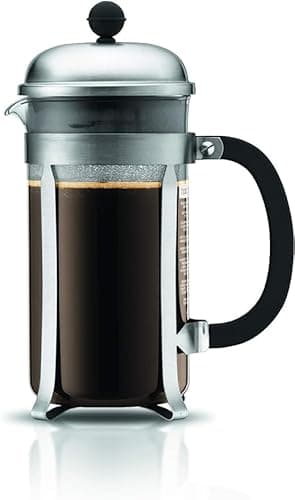
Bodum Bodum Chambord French Press (34 oz, 8-Cup)
Bodum Chambord French Press (34 oz, 8-Cup)

The French press almost everyone should buy, and the one nearly every other maker copies. Its borosilicate glass beaker and three-part stainless mesh let coffee oils straight into the cup for the full-bodied brew a press is supposed to make, and the chrome-plated steel frame is a real step up from the plastic-framed rivals. The glass is breakable, but Bodum sells replacement beakers, so a drop is an annoyance rather than the end.

Best overall
7.4
$39.99Amazon
02
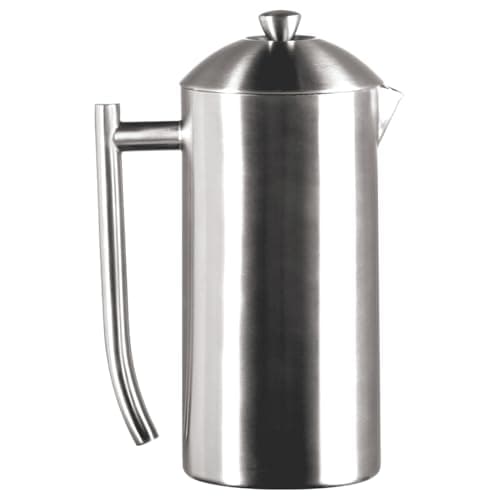
Frieling Frieling Double-Wall Stainless Steel French Press (36 oz)
Frieling Double-Wall Stainless Steel French Press (36 oz)

If you want a French press that keeps coffee hot and survives being dropped, this is the one. Frieling builds it from 18/10 stainless steel inside and out with a double-wall insulated body that holds temperature far longer than any glass press here, plus a patented two-stage filter that leaves a nearly sediment-free cup. The catch is the price: it costs several times what a Chambord does, and that is the main reason it is not our overall pick.

Best heat retention
7.2
$139.95Amazon
03
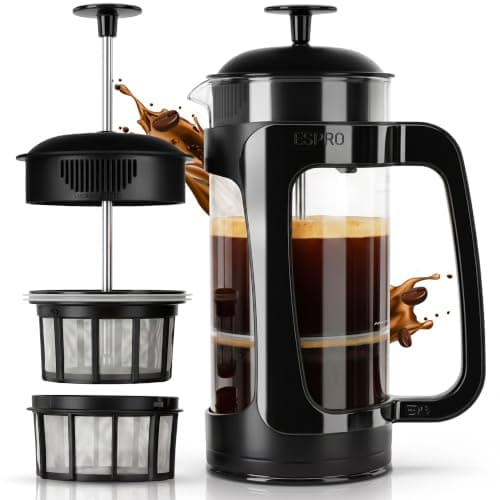
Espro Espro P3 French Press (32 oz)
Espro P3 French Press (32 oz)

The press for anyone who finds French press coffee too muddy. Espro's patented double micro-filter uses two nested stainless screens to trap the fines that slip through an ordinary mesh, so the cup is cleaner and less bitter, and pressing largely stops the coffee from over-extracting while it sits. It is pricier than a basic glass press and the replacement filters cost extra, but no other press here gives you a cleaner cup.

Best clean cup
7.0
$39.94Amazon
04
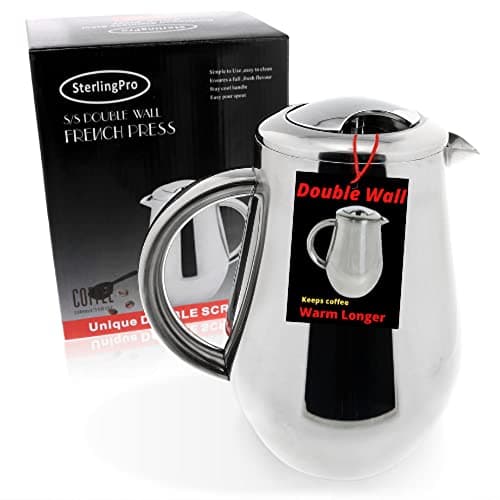
SterlingPro SterlingPro Double-Wall Stainless Steel French Press (34 oz)
SterlingPro Double-Wall Stainless Steel French Press (34 oz)

A stainless, insulated press that costs far less than the Frieling and covers most of the same ground. The 304 stainless body keeps plastic away from your coffee and the double wall holds heat, while a double-screen filter keeps sediment low, and SterlingPro even throws in two spare screens. Being metal it is opaque, so you cannot watch the brew, but for the money it is the value pick in stainless.

Best stainless value
7.0
$53.00Amazon
05
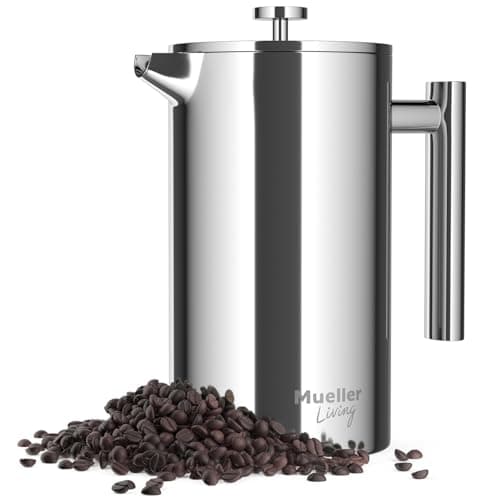
MuellerLiving MuellerLiving Stainless Steel French Press (34 oz)
MuellerLiving Stainless Steel French Press (34 oz)

The cheapest way here to get an insulated stainless press. It is all 304 stainless with a double-wall body that keeps coffee hot far longer than glass and will not shatter, plus a four-level filtration stack that keeps sediment down. Build quality is a notch below the pricier stainless presses and the metal body hides the brew, but for the price the insulation is the headline.

Best insulated for less
7.0
$46.74Amazon
06
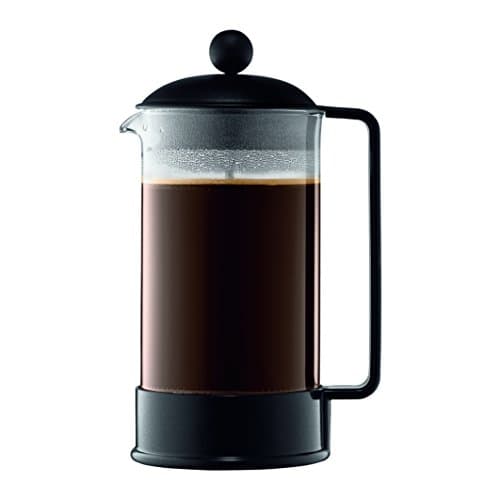
Bodum Bodum Brazil French Press (34 oz, 8-Cup)
Bodum Brazil French Press (34 oz, 8-Cup)

The same coffee as our top pick for less money. The Brazil uses the same borosilicate glass beaker and three-part stainless mesh as the Chambord, so the cup is essentially identical, but it sits in a lightweight BPA-free plastic frame instead of chrome-plated steel. That frame is why it is cheap and why it feels less durable, but if you just want a good press for the least money, this is it.

Cheapest pick
6.4
$19.99Amazon

#ad · Live prices from the Amazon Product API, as of Jul 26, 2026. Where we have no verified live price, we show none — a gap beats a number that has rotted.

In detail

The picks, in full

01
Bodum Bodum Chambord French Press (34 oz, 8-Cup)

Best overall

Bodum Chambord French Press (34 oz, 8-Cup)

34 oz / 8-cupBorosilicate glassChrome-plated steel frameStainless mesh filter
7.4/10

The French press almost everyone should buy, and the one nearly every other maker copies. Its borosilicate glass beaker and three-part stainless mesh let coffee oils straight into the cup for the full-bodied brew a press is supposed to make, and the chrome-plated steel frame is a real step up from the plastic-framed rivals. The glass is breakable, but Bodum sells replacement beakers, so a drop is an annoyance rather than the end.

Cup quality
9
Heat retention
5
Filtration
6
Build
8
Value
9

Pros

  • Three-part stainless mesh filter passes coffee oils for a genuinely full-bodied cup
  • Chrome-plated steel frame feels far sturdier than the plastic-framed presses it competes with
  • Brews a full 34 oz in about four minutes and is dishwasher safe
  • Glass beaker is replaceable, so a broken carafe does not mean a whole new press

Cons

  • Single-wall borosilicate glass loses heat quickly, so coffee cools in the pot
  • One stainless mesh screen lets fine sediment through into the cup
  • Glass carafe can shatter if you knock or drop it
  • No insulation, so it is a poor pick if you sip slowly over an hour

Don't buy this if…

you want coffee to stay piping hot for an hour or you are hard on your gear, because a double-wall stainless press survives both far better.

$39.99View on Amazon

Price as of Jul 26, 2026. Prices change — Amazon's at checkout is the one that counts.

#ad · we may earn a commission from this link to Bodum Chambord French Press (34 oz, 8-Cup)

02
Frieling Frieling Double-Wall Stainless Steel French Press (36 oz)

Best heat retention

Frieling Double-Wall Stainless Steel French Press (36 oz)

36 oz / ~1 L18/10 stainless steelDouble-wall insulatedTwo-stage filter
7.2/10

If you want a French press that keeps coffee hot and survives being dropped, this is the one. Frieling builds it from 18/10 stainless steel inside and out with a double-wall insulated body that holds temperature far longer than any glass press here, plus a patented two-stage filter that leaves a nearly sediment-free cup. The catch is the price: it costs several times what a Chambord does, and that is the main reason it is not our overall pick.

Cup quality
7
Heat retention
9
Filtration
8
Build
9
Value
3

Pros

  • Double-wall insulation keeps coffee hot up to about four times longer than glass
  • 18/10 stainless inside and out is virtually unbreakable, with no beaker to shatter
  • Two-stage filter delivers a nearly sediment-free cup
  • No-drip spout and a dishwasher-safe body make it easy to live with

Cons

  • Costs several times more than a glass press for the same basic brewing job
  • Opaque metal body means you cannot watch the brew level or color
  • Heavier than a glass press to lift and pour
  • Full immersion still means coarse grinding and a careful press; the metal does not do that for you

Don't buy this if…

your budget is tight, because you are paying a big premium for the insulation and durability, and a Chambord makes just as good a cup for a fraction of the price.

$139.95View on Amazon

Price as of Jul 26, 2026. Prices change — Amazon's at checkout is the one that counts.

#ad · we may earn a commission from this link to Frieling Double-Wall Stainless Steel French Press (36 oz)

03
Espro Espro P3 French Press (32 oz)

Best clean cup

Espro P3 French Press (32 oz)

32 oz capacityThicker borosilicate glassDouble micro-filterBPA/BPS-free frame
7.0/10

The press for anyone who finds French press coffee too muddy. Espro's patented double micro-filter uses two nested stainless screens to trap the fines that slip through an ordinary mesh, so the cup is cleaner and less bitter, and pressing largely stops the coffee from over-extracting while it sits. It is pricier than a basic glass press and the replacement filters cost extra, but no other press here gives you a cleaner cup.

Cup quality
8
Heat retention
5
Filtration
9
Build
7
Value
6

Pros

  • Double micro-filter traps fine grounds for a noticeably cleaner, less bitter cup
  • Pressing largely halts extraction, so coffee left in the pot turns bitter more slowly
  • Thicker borosilicate glass is sturdier than a standard press beaker
  • Doubles as a loose-leaf tea press with the same filter

Cons

  • Costs more than a basic glass press for the filtration upgrade
  • Replacement micro-filters are sold separately and do wear over time
  • Single-wall glass still loses heat quickly; insulation is not its job
  • The cleaner cup means less of the heavy body some press drinkers actually want

Don't buy this if…

you love a big, oily, full-bodied press cup, because the double filter deliberately strips out the fines and some of the body that give a classic press its heft.

$39.94View on Amazon

Price as of Jul 26, 2026. Prices change — Amazon's at checkout is the one that counts.

#ad · we may earn a commission from this link to Espro P3 French Press (32 oz)

04
SterlingPro SterlingPro Double-Wall Stainless Steel French Press (34 oz)

Best stainless value

SterlingPro Double-Wall Stainless Steel French Press (34 oz)

34 oz / 8-cup304 stainless, plastic-freeDouble-wall insulatedDouble-screen + 2 spares
7.0/10

A stainless, insulated press that costs far less than the Frieling and covers most of the same ground. The 304 stainless body keeps plastic away from your coffee and the double wall holds heat, while a double-screen filter keeps sediment low, and SterlingPro even throws in two spare screens. Being metal it is opaque, so you cannot watch the brew, but for the money it is the value pick in stainless.

Cup quality
7
Heat retention
7
Filtration
7
Build
7
Value
7

Pros

  • 304 stainless with no plastic touching the coffee, and a double wall that holds heat
  • Double-screen filter keeps sediment lower than a single mesh does
  • Includes two replacement screens, so worn filters are not an extra purchase
  • Dishwasher safe and far harder to break than a glass press

Cons

  • Opaque metal body, so you cannot see the brew or judge the level by eye
  • Double-screen filtration is good but not as clean as the Espro's micro-filter
  • Insulation is real but does not match the premium Frieling
  • Nothing about it stands out; it is a solid all-rounder rather than a specialist

Don't buy this if…

watching the coffee bloom and brew is part of the ritual for you, because a glass Chambord or Brazil lets you see everything a metal press hides.

$53.00View on Amazon

Price as of Jul 26, 2026. Prices change — Amazon's at checkout is the one that counts.

#ad · we may earn a commission from this link to SterlingPro Double-Wall Stainless Steel French Press (34 oz)

05
MuellerLiving MuellerLiving Stainless Steel French Press (34 oz)

Best insulated for less

MuellerLiving Stainless Steel French Press (34 oz)

34 oz / 8-cup304 stainless steelDouble-wall insulated4-level filtration
7.0/10

The cheapest way here to get an insulated stainless press. It is all 304 stainless with a double-wall body that keeps coffee hot far longer than glass and will not shatter, plus a four-level filtration stack that keeps sediment down. Build quality is a notch below the pricier stainless presses and the metal body hides the brew, but for the price the insulation is the headline.

Cup quality
7
Heat retention
8
Filtration
7
Build
6
Value
7

Pros

  • Double-wall stainless keeps coffee hot far longer than any glass press here
  • Four-level filtration stack meaningfully reduces sediment in the cup
  • All-stainless body will not shatter if you drop it
  • Plunger disassembles for cleaning and the whole press is dishwasher safe

Cons

  • Opaque metal body means you cannot see the brew level
  • Build feels a step below the Frieling and SterlingPro
  • Multi-piece filter stack is more parts to rinse and reassemble
  • No view of the brew makes it less satisfying for hands-on brewers

Don't buy this if…

you want the sturdiest stainless press you can get, because this one prioritizes a low price and the Frieling or SterlingPro feel more solid in the hand.

$46.74View on Amazon

$54.9915% off

Price as of Jul 26, 2026. Prices change — Amazon's at checkout is the one that counts.

#ad · we may earn a commission from this link to MuellerLiving Stainless Steel French Press (34 oz)

06
Bodum Bodum Brazil French Press (34 oz, 8-Cup)

Cheapest pick

Bodum Brazil French Press (34 oz, 8-Cup)

34 oz / 8-cupBorosilicate glassBPA-free plastic frameStainless mesh filter
6.4/10

The same coffee as our top pick for less money. The Brazil uses the same borosilicate glass beaker and three-part stainless mesh as the Chambord, so the cup is essentially identical, but it sits in a lightweight BPA-free plastic frame instead of chrome-plated steel. That frame is why it is cheap and why it feels less durable, but if you just want a good press for the least money, this is it.

Cup quality
8
Heat retention
5
Filtration
6
Build
4
Value
9

Pros

  • Same borosilicate glass and three-part mesh as the Chambord, so the cup is basically the same
  • Lowest price here, the least you can spend for a genuinely good press
  • Heat-resistant glass brews 34 oz in about four minutes and is dishwasher safe
  • Lightweight BPA-free frame is easy to handle and made in Portugal like the Chambord

Cons

  • Plastic frame feels less durable than the metal-framed Chambord
  • Single-wall glass loses heat fast, with no insulation
  • One stainless mesh lets fine sediment into the cup
  • Glass beaker can shatter if dropped

Don't buy this if…

you want a press that will last for years of hard use, because the plastic frame is the first thing to feel cheap and the metal-framed Chambord is worth the small step up.

$19.99View on Amazon

$27.5027% off

Price as of Jul 26, 2026. Prices change — Amazon's at checkout is the one that counts.

#ad · we may earn a commission from this link to Bodum Brazil French Press (34 oz, 8-Cup)

How we picked

Every press here is a real, currently-purchasable French press you can buy in the US, and we judged them on five things, in this order.

  1. Cup quality. The whole point of a press is a full-bodied, full-immersion cup, so the filter and how it handles oils and sediment come first. A plain mesh gives the classic heavy body; a double or two-stage filter trades a little of that body for a cleaner cup.
  2. Heat retention. Press coffee sits in the pot while you drink it. Single-wall glass cools fast; a double-wall stainless body keeps it hot far longer, which for slow sippers is the difference between a good second cup and a lukewarm one.
  3. Filtration. How much sediment ends up in the cup. This is really a preference rather than a fault, since some people want the silt and body and others want it gone, but it is the spec that most changes the drink.
  4. Build. Glass breaks; stainless does not, and a metal frame beats a plastic one. We weighted whether a press will survive a busy kitchen and whether broken parts can be replaced.
  5. Value. What you pay for the cup you get. A press is a simple object, so paying four times as much has to buy something real, whether that is insulation, durability or cleaner filtration, or it does not earn the money.

We did not lab-test these presses, because we have no lab and we will not pretend otherwise. Our scores come from published manufacturer specs, the filter and material details each maker lists, and how full-immersion brewing actually behaves in the cup; our methodology page sets out exactly how we score.

Glass vs stainless (and why it matters)

This is the first fork, and it is a genuine trade rather than a right answer. Glass presses — the Chambord, the Brazil and the Espro here — use a borosilicate beaker that lets you watch the coffee bloom and see exactly how full the pot is. They are cheaper, and glass is inert, so nothing touches your coffee but steel and glass. The cost is heat and durability: a single-wall beaker cools quickly and cracks if you are careless.

Stainless presses — the Frieling, SterlingPro and MuellerLiving — flip both. A double-wall stainless body keeps coffee hot far longer and shrugs off drops that would shatter glass, and the better ones keep plastic away from the coffee entirely. What you give up is the view: metal is opaque, so you brew by the clock instead of by eye, and the best stainless presses cost noticeably more. If your press lives on the counter and you drink fast, glass is fine; if it travels, gets knocked around, or you nurse a pot for an hour, stainless earns its keep.

Getting a clean cup from a press

Most bad French press coffee is a grind problem, not a press problem. Because the method is full immersion, every particle brews for the full four minutes, so a fine or uneven grind over-extracts and dumps silt into the cup. You want a coarse, even grind, roughly the texture of coarse sea salt, which realistically means a burr grinder rather than a blade one; our roundup of grinders for drip and press and the hand versus electric comparison both cover coarse-capable options. If you want the grind detail on its own, our grind size guide explains why coarseness changes the cup.

Technique does the rest. Use roughly a 1-to-15 ratio of coffee to water, pour water just off the boil, give it a gentle stir, and let it steep about four minutes before pressing slowly and evenly. Press gently, because forcing the plunger churns the bed and pushes fines through. And decant: leave coffee sitting on the grounds and it keeps extracting and turns bitter, which is exactly the problem the Espro's double filter is built to slow. A cheaper press with a good grind and good technique beats an expensive one fed gravel.

What we would skip

Skip blade grinders. They cannot produce the even coarse grind a press needs, and no press on this page will save the cup if the grounds are half powder and half chunks. Skip the finest mesh you can find as a fix for sediment, because the honest way to a cleaner cup is a coarser grind and a slower press, or a press built with a double or two-stage filter like the Espro or the Frieling, not a finer screen that just clogs. And be realistic about giant presses: a 34 oz press is only good for one cup if you drink it fast, because coffee left on the grounds keeps brewing. If it is just you, a smaller press or a stainless one that holds heat serves you better than the biggest beaker on the shelf.

Which French press fits you

  • Want the best all-round press most people should buy? The Bodum Chambord, for its full-bodied cup, sturdy metal frame and replaceable glass.
  • Nurse your coffee for an hour, or hard on your gear? The Frieling, for double-wall heat and near-unbreakable stainless.
  • Find press coffee too muddy? The Espro P3 and its double micro-filter, for the cleanest cup here.
  • Want stainless without the premium price? The SterlingPro, insulated and low-sediment with spare screens in the box.
  • Want insulation for the least money? The MuellerLiving.
  • Just want a good press for the lowest price? The Bodum Brazil, the same cup as our top pick in a plastic frame.

Whichever you choose, buy a coarse-capable grinder before you upgrade the press, and if you are still deciding between a press and a dripper, read French press versus pour over — the two make genuinely different coffee.
How we picked

We did not lab-test this gear

Everyone in this category says they tested twenty machines. We have not pulled shots on every product here, and we say so. What we did instead: compiled the published specifications, cross-checked the manufacturer manuals, computed the running cost (wattage to energy, grams-per-shot to cost-per-cup), weighed aggregated owner reports, and scored each product against a published rubric. The scores are judgments from documented research — not measurements we took, because we do not have a test lab and we will not pretend we do. Where hands-on time would tell you more than a spec sheet, we flag it. Where a number came from someone else's work, we name them in Sources.

Questions

Frequently asked

How is French press coffee different from drip or pour over?
A French press is full-immersion brewing: the grounds soak in the water for the whole steep, and a metal mesh, not a paper filter, separates them at the end. That mesh lets coffee oils and a little fine sediment through, which gives press coffee its heavy, full body. Paper-filtered methods like drip and pour over trap those oils and fines, so they taste cleaner and lighter. Neither is better; they are simply different drinks.
What grind should I use for a French press?
A coarse, even grind, roughly the texture of coarse sea salt. Because the coffee steeps for the full four minutes, a fine grind over-extracts and leaves silt in the cup, so a burr grinder that can hold a coarse setting matters more than the press itself. Our hand grinder picks and the grind size guide both cover getting a clean, coarse grind.
Why is there sediment at the bottom of my cup?
Some sediment is normal for a French press; the mesh filter is designed to let fines and oils through, and that is part of the body. Too much silt usually means the grind is too fine or you pressed the plunger too hard and fast, both of which push more fine particles through the screen. Grinding coarser, pressing slowly, and leaving the last inch of coffee in the pot all cut it down. If you want a genuinely clean cup, a double-filter press like the Espro P3 or a switch to pour over is the real fix.
Glass or stainless steel French press: which should I get?
Glass if you want to watch the brew and spend less; stainless if you want coffee to stay hot and the press to survive drops. A glass Chambord makes essentially the same cup as a stainless press, so this is about heat and durability, not flavor. If you sip slowly or the press will get knocked around, the insulation of a stainless body is worth it; if it sits on the counter and you drink fast, glass is fine. Our French press versus pour over guide helps if you are still choosing the method itself.
How long does French press coffee stay hot?
In a single-wall glass press like the Chambord or Brazil, not long: glass has no insulation, so a full pot noticeably cools within about fifteen to twenty minutes, which is why you should decant it rather than leave it sitting. A double-wall stainless press like the Frieling keeps coffee hot far longer, up to around four times as long as glass by the maker's measure. If you drink slowly or make coffee for the whole morning, that insulation is the single biggest reason to choose stainless.

Keep reading

Receipts

Sources

We do not run a testing lab, and we do not pretend to. Where a measured number came from someone else's work, we name them and link them. Where we could not verify something, we say so on the page rather than quietly leaving it out. Read our full method.