Skip to content
Portafilter Co

Accessories & Tools · Espresso Accessories

The best WDT tools for espresso

A cheap set of fine needles that breaks up clumps and stops channeling — the number-one cause of sour, fast, spraying shots. Six WDT tools ranked, with the gauge and stand differences that actually matter.

By Stephen V.Updated How we pick
#ad

We earn a commission when you buy through our Amazon links, at no extra cost to you. It never changes a verdict, and we say so when the cheaper product is the better buy. How this works.

WDT stands for the Weiss Distribution Technique, and behind the jargon is the simplest tool in home espresso: a cluster of fine needles you stir through the dry grounds before you tamp. Coffee leaves a grinder in clumps, and clumps are the problem. Where the grounds are packed tight the water is forced around them; where they are loose it races straight through. That uneven flow is called channeling, and it is the number-one cause of a shot that runs sour and fast, sprays sideways out of a bottomless portafilter, or tastes thin no matter how carefully you dialed in the grind. Ten seconds of gentle stirring breaks the clumps up and levels the bed, so the water meets one even puck.

Here is the honest part, and it is the reason this page exists. An inexpensive WDT tool fixes more bad shots than almost any machine upgrade you could make for many times the money. If your espresso sprays, tastes sharp on one side, or gushes out in fifteen seconds, the culprit is rarely the machine — it is distribution, and this is the cheapest thing on the shelf that solves it. That is why it sits near the top of our accessories starter kit, one rung below a proper tamper.

So what separates a good WDT tool from a mediocre one? Two things, and neither is the brand on the handle. The first is needle gauge, which runs from roughly 0.2mm to 0.4mm: finer wires slip between particles and break the micro-clumps that thicker ones skate over, while thicker wires are stiffer and shrug off rough handling. The second is whether a weighted stand is included, because a tool that stands upright between shots is one you keep using instead of leaving to roll under the grinder. Everything below is ranked on those two differences and on how the tool feels in the hand while you learn to pull a proper shot.

The short answer

Quick picks

#ProductBest forScorePrice
01
Normcore Normcore WDT Distribution Tool V3 (with Stand)
Normcore WDT Distribution Tool V3 (with Stand)

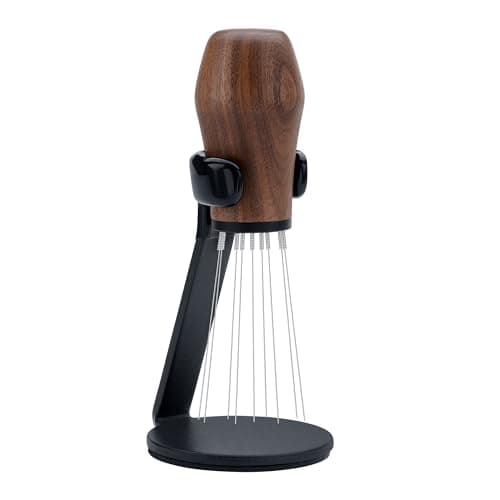
The most complete WDT tool here, and the one to buy if you want to stop thinking about distribution. Nine needle slots and two full swappable needle sets — a finer 0.25mm and a slightly stiffer 0.3mm — let you tune how aggressively it breaks up clumps, and the weighted walnut-topped stand keeps it planted and upright between shots. It is the most expensive pick, and the two-gauge flexibility is more nuance than a casual user strictly needs — but nothing else here feels this considered.

Best overall
8.4
$32.99Amazon
02
Normcore Normcore WDT Distribution Tool V2.1 (with Stand)
Normcore WDT Distribution Tool V2.1 (with Stand)

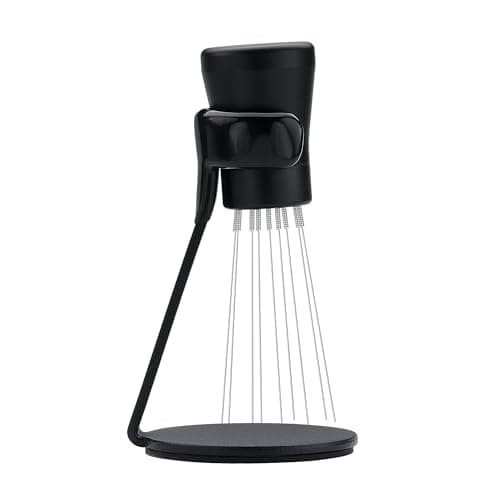
The distribution specialist. Eight ultra-thin 0.23mm needles slip between the finest particles and break the micro-clumps that coarser wires skate over, which makes for genuinely even distribution — and the magnetic handle plus a weighted stand and sixteen spare needles mean you are covered when one eventually gives out. Wires this fine bend more easily than 0.3-0.4mm ones if you are heavy-handed, so treat it gently.

Best fine-needle
8.2
$23.99Amazon
03
MATOW MATOW 6-Prong WDT Espresso Tool (Weighted Stand)
MATOW 6-Prong WDT Espresso Tool (Weighted Stand)

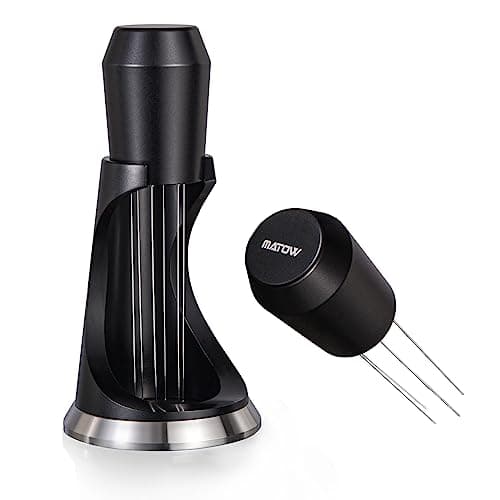
The pick if a solid, planted stand matters as much as the needles. Six 0.4mm 304 stainless needles on a CNC aluminum handle drop into a heavy self-aligning stainless base that doubles as a small catch tray, and the whole thing has a reassuringly quality feel. The trade-off is in the mixing: six thicker 0.4mm needles distribute a little more coarsely than the eight-to-ten-needle tools above it, favoring durability over ultra-fine work.

Best weighted stand
7.6
$27.99Amazon
04
Nessus Nessus WDT Espresso Distribution Tool (Brush + Stand)
Nessus WDT Espresso Distribution Tool (Brush + Stand)

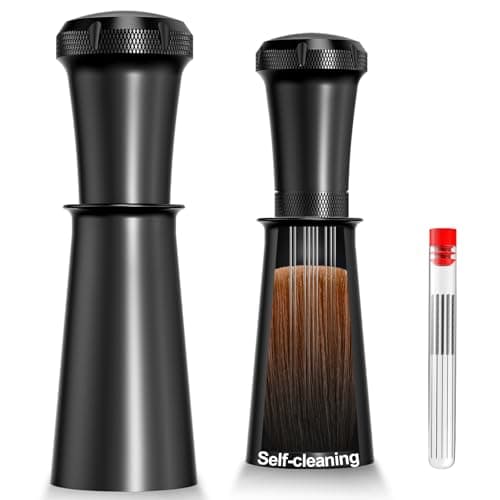
The clever-value option. Ten 0.35mm needles (with ten spares in a tube) sit in a stand with a built-in cleaning brush — you pull the needles through it to clear packed grounds, a genuinely useful touch — and the needle count is user-configurable from five to nine if you want to experiment. The catch is the base: its silicone-and-aluminum stand is lighter than a weighted metal one, so it feels slightly less planted on the counter.

Best value + brush
7.4
$9.99Amazon
05
Apexstone Apexstone WDT Tool (with Stand)
Apexstone WDT Tool (with Stand)

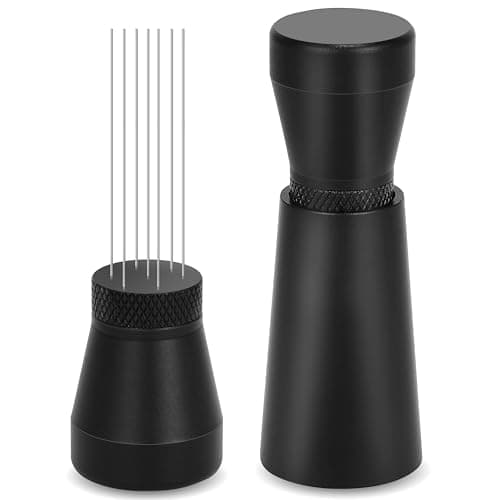
The honest budget entry point. Eight 0.4mm 304 stainless needles with deliberately blunted tips (so they will not tear a paper filter or puck screen), four spares, an adjustable needle count and an aluminum-alloy stand add up to a lot of tool for very little money. The 0.4mm wires sit at the thicker end of the range, so they break up clumps a shade less finely than a 0.3mm tool — but for a first WDT tool that is a fair trade.

Best budget
7.2
$9.99Amazon
06
MATOW MATOW Mini Stainless Steel WDT Tool
MATOW Mini Stainless Steel WDT Tool

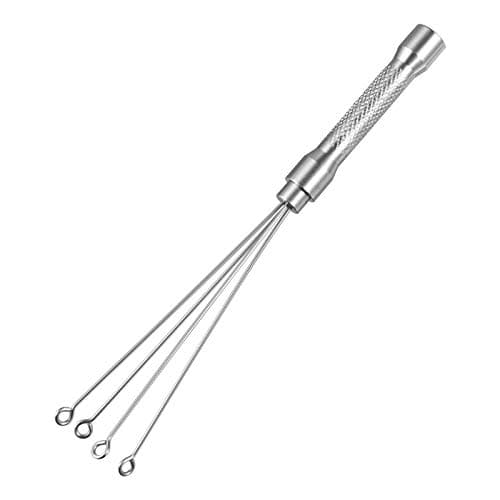
The one to throw in a bag. A one-piece 304 stainless needle whisk with no handle body and no stand, it is light, durable and near-indestructible — you simply fan the wires out to a couple of centimeters before use. It gives you less control than a weighted needle tool and the needles cannot be replaced, but for travel, or as a cheap way to try the technique, it does the core job.

Best for travel
6.6
$11.99Amazon

#ad · Live prices from the Amazon Product API, as of Jul 26, 2026. Where we have no verified live price, we show none — a gap beats a number that has rotted.

In detail

The picks, in full

01
Normcore Normcore WDT Distribution Tool V3 (with Stand)

Best overall

Normcore WDT Distribution Tool V3 (with Stand)

9 prong, swappable 0.25mm & 0.3mmAmerican walnut handle~80g weighted stand304 stainless needles
8.4/10

The most complete WDT tool here, and the one to buy if you want to stop thinking about distribution. Nine needle slots and two full swappable needle sets — a finer 0.25mm and a slightly stiffer 0.3mm — let you tune how aggressively it breaks up clumps, and the weighted walnut-topped stand keeps it planted and upright between shots. It is the most expensive pick, and the two-gauge flexibility is more nuance than a casual user strictly needs — but nothing else here feels this considered.

Distribution
9
Needle quality
9
Build
9
Ease of use
8
Value
7

Pros

  • Two swappable 304 stainless needle sets (0.25mm and 0.3mm) let you tune the distribution feel
  • Nine needles spread the stir evenly across the whole puck
  • Heavy ~80g weighted stand keeps it upright and planted between shots
  • Anodized-aluminum body and American walnut handle feel a clear cut above

Cons

  • The most expensive tool on this page
  • Two needle gauges is more nuance than a casual user really needs
  • Like any fine-needle tool, it adds a step to every shot

Don't buy this if…

you just want the cheapest thing that works — the Apexstone or MATOW Mini pull most of the same trick for a fraction of the outlay.

$32.99View on Amazon

Price as of Jul 26, 2026. Prices change — Amazon's at checkout is the one that counts.

#ad · we may earn a commission from this link to Normcore WDT Distribution Tool V3 (with Stand)

02
Normcore Normcore WDT Distribution Tool V2.1 (with Stand)

Best fine-needle

Normcore WDT Distribution Tool V2.1 (with Stand)

8 prong 0.23mm needlesMagnetic handle+16 spare needlesWeighted stand incl.
8.2/10

The distribution specialist. Eight ultra-thin 0.23mm needles slip between the finest particles and break the micro-clumps that coarser wires skate over, which makes for genuinely even distribution — and the magnetic handle plus a weighted stand and sixteen spare needles mean you are covered when one eventually gives out. Wires this fine bend more easily than 0.3-0.4mm ones if you are heavy-handed, so treat it gently.

Distribution
9
Needle quality
8
Build
8
Ease of use
8
Value
8

Pros

  • Ultra-fine 0.23mm needles break micro-clumps thicker tools skate over
  • Eight needles give even coverage across the basket
  • Ships with sixteen spare needles, so a bent wire is never a problem
  • Magnetic handle docks neatly to the included weighted stand

Cons

  • 0.23mm wires bend more easily than thicker needles if handled roughly
  • Single, non-swappable gauge — you are committed to very fine needles
  • Adds a step to every shot, like all WDT tools

Don't buy this if…

you are heavy-handed or want a do-everything tool you never have to baby — thicker 0.3-0.4mm needles on the MATOW or Apexstone survive rougher treatment.

$23.99View on Amazon

Price as of Jul 26, 2026. Prices change — Amazon's at checkout is the one that counts.

#ad · we may earn a commission from this link to Normcore WDT Distribution Tool V2.1 (with Stand)

03
MATOW MATOW 6-Prong WDT Espresso Tool (Weighted Stand)

Best weighted stand

MATOW 6-Prong WDT Espresso Tool (Weighted Stand)

6 × 0.4mm 304 stainless needlesAnodized aluminum handleWeighted stainless stand + tray110mm length
7.6/10

The pick if a solid, planted stand matters as much as the needles. Six 0.4mm 304 stainless needles on a CNC aluminum handle drop into a heavy self-aligning stainless base that doubles as a small catch tray, and the whole thing has a reassuringly quality feel. The trade-off is in the mixing: six thicker 0.4mm needles distribute a little more coarsely than the eight-to-ten-needle tools above it, favoring durability over ultra-fine work.

Distribution
7
Needle quality
7
Build
9
Ease of use
8
Value
7

Pros

  • Heavy self-aligning stainless stand feels planted and doubles as a catch tray
  • 0.4mm 304 stainless needles are stiff and shrug off rough handling
  • Anodized-aluminum CNC handle has a solid, weighty feel
  • Self-aligning base makes docking the tool between shots effortless

Cons

  • Only six needles, and thicker 0.4mm ones, so distribution is a touch coarser
  • No spare needles included in the box
  • Costs more than plainer tools that mix nearly as well

Don't buy this if…

your priority is the finest possible distribution — the 0.23mm Normcore V2.1 or a 0.35mm ten-needle tool will break micro-clumps this one leaves behind.

$27.99View on Amazon

Price as of Jul 26, 2026. Prices change — Amazon's at checkout is the one that counts.

#ad · we may earn a commission from this link to MATOW 6-Prong WDT Espresso Tool (Weighted Stand)

04
Nessus Nessus WDT Espresso Distribution Tool (Brush + Stand)

Best value + brush

Nessus WDT Espresso Distribution Tool (Brush + Stand)

10 × 0.35mm stainless needles+10 spare needlesStand with cleaning brushConfigurable 5-9 needles
7.4/10

The clever-value option. Ten 0.35mm needles (with ten spares in a tube) sit in a stand with a built-in cleaning brush — you pull the needles through it to clear packed grounds, a genuinely useful touch — and the needle count is user-configurable from five to nine if you want to experiment. The catch is the base: its silicone-and-aluminum stand is lighter than a weighted metal one, so it feels slightly less planted on the counter.

Distribution
8
Needle quality
7
Build
6
Ease of use
8
Value
8

Pros

  • Built-in cleaning brush in the stand clears packed grounds from the needles
  • Ten 0.35mm needles, a well-judged middle gauge, plus ten spares
  • Needle count configurable from five to nine to suit your dose
  • Strong all-round value for everything in the box

Cons

  • Silicone-and-aluminum stand is lighter and less planted than a metal one
  • 0.35mm needles are less fine than the 0.23-0.25mm premium tools
  • Reconfiguring the needle count is fiddly the first time

Don't buy this if…

you want the most stable, planted stand on the counter — the weighted stainless base on the MATOW 6-Prong is the more solid option.

$9.99View on Amazon

Price as of Jul 26, 2026. Prices change — Amazon's at checkout is the one that counts.

#ad · we may earn a commission from this link to Nessus WDT Espresso Distribution Tool (Brush + Stand)

05
Apexstone Apexstone WDT Tool (with Stand)

Best budget

Apexstone WDT Tool (with Stand)

8 × 0.4mm 304 needles+4 spare needlesAluminum-alloy standBlunted needle tips
7.2/10

The honest budget entry point. Eight 0.4mm 304 stainless needles with deliberately blunted tips (so they will not tear a paper filter or puck screen), four spares, an adjustable needle count and an aluminum-alloy stand add up to a lot of tool for very little money. The 0.4mm wires sit at the thicker end of the range, so they break up clumps a shade less finely than a 0.3mm tool — but for a first WDT tool that is a fair trade.

Distribution
7
Needle quality
7
Build
7
Ease of use
7
Value
8

Pros

  • Blunted needle tips will not tear paper filters or puck screens
  • Includes four spare needles and an aluminum-alloy stand
  • Needle count is adjustable by removing pins
  • A genuinely capable tool for very little money

Cons

  • 0.4mm needles are at the thicker end, so the mixing is less fine
  • Aluminum-alloy stand is lighter than a weighted metal base
  • Only four spares, versus the ten-plus on some rivals

Don't buy this if…

you want the finest distribution money can buy — step up to the 0.23mm Normcore V2.1 or the swappable-gauge V3.

$9.99View on Amazon

Price as of Jul 26, 2026. Prices change — Amazon's at checkout is the one that counts.

#ad · we may earn a commission from this link to Apexstone WDT Tool (with Stand)

06
MATOW MATOW Mini Stainless Steel WDT Tool

Best for travel

MATOW Mini Stainless Steel WDT Tool

304 stainless needle whisk~14cm long, ~28gNo stand (compact/travel)Fan-out prongs
6.6/10

The one to throw in a bag. A one-piece 304 stainless needle whisk with no handle body and no stand, it is light, durable and near-indestructible — you simply fan the wires out to a couple of centimeters before use. It gives you less control than a weighted needle tool and the needles cannot be replaced, but for travel, or as a cheap way to try the technique, it does the core job.

Distribution
6
Needle quality
6
Build
7
Ease of use
6
Value
8

Pros

  • Tiny (~14cm, ~28g) and near-indestructible — ideal for a travel kit
  • One-piece 304 stainless, with nothing to loosen or lose
  • The cheapest way to try the technique
  • No stand to store or knock over

Cons

  • No stand, so it rolls loose on the counter
  • The needles are fixed and cannot be replaced
  • Fanning the wires out by hand gives less control than a weighted tool
  • Fixed whisk offers no gauge or needle-count options

Don't buy this if…

this is your only, everyday WDT tool at home — a weighted needle tool with a stand is more controlled and more pleasant to use every morning.

$11.99View on Amazon

Price as of Jul 26, 2026. Prices change — Amazon's at checkout is the one that counts.

#ad · we may earn a commission from this link to MATOW Mini Stainless Steel WDT Tool

How we picked

Every tool here is a real, currently-purchasable WDT tool you can buy in the US, and every needle spec below is taken from the maker's own listing. We ranked on five things, in this order.

  1. Distribution. The whole job of a WDT tool is to break up clumps and even out the grounds, and that comes down to how many needles it has and how fine they are. Eight to ten fine needles mix more thoroughly than six thick ones.
  2. Needle quality and durability. Fine wires distribute better but bend more easily. We weighed how fine the needles are against how well they survive daily, slightly-careless use — and whether spare needles are in the box for when one finally gives out.
  3. The stand. A weighted stand that holds the tool upright between shots is the difference between a tool you use every morning and one that rolls under the grinder and gets forgotten. Heavier, self-aligning stands score higher than light ones.
  4. Ease of use and feel. Handle comfort, how cleanly the needles clear grounds, and small touches like a built-in cleaning brush or blunted tips that will not tear a paper filter.
  5. Value. This is a cheap category, so value is less about the lowest price than about what you get for it — spare needles, a solid stand, swappable gauges — versus what you actually need.

We did not lab-test these tools; we do not run a lab. The scores are editorial judgments built from published manufacturer specs and aggregated owner reports, and our methodology pagespells out exactly how. Specifications come from the makers' own product pages, listed in Sources.

Needle gauge, count and why they matter

Needle gauge is the single number that separates these tools, and it runs from about 0.2mm to 0.4mm. Think of it as a trade-off with no free lunch. A fine 0.2-0.25mm needle slides between individual coffee particles and breaks up the micro-clumps a grinder throws off, which is where truly even distribution comes from — the finest tools here, like the 0.23mm Normcore V2.1, live at this end. The cost is fragility: wires this thin bend if you stab the puck or knock them against the basket, and a bent needle drags a groove through the grounds instead of stirring them.

A thicker 0.35-0.4mm needle is stiffer and near-impossible to bend in normal use, so it shrugs off rough handling and lasts for years — but it mixes a little more coarsely, because a fatter wire cannot chase the smallest clumps. Most of the sturdier picks here, like the MATOW and Apexstone tools, sit at 0.4mm. Needle count matters too: more needles (eight to ten) cover the basket in fewer passes and distribute more evenly, while fewer needles (six) are faster to wipe clean but leave more of the work to your stirring hand. There is no single right answer — a fine-needle tool if you are careful and want the best distribution, a thicker one if you want a tool you never have to baby.

WDT vs distribution and leveling tools

This trips up a lot of first-time buyers, because the words sound interchangeable and the tools are not. A WDT tool uses needles that reach down into the grounds and redistribute them through the whole depth of the puck, breaking clumps as they go — that is what actually prevents channeling. A spinning distributor or leveler (the flat disc you twist on top of the basket) only touches and flattens the top surface; it makes the puck look neat but does nothing about the clumps buried underneath, which are exactly what the water finds and channels around. If you are choosing one tool to fix uneven, spraying shots, it is the WDT tool every time — a leveler is a cosmetic finisher you can add later, not a substitute.

None of this replaces the two things upstream of distribution: a decent grinder and the right grind size. A WDT tool evens out what the grinder gives you; it cannot fix a grinder that clumps horribly or a grind that is flat-out too coarse. If your shots are still poor after you distribute and tamp well, the problem is upstream — start with the grinder, then the beans, then technique.

What we would skip

Anything expensive. This is the one espresso upgrade where spending more buys you very little. The premium picks here justify their price with swappable gauges and nicer materials, not with better coffee — a careful stir with a cheap set of needles distributes just as well as a stir with an expensive one. Pressurized-basket owners, mostly skip it for now. Dual-wall baskets mask distribution by design, so a WDT tool earns its keep once you move to single-wall baskets; if you are still on the ones that came with an entry machine, put the money toward a proper tamper first. And skip treating the tool as a fix for a bad grinder. WDT evens out clumps; it does not turn a clumpy, inconsistent grinder into a good one, and no amount of stirring rescues stale, pre-ground coffee.

Which WDT tool fits you

  • Want the best tool and do not mind paying for it? Normcore WDT V3, with two swappable needle gauges and a weighted walnut stand.
  • Chasing the most even distribution? Normcore V2.1 and its ultra-fine 0.23mm needles — just handle them gently.
  • Want a heavy, planted stand you never chase around the counter? MATOW 6-Prong, with its weighted stainless base.
  • Want the most in the box for the money? Nessus, with ten needles, ten spares and a built-in cleaning brush.
  • On a tight budget? Apexstone — a genuinely capable tool for very little, with blunted filter-safe tips.
  • Need one for a travel or office kit? MATOW Mini — no stand, nothing to break, throw it in a bag.

Whichever you land on, remember the order of operations: a WDT tool finishes a good setup, it does not create one. Sort the grinder and fresh espresso beans first, then let the needles do the last, cheapest ten percent that makes every shot repeatable.
How we picked

We did not lab-test this gear

Everyone in this category says they tested twenty machines. We have not pulled shots on every product here, and we say so. What we did instead: compiled the published specifications, cross-checked the manufacturer manuals, computed the running cost (wattage to energy, grams-per-shot to cost-per-cup), weighed aggregated owner reports, and scored each product against a published rubric. The scores are judgments from documented research — not measurements we took, because we do not have a test lab and we will not pretend we do. Where hands-on time would tell you more than a spec sheet, we flag it. Where a number came from someone else's work, we name them in Sources.

Questions

Frequently asked

What does a WDT tool do?
A WDT tool is a set of fine needles you stir through the dry coffee grounds in the basket before you tamp. Coffee comes out of a grinder in clumps, and clumps make water flow unevenly through the puck — a fault called channeling. Stirring with the needles breaks up those clumps and spreads the grounds evenly, so the water passes through a uniform bed and the shot extracts evenly instead of running sour, fast or lopsided. It takes about ten seconds and is one of the cheapest upgrades in home espresso.
Does a WDT tool really make a difference?
For most people, yes — it is often the single biggest improvement you can make short of a better grinder. If your shots spray from a bottomless portafilter, taste sharp on one side, or gush out in well under twenty seconds, the cause is almost always uneven distribution, and a WDT tool fixes exactly that. It matters most with single-wall (non-pressurized) baskets; pressurized dual-wall baskets mask distribution, so the benefit is smaller there. It will not rescue a bad grinder or stale coffee, though — it evens out good grounds, it does not create them.
What needle thickness should I get?
Somewhere between 0.2mm and 0.4mm, and the choice is a trade-off. Finer needles (around 0.23-0.25mm) break up the smallest clumps and distribute more evenly, but they bend more easily if you are rough with them. Thicker needles (0.35-0.4mm) mix a little more coarsely but are far more durable and hard to bend. If you want the best distribution and will handle the tool carefully, go fine; if you want something near-indestructible you never have to think about, go thicker. Needle count matters too — eight to ten needles cover the basket more evenly than six.
What is the difference between a WDT tool and a distributor or leveler?
They do different jobs. A WDT tool uses needles that reach down into the grounds and redistribute them through the full depth of the puck, breaking up clumps — which is what actually stops channeling. A spinning distributor or leveler only flattens and lightly compresses the top surface; it tidies the puck's appearance but leaves the clumps underneath untouched. For fixing uneven, spraying shots you want the WDT tool. A leveler is an optional cosmetic finisher, and it works best after you have already dialed in your grind size.
Do you need the stand that comes with it?
You do not strictly need it, but it is worth having. A weighted stand holds the tool upright between shots so the needles are not resting in coffee grounds or rolling off the counter, and in practice a tool that has a home is a tool you keep using. If you buy a standless tool like the MATOW Mini for travel, it works exactly the same — you just have to find somewhere to put it down. For an everyday tool at home, a stand is a small convenience that makes the whole routine tidier.

Keep reading

Receipts

Sources

We do not run a testing lab, and we do not pretend to. Where a measured number came from someone else's work, we name them and link them. Where we could not verify something, we say so on the page rather than quietly leaving it out. Read our full method.