Skip to content
Portafilter Co

Accessories & Tools · Espresso Accessories

The best espresso machine cleaning and descaling kits

Six cleaners, descalers and maintenance kits ranked on how well they do the two jobs a home espresso machine actually needs — with a plain explanation of why cleaning and descaling are not the same thing, and how to avoid using the wrong product.

By Stephen V.Updated How we pick
#ad

We earn a commission when you buy through our Amazon links, at no extra cost to you. It never changes a verdict, and we say so when the cheaper product is the better buy. How this works.

Two jobs keep a home espresso machine alive, and almost everyone conflates them. The first is cleaning: every shot leaves coffee oils behind in the group head, the shower screen and the portafilter, and left alone those oils go rancid and turn the next shot bitter. You remove them by backflushing — running water back through the group with a detergent tablet or powder sitting in a blind basket — and by scrubbing the parts a backflush cannot reach. The second is descaling: the water you brew with leaves mineral scale inside the boiler and on the heating element, and that scale slowly chokes flow and, eventually, kills the machine. You remove it with an acid descaler run through the water tank. Different problem, different chemical, different part of the machine — and reaching for the wrong one does nothing at best.

That distinction is the entire point of this page. A cleaning tablet will not touch limescale in your boiler, and a descaler will not clear coffee oils from your group head. Plenty of people buy one product, assume their machine is "maintained," and are quietly neglecting half the job. So we split the field honestly: the picks below include dedicated backflush cleaners, dedicated descalers, brand-matched options and an all-in-one kit, and we say clearly which job each one does. Most home setups end up owning a cleaner anda descaler — they are cheap, they last for months, and together they are the difference between a machine that lasts five years and one that lasts fifteen.

One caveat before the list, because it trips people up: backflushing only works on machines built for it — those with a three-way solenoid valve, which covers most pump machines but not every thermoblock or entry model. It also needs a blind basket (a blank basket with no holes) so the detergent and water pressure stay in the group instead of draining out. Many machines ship with one; some kits add one; and a bottomless portafilter cannot backflush at all, because there is nothing to seal the water in. If you are still learning the mechanics of a shot, our guide to pulling espresso explains where those oils come from, and the accessories starter kit puts routine cleaning in context with the rest of the gear.

The short answer

Quick picks

#ProductBest forScorePrice
01
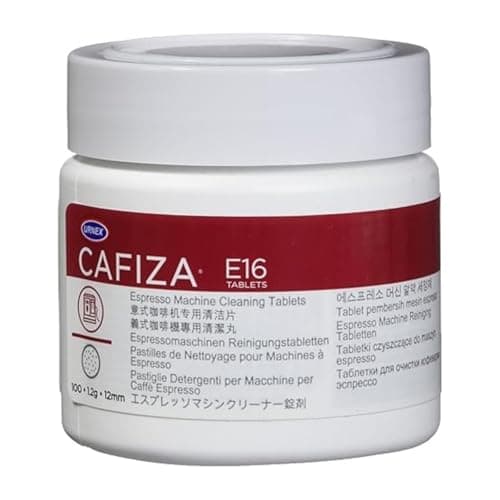
Urnex Urnex Cafiza Espresso Machine Cleaning Tablets (100 ct)
Urnex Cafiza Espresso Machine Cleaning Tablets (100 ct)

The detergent tablet you will find behind the counter of half the cafes you walk into, in a home-sized tub that lasts most people the better part of a year. Drop one in a blind basket, run a few backflush cycles, and it dissolves the coffee oils out of the group head, shower screen and portafilter that a rinse leaves behind. It is odorless and tasteless once rinsed, food-safe, and the 100-count tub makes it the best value cleaner here by a wide margin. This is the backflush cleaner to buy unless your machine specifically calls for its own.

Best overall cleaner
8.8
$17.99Amazon
02
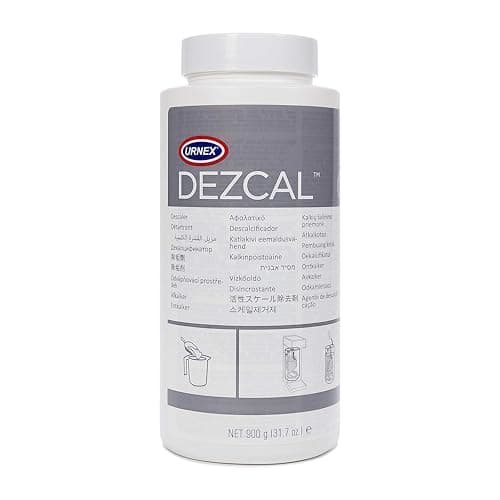
Urnex Urnex Dezcal Coffee & Espresso Descaler (900g)
Urnex Dezcal Coffee & Espresso Descaler (900g)

The companion to the Cafiza above, and the descaler most home baristas settle on. It is a food-safe activated powder you dissolve in water and run through the tank to strip limescale off the boiler and heating element — the job a cleaner cannot do. It is universal, so it works on most drip brewers and espresso machines, it rinses far more cleanly than vinegar, and the big resealable tub descales a home machine many times over. Different job from the Cafiza, but every bit as essential to owning one product for each.

Best descaler
8.4
$29.98Amazon
03
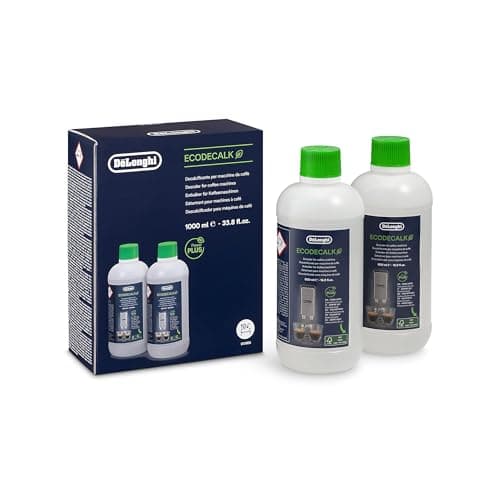
De'Longhi De'Longhi EcoDecalk Descaler (2-pack)
De'Longhi EcoDecalk Descaler (2-pack)

The convenient descaler for anyone with a pump or bean-to-cup machine that runs its own descale cycle. It is a liquid, plant-derived (lactic-acid) universal descaler that De'Longhi recommends across its range, and the two-pack means you pour a dose, start the cycle and you are done — no measuring powder. It is not exclusive to De'Longhi machines, but it is the easiest match for them and for the super-automatics that prompt you to descale. You pay a little more per descale than a bulk powder for that convenience and the eco-friendly formula.

Best for pump & bean-to-cup machines
8.0
$29.80Amazon
04
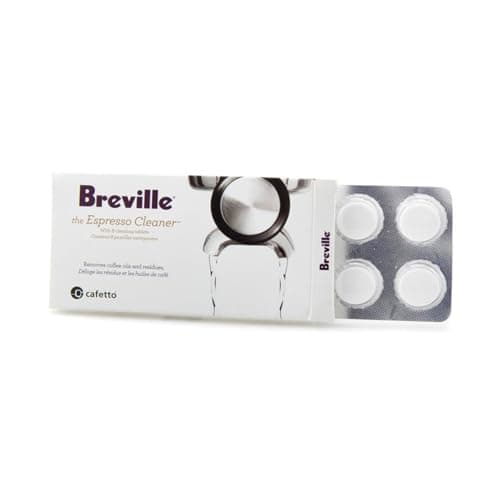
Breville Breville BEC250 Espresso Cleaning Tablets (8 pack)
Breville BEC250 Espresso Cleaning Tablets (8 pack)

The OEM cleaning tablet sized for Breville's automatic cleaning cycle. If you own a Barista-series machine, it prompts you to run a clean and expects a tablet that fits its cleaning disc — and this is the one Breville makes for it. It is the no-guesswork choice: right size, right dose, and it removes coffee residue from the shower screen and baskets exactly as the machine intends. You pay for the badge and the small eight-pack, so a generic tablet is cheaper per clean, but this removes any doubt about fit.

Best for Breville machines
7.4
$11.98Amazon
05
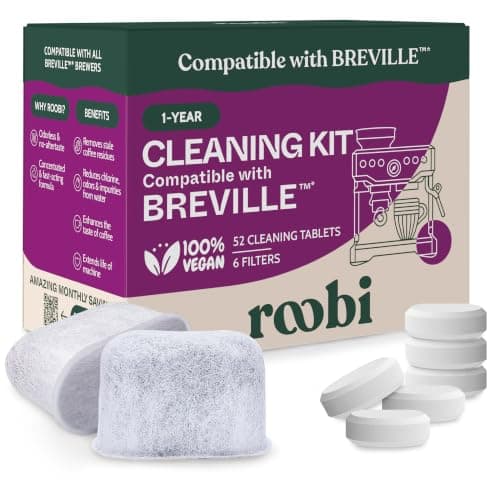
Roobi Roobi Breville-Compatible Cleaning & Maintenance Kit
Roobi Breville-Compatible Cleaning & Maintenance Kit

The one-box answer for a Breville owner who does not want to think about it. This bundle gathers the pieces of routine maintenance — cleaning tablets, descaling solution and a brush plus cleaning disc — aimed at Barista-series machines, so you get both jobs handled in a single purchase. The trade-off is that it is third-party compatible rather than OEM, and buying components separately can work out cheaper. But if you want cleaning and descaling and the tools together, and you value not researching each one, this is the tidy choice.

Best all-in-one kit
7.2
$29.99Amazon
06
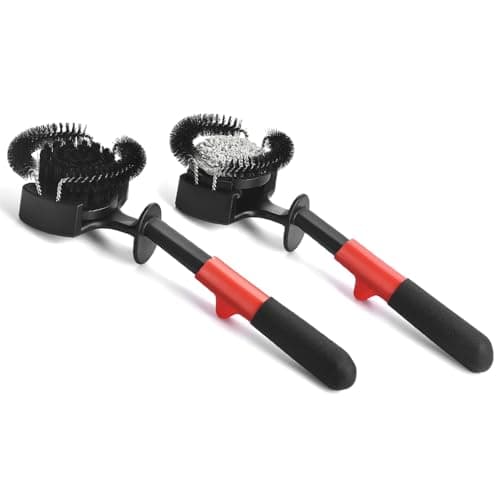
CAFEMASY CAFEMASY Grouphead Cleaning Brush (58mm, 2-pack)
CAFEMASY Grouphead Cleaning Brush (58mm, 2-pack)

Not a chemical at all, but the cheap tool that keeps everything else clean between deep cleans. It is a heat-resistant nylon brush with an angled head sized for a 58mm group, and it scrubs the shower screen, the group gasket and the grinder in the daily thirty seconds a backflush does not cover. On its own it will not clear oils the way a detergent does, and it does nothing for scale, but every setup should own one — and at this price, buying the two-pack is a non-decision.

Best detail brush
7.0
$19.99Amazon

#ad · Live prices from the Amazon Product API, as of Jul 26, 2026. Where we have no verified live price, we show none — a gap beats a number that has rotted.

In detail

The picks, in full

01
Urnex Urnex Cafiza Espresso Machine Cleaning Tablets (100 ct)

Best overall cleaner

Urnex Cafiza Espresso Machine Cleaning Tablets (100 ct)

Backflush detergent tablets100-count tub (long supply)Cleans group head, portafilter & basketsOdorless, food-safe, rinses clean
8.8/10

The detergent tablet you will find behind the counter of half the cafes you walk into, in a home-sized tub that lasts most people the better part of a year. Drop one in a blind basket, run a few backflush cycles, and it dissolves the coffee oils out of the group head, shower screen and portafilter that a rinse leaves behind. It is odorless and tasteless once rinsed, food-safe, and the 100-count tub makes it the best value cleaner here by a wide margin. This is the backflush cleaner to buy unless your machine specifically calls for its own.

Effectiveness
9
Ease of use
9
Compatibility
9
Value
9
Safety
8

Pros

  • The barista-standard backflush detergent — the same chemistry cafes trust, so it genuinely clears built-up coffee oils
  • Enormous 100-count tub is the cheapest per-clean cost on this page and lasts a home user close to a year
  • Odorless and tasteless once rinsed, so it never taints the next shot
  • Works in any backflush-capable machine — it is not tied to one brand or model
  • Tablet form is mess-free and pre-dosed, so you are not guessing at a scoop of powder

Cons

  • Cleans only — it does nothing for limescale, so you still need a separate descaler
  • Needs a backflush-capable machine and a blind basket to use as intended
  • The 100-count tub is more than a light user will get through before it is worth restocking

Don't buy this if…

your machine cannot backflush, or you were hoping one product would handle scale too — this is a dedicated cleaner and you will still need a descaler alongside it.

$17.99View on Amazon

Price as of Jul 26, 2026. Prices change — Amazon's at checkout is the one that counts.

#ad · we may earn a commission from this link to Urnex Cafiza Espresso Machine Cleaning Tablets (100 ct)

02
Urnex Urnex Dezcal Coffee & Espresso Descaler (900g)

Best descaler

Urnex Dezcal Coffee & Espresso Descaler (900g)

Activated descaling powder900g resealable tub (many descales)Strips scale from boiler & heating elementUniversal — most coffee & espresso machines
8.4/10

The companion to the Cafiza above, and the descaler most home baristas settle on. It is a food-safe activated powder you dissolve in water and run through the tank to strip limescale off the boiler and heating element — the job a cleaner cannot do. It is universal, so it works on most drip brewers and espresso machines, it rinses far more cleanly than vinegar, and the big resealable tub descales a home machine many times over. Different job from the Cafiza, but every bit as essential to owning one product for each.

Effectiveness
9
Ease of use
8
Compatibility
9
Value
8
Safety
8

Pros

  • Purpose-built to dissolve mineral scale off boilers and elements — the half of maintenance a cleaner ignores
  • Food-safe activated formula rinses out cleanly, without the lingering smell and taste vinegar leaves behind
  • Universal across most brewers and espresso machines, so one tub covers a whole kitchen of gear
  • The large tub works out very cheap per descale and lasts a home user a long time

Cons

  • Descales only — it will not clear coffee oils, so it is the partner to a cleaner, not a replacement
  • Powder means measuring and dissolving rather than a pre-dosed pod
  • Always check your manual first — a few machines specify their own descaler and can void warranty otherwise

Don't buy this if…

your manufacturer mandates a specific branded descaler for warranty, or you would rather run a pre-measured liquid dose than mix a powder — a single-dose liquid suits you better.

$29.98View on Amazon

Price as of Jul 26, 2026. Prices change — Amazon's at checkout is the one that counts.

#ad · we may earn a commission from this link to Urnex Dezcal Coffee & Espresso Descaler (900g)

03
De'Longhi De'Longhi EcoDecalk Descaler (2-pack)

Best for pump & bean-to-cup machines

De'Longhi EcoDecalk Descaler (2-pack)

Liquid universal descalerPlant-derived, eco-friendly formula2-pack of dosesSuits pump & super-automatic descale cycles
8.0/10

The convenient descaler for anyone with a pump or bean-to-cup machine that runs its own descale cycle. It is a liquid, plant-derived (lactic-acid) universal descaler that De'Longhi recommends across its range, and the two-pack means you pour a dose, start the cycle and you are done — no measuring powder. It is not exclusive to De'Longhi machines, but it is the easiest match for them and for the super-automatics that prompt you to descale. You pay a little more per descale than a bulk powder for that convenience and the eco-friendly formula.

Effectiveness
8
Ease of use
9
Compatibility
8
Value
7
Safety
8

Pros

  • Pre-measured liquid pours straight in — the least-fuss way to run a machine's built-in descale cycle
  • Plant-based lactic-acid formula is gentler on the environment than harsh traditional descalers
  • The descaler De'Longhi recommends for its own machines, so it is the no-argument choice for warranty peace of mind
  • Universal formula still works on most other pump and bean-to-cup brewers

Cons

  • Costs more per descale than a bulk powder tub, so it is convenience over outright value
  • A two-pack does not last nearly as long as a large powder tub
  • Like any descaler it does nothing for coffee oils — you still clean separately

Don't buy this if…

you want the lowest possible cost per descale over years — a big powder tub is cheaper — or your machine cannot run an automatic descale cycle and you would rather control the soak yourself.

$29.80View on Amazon

$35.9517% off

Price as of Jul 26, 2026. Prices change — Amazon's at checkout is the one that counts.

#ad · we may earn a commission from this link to De'Longhi EcoDecalk Descaler (2-pack)

04
Breville Breville BEC250 Espresso Cleaning Tablets (8 pack)

Best for Breville machines

Breville BEC250 Espresso Cleaning Tablets (8 pack)

OEM Breville cleaning tablets8 tablets per packSized for the cleaning cycle & discBackflush detergent (not a descaler)
7.4/10

The OEM cleaning tablet sized for Breville's automatic cleaning cycle. If you own a Barista-series machine, it prompts you to run a clean and expects a tablet that fits its cleaning disc — and this is the one Breville makes for it. It is the no-guesswork choice: right size, right dose, and it removes coffee residue from the shower screen and baskets exactly as the machine intends. You pay for the badge and the small eight-pack, so a generic tablet is cheaper per clean, but this removes any doubt about fit.

Effectiveness
8
Ease of use
9
Compatibility
6
Value
6
Safety
8

Pros

  • Sized and dosed for Breville's automatic cleaning cycle and cleaning disc, so there is zero guesswork on fit
  • The manufacturer's own tablet — the safest answer to a Barista-series clean prompt
  • Clears coffee oils from the shower screen and baskets just as the machine expects
  • Simple pre-dosed tablets, no measuring

Cons

  • Small eight-pack costs more per clean than a big generic tub of tablets
  • Cleans only — Breville machines still need a separate descale, which this does not do
  • Only really worth the premium if you own a Breville that prompts for a cleaning cycle

Don't buy this if…

you do not own a Breville, or you want the lowest cost per clean — a 100-count generic cleaning tablet does the same job for less on any backflush-capable machine.

$11.98View on Amazon

$14.9520% off

Price as of Jul 26, 2026. Prices change — Amazon's at checkout is the one that counts.

#ad · we may earn a commission from this link to Breville BEC250 Espresso Cleaning Tablets (8 pack)

05
Roobi Roobi Breville-Compatible Cleaning & Maintenance Kit

Best all-in-one kit

Roobi Breville-Compatible Cleaning & Maintenance Kit

All-in-one cleaning + descaling bundleIncludes tablets, descaler & brush/discAimed at Breville Barista-series machinesThird-party compatible (not OEM)
7.2/10

The one-box answer for a Breville owner who does not want to think about it. This bundle gathers the pieces of routine maintenance — cleaning tablets, descaling solution and a brush plus cleaning disc — aimed at Barista-series machines, so you get both jobs handled in a single purchase. The trade-off is that it is third-party compatible rather than OEM, and buying components separately can work out cheaper. But if you want cleaning and descaling and the tools together, and you value not researching each one, this is the tidy choice.

Effectiveness
7
Ease of use
8
Compatibility
6
Value
8
Safety
7

Pros

  • Covers both jobs in one box — cleaning and descaling supplies plus the tools, so nothing is missing
  • Includes the cleaning disc and brush a Breville clean cycle wants, which loose tablets do not
  • The simplest single purchase for a new Breville owner who does not want to assemble a kit piece by piece
  • Reasonable value for a bundle versus buying every component on its own

Cons

  • Third-party compatible rather than Breville OEM, which some owners prefer to avoid on a warranty
  • Buying a big tub of cleaner and a separate descaler outright can be cheaper over time
  • Bundle contents are fixed, so you may end up with more or less of one part than you use
  • Geared to Breville — less relevant if you own another brand

Don't buy this if…

you insist on OEM supplies, or you already own a machine that is not a Breville — a dedicated cleaner plus a universal descaler covers you for less and fits anything.

$29.99View on Amazon

Price as of Jul 26, 2026. Prices change — Amazon's at checkout is the one that counts.

#ad · we may earn a commission from this link to Roobi Breville-Compatible Cleaning & Maintenance Kit

06
CAFEMASY CAFEMASY Grouphead Cleaning Brush (58mm, 2-pack)

Best detail brush

CAFEMASY Grouphead Cleaning Brush (58mm, 2-pack)

Grouphead cleaning brush58mm angled head, 2-packHeat-resistant nylon bristlesFor group head, shower screen & grinder
7.0/10

Not a chemical at all, but the cheap tool that keeps everything else clean between deep cleans. It is a heat-resistant nylon brush with an angled head sized for a 58mm group, and it scrubs the shower screen, the group gasket and the grinder in the daily thirty seconds a backflush does not cover. On its own it will not clear oils the way a detergent does, and it does nothing for scale, but every setup should own one — and at this price, buying the two-pack is a non-decision.

Effectiveness
6
Ease of use
8
Compatibility
8
Value
8
Safety
5

Pros

  • The cheapest maintenance buy here and the one nearly every setup should own
  • Heat-resistant nylon lets you scrub the group head and gasket while they are still warm and oils wipe off easily
  • Angled 58mm head reaches the shower screen edge and works on the grinder burrs and chute too
  • Two-pack means a spare, or one for the machine and one for the grinder

Cons

  • A tool, not a cleaner — it cannot dissolve oils the way a detergent tablet does
  • Does nothing for limescale; it is purely a scrubbing brush
  • Nylon bristles wear down over time and eventually need replacing

Don't buy this if…

you expect it to replace a backflush or a descale — it complements them, it does not stand in for either, and a setup still needs a cleaner and a descaler.

$19.99View on Amazon

Price as of Jul 26, 2026. Prices change — Amazon's at checkout is the one that counts.

#ad · we may earn a commission from this link to CAFEMASY Grouphead Cleaning Brush (58mm, 2-pack)

How we picked

Maintenance products are the definition of "boring but load-bearing" — they never touch your cup directly, but neglecting them ruins both the coffee and the machine. We judged every product below on how well it does its stated job and how easy it is to live with, on five criteria.

  1. Effectiveness at the job.A cleaner has to actually strip coffee oils; a descaler has to actually dissolve scale. We weighted this most, using each product's published chemistry and the aggregated experience of owners who use it on a schedule.
  2. Ease of use.A pre-dosed tablet or single-shot liquid you pour and forget beats a powder you have to measure and dissolve — especially for a chore people skip when it is fiddly. Convenience matters because the easiest routine is the one you keep.
  3. Compatibility. A universal formula that works across brewers and machines is worth more than one tied to a single brand. We noted where a product is OEM or brand-specific, and where your manual might mandate its own.
  4. Value. Cost per clean or per descale, not the sticker price. A big tub that lasts a year is cheaper in the long run than a small pack you rebuy monthly, and we said so plainly.
  5. Safety. Food-safe, rinses clean, and gentle on the machine. This is where we flag the vinegar problem and the descaler-your-manual-specifies rule below.

What we didn't test.We did not run these chemicals through a boiler in a lab — we have no lab, and we will never pretend otherwise. There is no measured scale weight, no timed dissolve test, no before-and-after descaling of a heating element here. Our scores are compiled from published manufacturer information (formulation, dosing, stated compatibility) and the aggregated reports of owners who use these products on a maintenance schedule, exactly as our methodology describes. Treat them as an informed buying steer, not a laboratory result.

Cleaning vs descaling — they are different

If you take one thing from this page, take this. Cleaning deals with coffee: the oils and fine grounds that build up on the group head, shower screen, gaskets and portafilter every time you pull a shot. Those oils go rancid within days and make espresso taste bitter and stale. You remove them by backflushing— putting a detergent tablet or a scoop of cleaning powder in a blind basket and letting the machine push hot water back through the group in short bursts — and by brushing the parts a backflush cannot reach. Cafiza tablets, the Breville OEM tablets and the grouphead brush all live in this category.

Descaling deals with water: the calcium and magnesium in your tap water precipitate out as hard mineral scale (limescale) inside the boiler and on the heating element every time the machine heats up. Scale insulates the element, chokes water flow, and if you ignore it long enough it blocks the machine solid. You remove it with an acid descaler— Dezcal powder or EcoDecalk liquid here — dissolved in water and run through the tank on a descale cycle or a manual soak. A cleaner will not touch scale, and a descaler will not touch coffee oils. They are two chores with two products, and a well-kept machine gets both.

The honest caveat: use the descaler your machine's manual specifies. Most manuals are happy with a universal descaler like Dezcal or EcoDecalk, but some — particularly super-automatics — mandate their own brand and can technically void a warranty otherwise, so read it first. And never descale with vinegar on a machine with an aluminium boiler(common in older and budget machines): acetic acid attacks aluminium, and even where it is "safe," vinegar is a weak descaler that rinses badly and leaves a smell and taste behind for days. A purpose-made descaler is a few dollars and does the job properly — there is no good reason to gamble your boiler on the pantry.

How often should you clean and descale?

The two jobs run on very different clocks. Backflushingis frequent and quick: a plain-water backflush after a busy session or at the end of the day keeps the group clear, and a detergent backflush — the one with a tablet in the blind basket — once a week for a daily drinker keeps oils from ever building up. A quick pass over the shower screen and gasket with the brush belongs in the same weekly ten minutes.

Descalingis occasional and depends entirely on your water. Soft water might need it a couple of times a year; hard water can need it every month or two, and many machines will simply tell you with a descale light or prompt once they have counted enough brews. If you are on hard water and want to descale far less often, a water filter or bottled/filtered water in the tank slows scale dramatically — it is the single biggest thing you can do to stretch the interval. When in doubt, descale a little more often rather than less; scale is far easier to prevent than to remove once it has set hard.

Do you need a blind basket?

To backflush with detergent, yes. A blind (blank) basketis a portafilter basket with no holes: it traps the cleaning solution and lets water pressure build and push back through the group's three-way valve, which is what actually flushes the oils out. Many machines include one in the box, and some maintenance kits add one; if yours did not, they are cheap to buy for your basket size. Note that a bottomless portafilter cannot be used to backflush — it has no basket seal to hold the water — so keep your standard spouted portafilter and a blind basket for cleaning day. And remember backflushing only applies to machines with a three-way solenoid valve; if your machine does not have one, you clean the parts by hand and skip the backflush entirely.

Which cleaning kit fits you

  • Want the one cleaner everyone trusts?Urnex Cafiza tablets — barista-standard, huge value, works on any backflush-capable machine.
  • Need to deal with scale?Urnex Dezcal powder — the universal descaler that pairs with the Cafiza to cover both jobs.
  • Have a pump or bean-to-cup machine with a descale cycle?De'Longhi EcoDecalk — pour a liquid dose, run the cycle, done.
  • Own a Breville that prompts you to clean?The BEC250 OEM tablets — sized for the cleaning disc, no guesswork.
  • Want everything in one box?The Roobi Breville-compatible kit — cleaning, descaling and tools together, if you value not assembling it yourself.
  • Just need the daily tool?The CAFEMASY grouphead brush — cheap, and every setup should own one alongside a cleaner and a descaler.

For most people the honest answer is a two-item shopping list: a tub of cleaning tablets and a descaler, plus a brush if you do not already have one. That covers both jobs on almost any machine for less than the price of a bag of good beans. If you are still building out the rest of the setup, our accessories starter kit shows where maintenance fits, and if you are choosing the machine itself, the best espresso machines under $500 roundup flags which models backflush and which need hand-cleaning.

How we picked

We did not lab-test this gear

Everyone in this category says they tested twenty machines. We have not pulled shots on every product here, and we say so. What we did instead: compiled the published specifications, cross-checked the manufacturer manuals, computed the running cost (wattage to energy, grams-per-shot to cost-per-cup), weighed aggregated owner reports, and scored each product against a published rubric. The scores are judgments from documented research — not measurements we took, because we do not have a test lab and we will not pretend we do. Where hands-on time would tell you more than a spec sheet, we flag it. Where a number came from someone else's work, we name them in Sources.

Questions

Frequently asked

What's the difference between cleaning and descaling?
They are two different chores with two different products. Cleaning removes coffee oils and grounds from the group head, shower screen and portafilter — you do it by backflushing with a detergent tablet or powder and by brushing the parts. Descalingremoves mineral scale (limescale) that your water leaves inside the boiler and on the heating element — you do it with an acid descaler run through the tank. A cleaner will not touch scale and a descaler will not touch coffee oils, so a well-kept machine needs both.
How often should I backflush?
For a daily espresso drinker, a plain-water backflush after a busy session keeps the group clear, and a detergent backflush — one with a cleaning tablet in a blind basket — about once a week stops coffee oils from ever building up. Heavier users can do the detergent flush twice a week; a light, weekend-only user can stretch it further. The rule of thumb: rinse often, deep-clean with detergent weekly, and never let it become a monthly emergency. It only takes a few minutes when you keep on top of it.
Can I descale with vinegar?
We would not. Vinegar is a weak descaler that works slowly, rinses badly, and leaves a smell and taste in the machine for days afterwards. More importantly, its acetic acid can attack an aluminium boiler— common in older and budget machines — and cause real damage. A purpose-made descaler like Dezcal or EcoDecalk costs only a few dollars, dissolves scale far more effectively, rinses clean and is formulated to be safe on machine components. There is no good reason to risk your boiler to save the price of a proper descaler.
Do I need a blind basket?
To backflush with detergent, yes — a blind (blank) basket has no holes, so it traps the cleaning solution and lets pressure build and flush oils back through the group. Many machines include one; if yours did not, they are cheap to buy for your basket size, and some maintenance kits add one. Note that a bottomless portafilter cannot backflush, and that backflushing only works on machines with a three-way solenoid valve. If your machine has neither, you clean the parts by hand instead.
Which descaler should I use for my machine?
Check your manual first. Most machines are fine with a universal descaler such as Urnex Dezcal (powder) or De'Longhi EcoDecalk (liquid), and either will strip scale effectively. Some machines — particularly super-automatics and bean-to-cup models — specify their own brand of descaler and can technically void a warranty if you use another, so follow what the manual says. Whatever you choose, avoid vinegar, and if you are on hard water, consider a filter to slow how fast scale returns. When you are choosing the machine itself, our best machines for beginners roundup notes which models make descaling simple.

Keep reading

Receipts

Sources

We do not run a testing lab, and we do not pretend to. Where a measured number came from someone else's work, we name them and link them. Where we could not verify something, we say so on the page rather than quietly leaving it out. Read our full method.