Skip to content
Portafilter Co

Accessories & Tools · Espresso Accessories

The best espresso dosing cups

Five dosing cups ranked on the thing that decides everything — fit — then grounds release, build and workflow. A small convenience that tidies your grind, chosen honestly, from a 58mm default to Breville 54mm cups.

By Stephen V.Updated How we pick
#ad

We earn a commission when you buy through our Amazon links, at no extra cost to you. It never changes a verdict, and we say so when the cheaper product is the better buy. How this works.

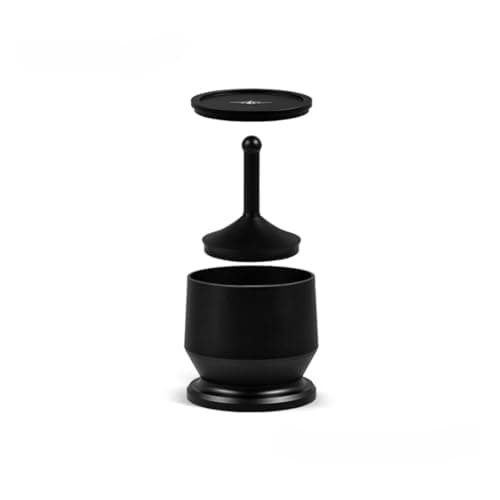
A dosing cup is one of the smallest objects in espresso and one of the easiest to explain: it is a little metal cup you grind into instead of grinding straight into the portafilter. You catch the whole dose in the cup, give it a moment, then tip it into the basket. That is the entire function. It exists because grinding directly into a portafilter—especially with a single-dose grinder or any grinder without a built-in doser—throws grounds everywhere, and static makes the mess worse.

Here is the honest framing before you spend a cent: a dosing cup does not change your espresso. It never touches water, it never touches the puck under pressure, and no cup on this page will make a shot taste better. What it does is make the grind-to-basket handoff clean, static-free and repeatable, which matters more than it sounds when you are doing it every morning. It is a workflow convenience, not an upgrade to the coffee in the cup. It pairs most naturally with a single-dose grinder, which has no doser of its own, and it sits one step before a WDT toolin the routine—grind into the cup, stir or WDT, tip into the basket, tamp.

If there is one thing to get right, it is size. A dosing cup has to match your portafilter, and there are really two camps: 58mm, which covers most prosumer and traditional machines, and roughly 53.3-54mm, which covers Breville's Barista-series machines. Buy the wrong diameter and the cup either will not seat or will not tip cleanly. After size come the smaller choices—a non-stick coating that helps grounds release, a mirror or matte finish, and how tall the cup is for your dose. We ranked five currently-available cups with those priorities in mind, and we are clear below about what we could and could not check.

The short answer

Quick picks

#ProductBest forScorePrice
01
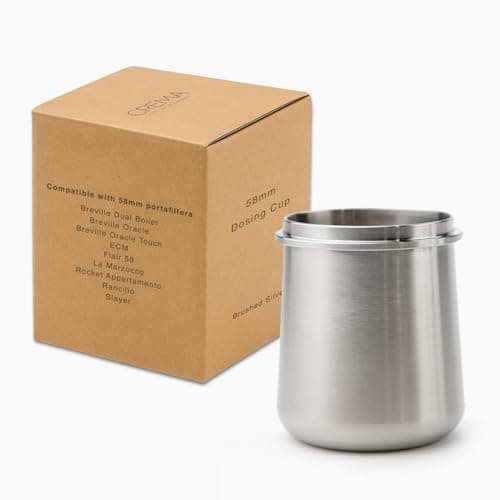
Normcore Normcore 58mm Dosing Cup (Mirror-Polished)
Normcore 58mm Dosing Cup (Mirror-Polished)

The default 58mm dosing cup, and the one to buy if you are not sure. It is heavy 304 stainless with a mirror-polished interior that grounds slide off cleanly, and the mouth is sized for a snug 58mm seat so it parks on top of a portafilter or under a single-dose grinder chute without wandering. It changes nothing about the shot — no cup does — but it makes the grind-to-basket handoff tidy and repeatable, which is the whole job.

Best overall (58mm)
8.4
$25.99Amazon
02
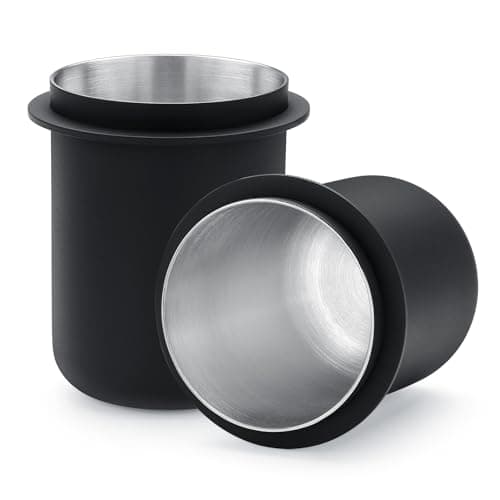
Normcore Normcore 58mm Dosing Cup (Non-Stick, Tall)
Normcore 58mm Dosing Cup (Non-Stick, Tall)

The same Normcore build with two changes that matter: a matte-black non-stick coating on the inside and a taller body. The coating gives the best grounds-release on the page — dry, fine, static-prone coffee tips out almost completely — and the extra height leaves room for bigger doses without overfilling. If you single-dose light roasts that love to stick, this is the cup to get.

Best non-stick
8.2
$25.99Amazon
03
MHW-3BOMBER MHW-3BOMBER 58mm Dosing Cup with Stirrer
MHW-3BOMBER 58mm Dosing Cup with Stirrer

A different idea: an aluminum 58mm cup with an integrated stirrer, so you grind in, spin the grounds to break up clumps, then tip a more even bed into the basket. It folds a light WDT-style step into the cup itself, which is genuinely handy if you do not already own a proper WDT tool. It is a convenience, not a replacement for real distribution, but as a one-piece workflow it is clever.

Best with built-in stirrer
7.8
$30.19Amazon
04
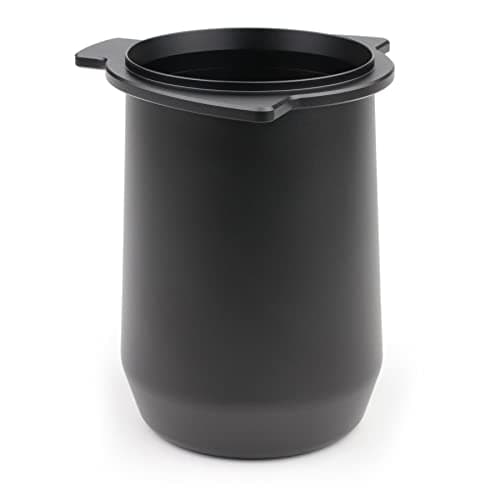
FIRJOY FIRJOY 54mm Dosing Cup (for Breville)
FIRJOY 54mm Dosing Cup (for Breville)

The Breville answer. It is sized for Breville's 54mm portafilter and, crucially, cut with a grinder-activating tab that presses the switch on a Barista Express or Pro and grinds hands-free straight into the cup. If you own a Breville with a built-in grinder, a generic 58mm cup simply will not work; this one is made for exactly that machine, and the black finish hides marks while it does it.

Best for Breville (54mm)
7.4
$19.99Amazon
05
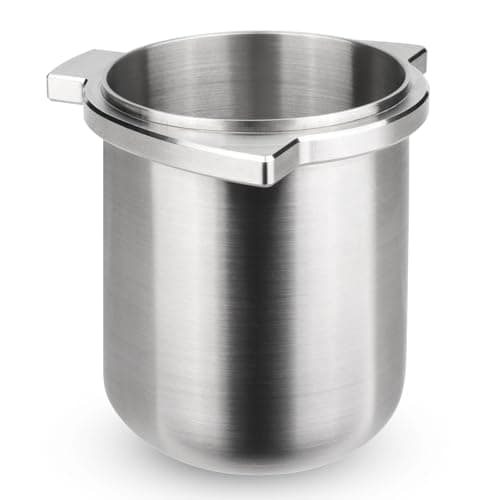
FIRJOY FIRJOY 53.3mm Dosing Cup (Stainless, for Breville)
FIRJOY 53.3mm Dosing Cup (Stainless, for Breville)

The metal alternative for Breville owners who want stainless rather than a coated finish. It measures 53.3mm so it seats down inside a Breville 54mm basket, and it carries the same grinder-activating tab for hands-free filling. The trade is that a plain stainless interior releases dry grounds a little less cleanly than a coated cup, so this one leans on being a sturdier, easy-to-clean metal option more than on slick release.

Best 54mm build
6.8
$24.99Amazon

#ad · Live prices from the Amazon Product API, as of Jul 27, 2026. Where we have no verified live price, we show none — a gap beats a number that has rotted.

In detail

The picks, in full

01
Normcore Normcore 58mm Dosing Cup (Mirror-Polished)

Best overall (58mm)

Normcore 58mm Dosing Cup (Mirror-Polished)

304 stainless steelMirror-polished interiorSnug 58mm fitDeep enough for a full dose
8.4/10

The default 58mm dosing cup, and the one to buy if you are not sure. It is heavy 304 stainless with a mirror-polished interior that grounds slide off cleanly, and the mouth is sized for a snug 58mm seat so it parks on top of a portafilter or under a single-dose grinder chute without wandering. It changes nothing about the shot — no cup does — but it makes the grind-to-basket handoff tidy and repeatable, which is the whole job.

Fit accuracy
9
Build quality
9
Grounds release
8
Workflow
8
Value
8

Pros

  • Mirror-polished 304 stainless interior lets grounds slide out in one clean tip, with little left clinging to the walls
  • Snug 58mm mouth seats securely on a standard portafilter and under most single-dose grinder chutes
  • Heavy, well-finished body that feels like a buy-once tool rather than a throwaway accessory
  • Deep enough to catch a full single or double dose without mounding over the rim

Cons

  • Bare polished steel can build a little static with very dry, fine grounds, so a few particles cling until you flick or wipe them
  • The mirror finish shows fingerprints and water spots, so it wants a wipe to keep looking new
  • Costs more than a plain unbranded cup that does broadly the same job

Don't buy this if…

you specifically want a coated interior that releases dry grounds with near-zero cling, or you own a Breville and need a 54mm cup — this is a 58mm tool with a bare-metal interior.

$25.99View on Amazon

Price as of Jul 27, 2026. Prices change — Amazon's at checkout is the one that counts.

#ad · we may earn a commission from this link to Normcore 58mm Dosing Cup (Mirror-Polished)

02
Normcore Normcore 58mm Dosing Cup (Non-Stick, Tall)

Best non-stick

Normcore 58mm Dosing Cup (Non-Stick, Tall)

304 stainless with non-stick coatingMatte black finishSnug 58mm fitTaller body for bigger doses
8.2/10

The same Normcore build with two changes that matter: a matte-black non-stick coating on the inside and a taller body. The coating gives the best grounds-release on the page — dry, fine, static-prone coffee tips out almost completely — and the extra height leaves room for bigger doses without overfilling. If you single-dose light roasts that love to stick, this is the cup to get.

Fit accuracy
9
Build quality
8
Grounds release
9
Workflow
8
Value
7

Pros

  • Non-stick coating gives the cleanest release here — even dry, staticky light-roast grounds tip out almost fully
  • Taller body swallows a large dose comfortably, so nothing mounds over the edge
  • Matte black finish hides fingerprints and water spots far better than mirror steel
  • Same solid 58mm Normcore fit and stainless build under the coating

Cons

  • The coating is a wear surface — scraping it with a metal WDT tool or spoon will eventually mark it, so treat it gently
  • The taller cup is slightly more awkward to store and can be tall for a low grinder chute
  • Priced at the upper end of the single-cup options here

Don't buy this if…

you like to stir or WDT inside the cup with a metal tool, or your grinder chute has little vertical clearance — a bare stainless cup shrugs off scraping and a shorter cup fits tighter spaces.

$25.99View on Amazon

Price as of Jul 27, 2026. Prices change — Amazon's at checkout is the one that counts.

#ad · we may earn a commission from this link to Normcore 58mm Dosing Cup (Non-Stick, Tall)

03
MHW-3BOMBER MHW-3BOMBER 58mm Dosing Cup with Stirrer

Best with built-in stirrer

MHW-3BOMBER 58mm Dosing Cup with Stirrer

Anodized aluminum alloyFits 58mm portafiltersIntegrated stirrer / funnelCNC-machined body
7.8/10

A different idea: an aluminum 58mm cup with an integrated stirrer, so you grind in, spin the grounds to break up clumps, then tip a more even bed into the basket. It folds a light WDT-style step into the cup itself, which is genuinely handy if you do not already own a proper WDT tool. It is a convenience, not a replacement for real distribution, but as a one-piece workflow it is clever.

Fit accuracy
8
Build quality
7
Grounds release
8
Workflow
9
Value
7

Pros

  • Built-in stirrer breaks up clumps as they land, so the bed you tip into the basket is more even than a bare cup gives you
  • Combines dosing and a light distribution step in one tool — useful if you do not own a separate WDT tool
  • CNC-machined anodized aluminum is light and cleans up easily
  • 58mm mouth fits standard portafilters and most single-dose grinder chutes

Cons

  • The stirrer is a light distribution aid, not a substitute for a fine-needle WDT tool on stubborn clumping
  • Aluminum is lighter and less premium-feeling than the stainless Normcore cups
  • More parts to rinse and dry than a plain open cup

Don't buy this if…

you already own a good WDT tool and want the simplest possible cup, or you prefer heavy stainless — the stirrer is redundant for you and aluminum will feel light.

$30.19View on Amazon

Price as of Jul 27, 2026. Prices change — Amazon's at checkout is the one that counts.

#ad · we may earn a commission from this link to MHW-3BOMBER 58mm Dosing Cup with Stirrer

04
FIRJOY FIRJOY 54mm Dosing Cup (for Breville)

Best for Breville (54mm)

FIRJOY 54mm Dosing Cup (for Breville)

Fits Breville 54mm portafiltersGrinder-activating tab for built-in grinderBlack finishHolds an 18-21g dose
7.4/10

The Breville answer. It is sized for Breville's 54mm portafilter and, crucially, cut with a grinder-activating tab that presses the switch on a Barista Express or Pro and grinds hands-free straight into the cup. If you own a Breville with a built-in grinder, a generic 58mm cup simply will not work; this one is made for exactly that machine, and the black finish hides marks while it does it.

Fit accuracy
8
Build quality
6
Grounds release
7
Workflow
8
Value
8

Pros

  • Grinder-activating tab trips a Breville Barista Express/Pro built-in grinder so it fills hands-free
  • Sized to the Breville 54mm portafilter, so grounds transfer straight in with no size mismatch
  • Black finish hides coffee oils, fingerprints and water spots
  • Deep enough to hold a normal 18-21g Breville dose without spilling

Cons

  • Only makes sense on a Breville 54mm setup — useless on a 58mm machine
  • Lighter build does not feel as substantial as the stainless options
  • The activating tab is tuned to Breville grinders and helps with nothing else

Don't buy this if…

you have a 58mm machine or grind on a separate standalone grinder — the 54mm size and Breville tab are wasted, and a plain 58mm cup suits you better.

$19.99View on Amazon

Price as of Jul 27, 2026. Prices change — Amazon's at checkout is the one that counts.

#ad · we may earn a commission from this link to FIRJOY 54mm Dosing Cup (for Breville)

05
FIRJOY FIRJOY 53.3mm Dosing Cup (Stainless, for Breville)

Best 54mm build

FIRJOY 53.3mm Dosing Cup (Stainless, for Breville)

304 stainless steel53.3mm — seats in Breville 54mm basketsGrinder-activating tabHolds an 18-21g dose
6.8/10

The metal alternative for Breville owners who want stainless rather than a coated finish. It measures 53.3mm so it seats down inside a Breville 54mm basket, and it carries the same grinder-activating tab for hands-free filling. The trade is that a plain stainless interior releases dry grounds a little less cleanly than a coated cup, so this one leans on being a sturdier, easy-to-clean metal option more than on slick release.

Fit accuracy
8
Build quality
7
Grounds release
6
Workflow
6
Value
7

Pros

  • Stainless steel body is sturdier and easier to keep clean over the long run than a coated cup
  • 53.3mm sizing seats neatly inside a Breville 54mm portafilter basket
  • Keeps the grinder-activating tab, so it still fills hands-free from a Breville built-in grinder
  • Silver stainless finish matches Breville's brushed-steel look

Cons

  • Bare stainless interior releases dry, staticky grounds less cleanly than a non-stick cup, so a little can cling
  • Silver finish shows water spots and fingerprints more than a black cup
  • Like the other FIRJOY, it is a Breville-specific 54mm tool with no use on a 58mm machine

Don't buy this if…

you want the cleanest possible release from a coated interior, or you do not own a 54mm Breville — a non-stick cup releases better and 58mm owners need a different size.

$24.99View on Amazon

Price as of Jul 27, 2026. Prices change — Amazon's at checkout is the one that counts.

#ad · we may earn a commission from this link to FIRJOY 53.3mm Dosing Cup (Stainless, for Breville)

How we picked

Every cup here is a real, in-stock dosing cup, and because none of them touches your coffee, we ranked on how well each one does its narrow job rather than on any effect in the cup. Four things decided the order.

  1. Fit accuracy.The mouth has to match your portafilter—58mm or Breville's 54mm—and seat snugly so it parks on the basket or under a grinder chute without wandering. Get this wrong and nothing else matters, so it carried the most weight.
  2. Grounds release. How cleanly the dose leaves the cup. A mirror-polished or non-stick interior tips out almost completely; a bare, matte metal wall lets a few staticky grounds cling. This is the difference you feel every single morning.
  3. Build quality. Stainless versus aluminum, wall thickness and how the rim is finished. A cup gets handled constantly, so a solid body that resists dings and cleans easily earns its place.
  4. Workflow.Whether the cup adds anything useful—a built-in stirrer, a Breville grinder tab, a height that suits your dose—or just gets in the way. We rewarded cups that make the routine smoother.

What we did not test.We did not lab-test these cups—there is very little to lab-test on a metal cup you tip—so our scores come from published manufacturer specifications and aggregated owner reports, exactly as our methodology explains. In particular, we did not measure long-term coating wear, nor how each cup behaves with your specific grinder chute; treat the release scores as informed judgments from documented specs and owner feedback, not measurements.

Match the size to your machine (58 vs 54mm)

This is the whole decision compressed into one line: most prosumer and traditional espresso machines use a 58mm portafilter, so a 58mm cup like the Normcore pair is the default. Breville's Barista-series machines—the Barista Express, Pro and Touch—use a 54mm portafilter, and their baskets take a cup measured around 53.3mm so it seats down inside the basket rim. That is why the FIRJOY cups are listed at 53.3mm and 54mm: they are built for Breville, not for a 58mm machine.

There is a second Breville-specific wrinkle. Breville machines with a built-in grinder only run the grinder when something presses the switch in the grinding cradle—normally the portafilter. A dosing cup made for Breville has a small grinder-activating tab that trips that switch, so you can grind hands-free straight into the cup instead of holding a portafilter. A generic 58mm cup has no tab and will not start a Breville grinder, which is the single most common mismatch we see. If you own a Breville, buy a Breville-specific cup; if you own a 58mm machine, buy 58mm and ignore the tab entirely. If you are still learning the sequence, our guide to pulling a shot shows exactly where the cup fits in the routine.

Do you even need a dosing cup?

Honestly, not everyone does. If your grinder has a built-in doser that fires straight into the portafilter with little mess, a dosing cup just adds a step for no real gain. Where it earns its place is single-dosing—weighing beans one shot at a time and grinding them through a grinder with no hopper or doser, which is how most serious home setups now work. Those grinders spray grounds and static everywhere, and a cup catches the whole dose cleanly. So the real question is not whether this cup is good but whether your grinder makes a mess worth containing. If it does, a cup is one of the cheapest fixes in espresso; if it does not, you can skip it with a clear conscience.

It also pairs with, rather than replaces, the tools that do change the shot. The cup gets the grounds to the basket; a WDT tool evens them out and a good tamp compresses them. Spending on a cup before you own those is putting the tidy before the substance, so if you are building from scratch, our accessories starter kit puts the cup in its proper place in the queue.

Static, RDT and grounds that stick

The mess a dosing cup fights is mostly static. Dry beans—especially light roasts and very fine espresso grinds—pick up a static charge as they pass through the burrs, and charged grounds cling to the cup, jump onto the counter and clump in the basket. Two things help. First, the cup's interior: a mirror-polished or non-stick surface holds far less than bare matte metal, which is why the coated Normcore releases most cleanly here. Second, and more effective, is RDT—the Ross Droplet Technique. Stir a single drop or a light mist of water into your beans before grinding; the trace of moisture neutralises the static charge, and grounds that were flying everywhere suddenly fall straight down. It costs nothing, it does not affect the shot, and it does more for cling than any coating. A cup plus RDT is close to a mess-free grind.

Which dosing cup fits you

  • On a 58mm machine and want one cup, done?Normcore 58mm mirror-polished—the safe default.
  • Single-dosing sticky light roasts? Normcore 58mm non-stick, for the cleanest release on the page.
  • Want a light distribution step built in? MHW-3BOMBER, with its integrated stirrer.
  • Own a Breville with a built-in grinder?A FIRJOY—the 54mm black for a coated finish, the 53.3mm stainless for a sturdier metal build.
  • Not sure you need one at all?If your grinder already doses cleanly into the portafilter, skip it—the cup only earns its place against single-dose mess.

Whichever you choose, a dosing cup is one of the cheapest tidy-ups in espresso and one of the first that makes single-dosing feel deliberate instead of messy. Pair it with a WDT tool and it becomes a real workflow rather than a cup on the counter.
How we picked

We did not lab-test this gear

Everyone in this category says they tested twenty machines. We have not pulled shots on every product here, and we say so. What we did instead: compiled the published specifications, cross-checked the manufacturer manuals, computed the running cost (wattage to energy, grams-per-shot to cost-per-cup), weighed aggregated owner reports, and scored each product against a published rubric. The scores are judgments from documented research — not measurements we took, because we do not have a test lab and we will not pretend we do. Where hands-on time would tell you more than a spec sheet, we flag it. Where a number came from someone else's work, we name them in Sources.

Questions

Frequently asked

What is a dosing cup for?
A dosing cup is a small metal cup you grind your coffee into instead of grinding straight into the portafilter. You catch the full dose in the cup, then tip it into the basket. Its whole job is to cut mess and static from the grind and hand a clean, even dose to the basket - it does not touch water and does not change how the shot tastes. It is most useful with a single-dose grinder that has no built-in doser.
What size dosing cup do I need?
Match it to your portafilter. Most prosumer and traditional machines use a 58mm portafilter, so you want a 58mm cup. Breville's Barista-series machines use a 54mm portafilter and take a cup measured around 53.3mm so it seats inside the basket. Buying the wrong diameter is the most common mistake - a 58mm cup will not work on a Breville, and a 54mm cup is too small for a 58mm machine.
Do you need a dosing cup with a single dose grinder?
It is where a dosing cup is most useful, though it is not strictly required. A single-dose grinderhas no hopper or doser, so it grinds straight out of a chute—and dry, static-prone grounds go everywhere. A cup catches the entire dose cleanly and lets you tip it neatly into the basket. You can single-dose without a cup, but almost everyone who does it daily ends up with one, usually paired with a drop of RDT water to kill the static.
Dosing cup vs dosing funnel?
They solve different halves of the same problem. A dosing cup is where you grind - it catches the dose before it reaches the basket. A dosing funnel sits on top of the portafilter and guides grounds into the basket without spilling over the rim while you distribute or WDT. Some people use both: grind into the cup, tip into a funnel-topped portafilter. If you only buy one, the cup is the more versatile tool for a single-dose workflow; the funnel mainly earns its keep once you are actively WDT-ing in the basket.
How do you stop static and grinds sticking?
Two things. Use a cup with a slick interior—a mirror-polished or non-stick surface holds far less than bare matte metal. And use RDT, the Ross Droplet Technique: stir a single drop or a light spritz of water into your beans before grinding. The trace of moisture neutralises the static charge that makes grounds fly and cling, so they fall straight into the cup instead. RDT costs nothing, does not affect the shot, and does more to stop cling than any cup coating.

Keep reading

Receipts

Sources

We do not run a testing lab, and we do not pretend to. Where a measured number came from someone else's work, we name them and link them. Where we could not verify something, we say so on the page rather than quietly leaving it out. Read our full method.