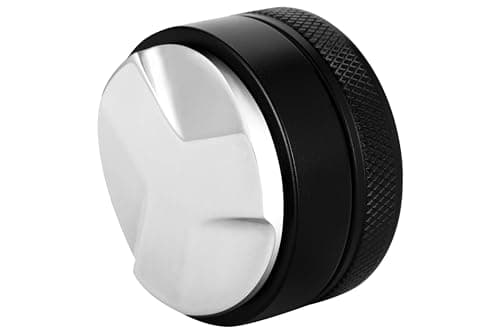
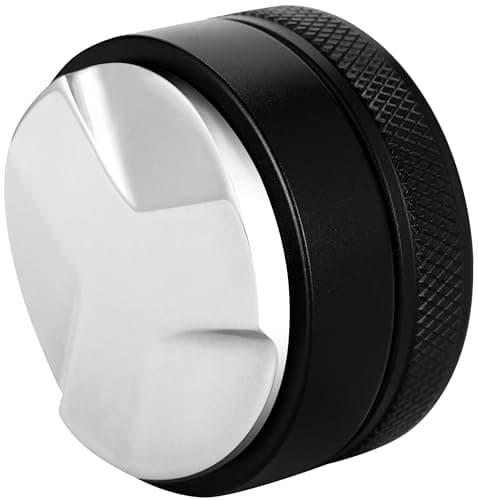
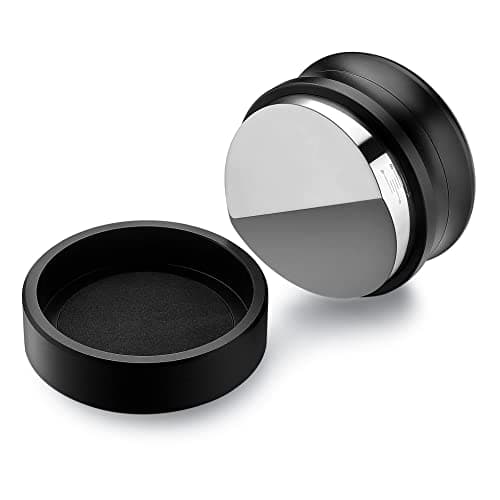
The best espresso distribution tool for most people is the Normcore 58.5mm Coffee Distribution Tool: a machined, weighted disc with angled ribs and an adjustable depth you set once for your dose, so the bed lands flat at the same height every morning. If you want to try the idea cheaply first, the Apexstone 58mm Coffee Distributor does broadly the same job for a third of the money. On a Breville, buy the Apexstone 53mm, which is the size that actually fits a 54mm basket; on a De'Longhi Dedica or a CASABREWS, buy the Apexstone 51mm. Diameter first, brand second.
Before the picks, the thing this page exists to settle. A distributor and a WDT tool are not two brands of the same product, and they do not substitute for each other.
What a distributor does. Coffee leaves a grinder in a cone or a clump pile, so the surface of the bed is uneven before you touch it. A distributor is a weighted disc with angled ramps on its face. You rest it on the grounds and spin it: the ramps drag coffee from the high spots into the low ones and leave a flat, level surface for the tamper. It works on the top few millimetres of the bed. That is its whole scope, and it is a real job — tamping an uneven surface presses an uneven puck, and water flows through the thin side first.
What a WDT tool does. A set of fine needles that you stir through the grounds before levelling. Needles break up the clumps that static and the grinder chute create inside the bed, where no amount of surface levelling reaches. A clump is a dense island the water has to go around; break it and the resistance evens out through the full depth of the puck.
Which to buy if you buy one. If you only buy one, buy the WDT tool — it addresses the deeper fault and costs less. The distributor is the second purchase, and it earns its place by making the result repeatable: the same depth, the same flat surface, every time, without your hand being the variable. If you already stir with needles and your shots still vary morning to morning, this is the tool that fixes it.
What to look for in a distributor. Four things, in order.
Correct diameter for your basket, which is not your machine's nominal size. A 58mm machine takes a 58.5mm distributor, because the basket is nominally 58mm and the tool has to sit inside it with a working clearance. A Breville 54mm machine takes a 53mm or 53.3mm tool for the same reason. A De'Longhi Dedica is a 51mm machine and takes a 51mm tool. Getting this wrong is the most common returned-accessory story we hear — see portafilter size by brand if you are not certain which you own.
Adjustable depth. A fixed-depth distributor only levels correctly at one dose. An adjustable one has a threaded collar: you set it so the ramps just skim the surface of your dose in your basket, lock it, and it repeats. Every pick on this page is adjustable, because a fixed one is a tool you outgrow the first time you change beans.
Weight and flatness of the base. The disc needs enough mass to move coffee without you pressing down, and a face machined flat enough that the ramps engage evenly across the whole circle. This is the main thing separating the Normcore from the budget options: the same mechanism, built to a tighter tolerance.
Ramp geometry. Three or more angled ramps rather than a smooth cone. A smooth-faced disc just compresses the high spots; ramps actually move coffee sideways. All four picks here use a ramped face.
The four distributors compared
Specs below are the manufacturers' published figures for the exact listings above. Prices come from the live price layer with the "as of" date shown in the quick picks table.
| Tool | Diameter | Fits | Depth | Face | Who it suits |
|---|
| Normcore Distribution Tool | 58.5mm | 58mm commercial portafilters | Adjustable collar | Angled ribs | Daily 58mm shots, built to last |
| Apexstone 58mm Distributor | 58mm | 58mm commercial portafilters | Adjustable | Three ramps | Trying distribution cheaply |
| Apexstone 53mm Distributor | 53mm | Breville / Sage 54mm baskets | Adjustable | Three ramps | Breville owners |
| Apexstone 51mm Distributor | 51mm | Dedica, Stilosa, CASABREWS and similar | Adjustable | Angled ramps | 51mm budget machines |
Distributor vs WDT: the honest comparison
Both tools exist because of the same underlying fact: espresso extraction is extremely sensitive to the water finding an even path. If one region of the puck is less dense than the rest, water goes there preferentially, that region over-extracts and the rest is barely touched. The result in the cup is sour and bitter at once, usually with a visible jet from one point in a bottomless portafilter.
They attack different causes. Clumping is caused by static and by the grinder chute, and it happens throughout the depth of the bed; needles are the only practical fix, because they physically reach down into it. Surface unevenness is caused by how the grounds land, and it happens at the top; a ribbed disc fixes that in one spin. Neither tool does the other's job, and no amount of tamping force substitutes for either — pressing harder on an uneven bed makes an unevenly dense puck, not a flat one.
If you are buying both, the order we would buy in is WDT first, then a distributor, then a calibrated tamper. The first fixes the biggest fault, the second makes the result repeatable, the third removes your hand as a variable in the final step. Our best espresso tampers page covers that last step.
Setting the depth, once
This is the part people skip, and it is why some owners conclude distributors do nothing. An adjustable distributor is not a tool you use straight out of the box.
Dose and stir as normal. Rest the tool on the grounds and look at where the ramps sit: you want them just engaging the surface, not buried in it and not floating above it. Turn the collar until that is true, then lock it. If the tool is set too deep it compacts the top of the bed into a crust before your tamper ever arrives, which is worse than not levelling at all. If it is set too shallow it spins without touching anything.
Re-check the setting whenever you change dose or basket. A 20g basket and an 18g basket need different depths, and so does a new bag of beans that happens to be much less dense than the last one. That is a thirty-second check, not a re-learning exercise.
Which diameter do I actually have?
Measure the inside diameter of the basket, not the outside of the portafilter, and round to the nearest standard size. The three that matter are 58mm (the commercial standard, used by Gaggia, Rancilio, most prosumer machines and the Breville Dual Boiler), 54mm (the whole Breville and Sage Barista line), and 51mm (De'Longhi Dedica and Stilosa, CASABREWS and a long tail of budget machines). Then buy the tool that is slightly smaller than the basket: 58.5mm tools for 58mm baskets, 53mm for 54mm, 51mm for 51mm.
If you are unsure, portafilter size by brand lists the diameter for every machine we cover, and portafilter sizes explained covers why the standards exist and why the numbers never quite match.
What a distributor will not fix
Three things, because the tool gets blamed for all of them. It will not compensate for a grinder that cannot grind evenly — an uneven particle distribution channels regardless of how flat the bed is. It will not rescue a pressurized dual-wall basket, which creates its crema through a restriction rather than through extraction, so puck geometry barely matters. And it will not fix a dose that does not suit the basket: too little coffee leaves headspace the water pools in, too much gets crushed against the shower screen. Grinder, basket, dose, then prep — that is the order of operations, and espresso pressure problems works through the symptoms when something upstream is wrong.