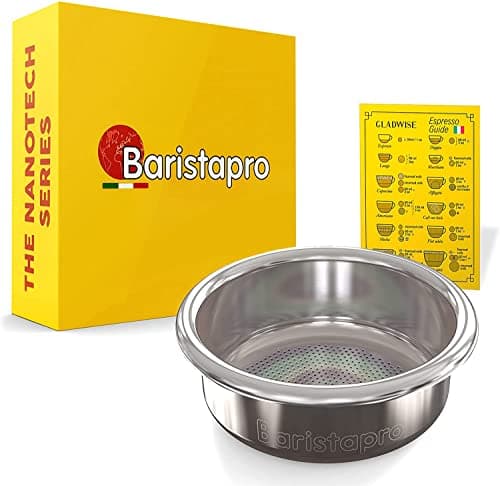
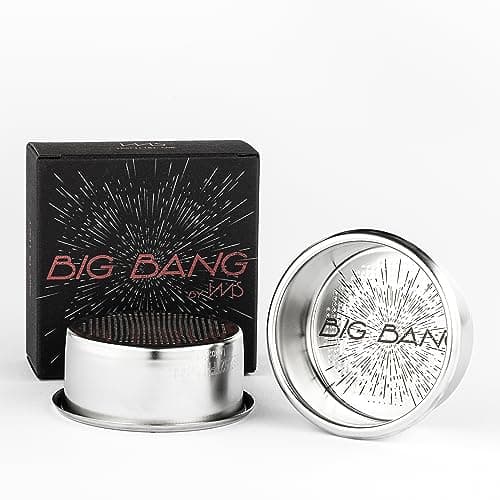
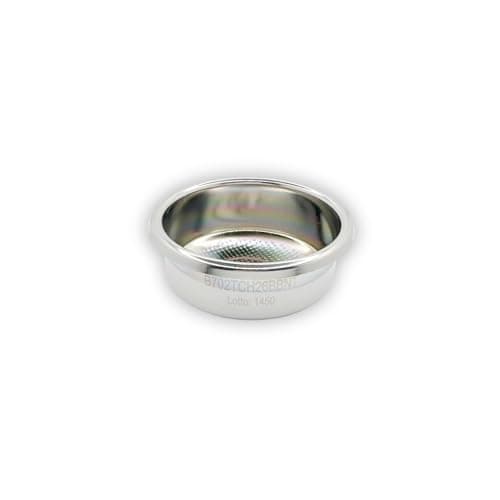
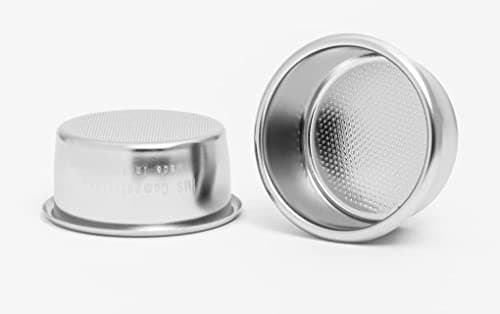
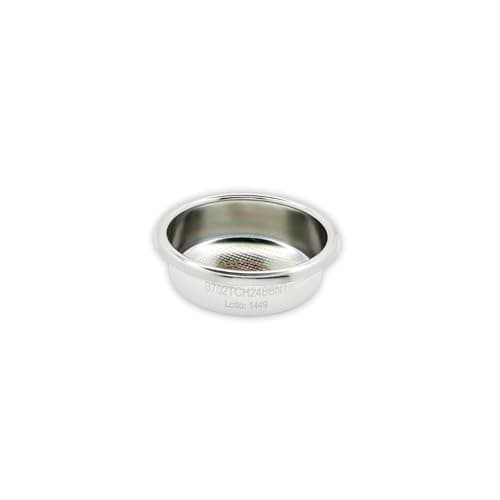
A precision filter basket is a machined, tightly-toleranced replacement for the stock basket that came with your machine. Where a factory basket is stamped with holes that vary in size and spacing, a precision basket is perforated to a tight tolerance: the holes are more numerous, more evenly spaced, and more uniform in diameter. The idea is simple — if water meets the same resistance across the whole puck, it extracts the coffee more evenly, and an even extraction is a cleaner, more repeatable shot.
Here is the honest part first, because it decides whether this page is even for you. A precision basket is a real upgrade, but an incremental one. It helps most on a single-wall (non-pressurized) setup paired with a decent grinder and good puck prep — the kind of even coffee bed you get from a WDT tool. It will sharpen a shot that is already close. What it will not do is rescue a bad grind, an uneven tamp, or a channeling puck; put a precision basket under a sloppy dose and you will simply see the same faults more clearly. If you are running pressurized (dual-wall) baskets because you do not yet have a grinder that can go fine enough, fix that first — the basket is the last five percent, not the first fifty.
If you are still in, the single most important decision is fit, not brand. A basket has to match your portafilter's diameter and your intended dose. Most prosumer machines take a 58mm basket; Breville's home machines take a smaller 53.3–54mm basket, and IMS also makes machine-specific baskets cut for particular groups. Dose matters too: an 18g basket and a 20g basket differ by how much coffee they are built to hold at the right puck height. IMS is the dominant brand on the market and takes five of the six spots below; VST is the other famous name, mostly sold through specialty coffee retailers rather than the marketplace. Ridgeless versus ridged is a smaller, workflow-level choice we cover further down — some bottomless portafilter setups prefer ridgeless. Before you buy anything, verify your basket's diameter and depth against your portafilter — the wrong fit is the one mistake here that no amount of technique can fix.
A precision basket is only worth fitting if you dose to its published range, and that range is much of the point of buying one: our how much coffee goes in a portafilter guide covers the grams for every diameter and how to read the headspace off your own puck. Level the bed before tamping or that reading means nothing — best espresso distribution tools covers that step.
How we picked
Every basket here is a real, currently-purchasable precision filter basket that fits a mainstream home portafilter. Because a basket is one of the few accessories that genuinely touches your coffee and shapes the shot, we ranked on how well each one does that job for its intended user — but we weighted fit heavily, because the best basket in the world is useless if it does not match your machine. Five things decided the order.
- Fit and sizing.Diameter and dose come first. A basket has to match your portafilter (58mm for most prosumer machines, 53.3–54mm for Breville) and the dose you actually weigh out. We rewarded baskets that fit the widest, clearest use case and penalized anything easy to buy in the wrong size.
- Extraction evenness. The reason a precision basket exists is uniform flow: holes that are numerous, evenly spaced and consistent in size so water meets even resistance across the puck. We judged this on published perforation design and aggregated owner reports.
- Build precision.Tolerance, stainless grade and finish. IMS's AISI 304 baskets and Normcore's 0.8mm stainless are both well made; we noted coatings like IMS's Nanotech quartz where they add real daily value.
- Workflow. Ridged versus ridgeless, non-stick versus bare, and whether the basket suits a spouted or bottomless portafilter. These are small quality-of-life factors, but they decide how pleasant the basket is to live with.
- Value. What you pay for the precision, and any extras in the box. Normcore bundling a puck screen and paper filters genuinely changes the maths against a bare IMS basket.
What we did not test
We did not run these baskets on a refractometer or measure extraction yield in a lab — we do not have one. Our scores come from published manufacturer specifications, the documented perforation and coating designs, and aggregated owner feedback, exactly as our methodology describes. Nothing here is a measured shot-by-shot comparison; treat the rankings as informed judgment about fit and design, not lab results.
Do precision baskets actually help?
Yes, but honestly and in proportion. The gain from a precision basket is even extraction: a uniform hole pattern means water passes through the whole coffee bed at a similar rate instead of racing through the thin, loosely-packed spots a stamped stock basket allows. In the cup, a well-fitted precision basket on a good setup can taste a little cleaner, sweeter and more consistent from shot to shot. That is a real, repeatable improvement, and it is why serious home baristas fit one.
But it is the last few percent, not the first fifty. A precision basket does nothing for a grind that is too coarse or wildly inconsistent, an uneven distribution, or a crooked tamp — in fact it will show those faults more plainly, because a shot that channels in a precise basket channels obviously. The upgrade only pays off on a single-wall (non-pressurized) setup where the rest of the chain is already reasonable: a grinder that can go fine enough, even puck prep with a WDT tool, and a level tamp. If you are still relying on pressurized dual-wall baskets to get crema because your grinder cannot keep up, spend the money there first — walk through the whole sequence in our guide to pulling a shot before you upgrade the basket. Get the fundamentals right and a precision basket is a satisfying finishing touch; skip them and it is money that changes nothing.
Match the size and dose to your machine
This is the decision that matters more than any other on the page, and it has two parts: diameter and dose.
Diameterhas to match your portafilter exactly. Most prosumer and commercial machines — anything with an E61 group and a lot of standalone machines — use a 58mm basket, and that is what five of our six picks are. Breville's home machines (Barista Express, Barista Pro, Bambino, Impress, Infuser) use a smaller 53.3–54mm basket, which is why we include an IMS Breville-specific pick; a 58mm basket will not physically fit those portafilters, and a 54mm basket rattles loose in a 58mm one. IMS also makes machine-specific baskets cut for particular groups, so if you own something unusual it is worth checking whether a dedicated basket exists. Measure or look up your portafilter before you buy — this is the one mistake technique cannot rescue.
Doseis the second half. Basket capacity is quoted in grams — 18g, 20g, 22g — and it describes how much ground coffee the basket is designed to hold so the tamped puck sits at the right height below the shower screen. The difference between an 18g and a 20g basket is simply how much coffee you pull: use the size that matches the dose you actually weigh out. An 18g dose in a 20g basket leaves the puck sitting too low, with a gap that invites channeling; a 20g dose crammed into an 18g basket rides up and can catch the screen. Some baskets, like the Big Bang and the Breville pick, quote a range (18–20g, 18–22g) and are more forgiving of a dose that drifts. When in doubt, pick the basket around your normal recipe, not your biggest imaginable one.
Ridged vs ridgeless
A ridged basket has a small pressed lip near the top that clips it into the portafilter and stops it falling out when you knock the puck. A ridgeless basket has no lip; it seats deeper and flush, held in place by the portafilter itself. This is a workflow detail, not a taste one, and most people are happy either way. The practical guidance: if you run a spouted portafilter, a ridged basket is the safe default because the ridge positively retains it. If you shoot with a bottomless (naked) portafilter, many baristas prefer a ridgeless basket because it sits flush and gives a clean, unobstructed view of the puck face — which is the whole reason to go bottomless in the first place. The one thing to confirm is that your portafilter actually retains a ridgeless basket before you buy one; most do, but a few rely on the ridge. Our tamper roundup sorts by basket size the same way, so you can match the whole prep chain to your portafilter at once.
Which precision basket fits you
- 58mm machine, standard 18g double, want the best? IMS Competition Nanotech 18g — the safe, high-quality default.
- Shoot bottomless and want a flush, diagnostic view? IMS Baristapro Nanotech Ridgeless 18g.
- Still refining technique, or like a faster, brighter shot? IMS Big Bang — a more forgiving, higher-flow basket.
- Pull bigger 20g doses? IMS Competition Nanotech 20g — same basket, sized up.
- Want value, or a non-IMS brand? Normcore 58mm 20g, which throws in a puck screen and paper filters.
- Own a Breville (not the JET)? IMS Precision Basket for Breville 54mm — the correct diameter for that whole family.
Whichever you pick, remember the order of operations: fit first, dose second, everything else third. A precision basket rewards a setup that already gets the basics right, and it is one of the most satisfying small upgrades in espresso once the rest of the chain is in place.