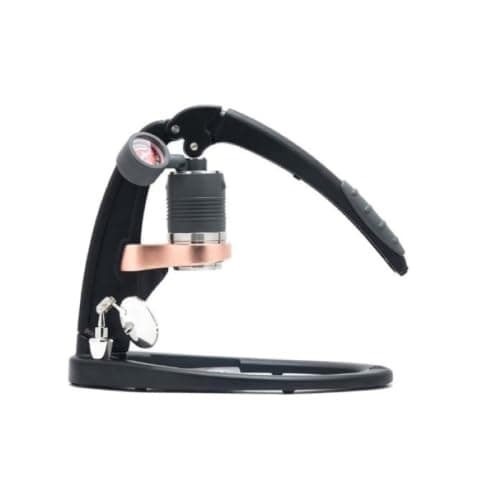
The Flair PRO 2 is a manual lever espresso maker— and "manual" here means exactly what it says. There is no electric pump forcing water through the coffee and no boiler heating it. You boil a kettle, pour the hot water into an all-stainless brew cylinder, seat a 49mm basket of finely ground coffee, and press a long lever down by hand. Your arm supplies the pressure, and a gauge on the machine shows you the 5-9 bar espresso zone as you push, so you are pulling by feedback rather than guessing. The result is a real nine-bar shot with crema — the same physics a commercial machine uses, minus the electronics.
That sounds like a downgrade and it is not. Because there is no pump, no boiler and nothing to fail out of warranty, the 49 PRO is close to indestructible and endlessly rebuildable, and it punches far above its price: paired with a good grinder it pulls shots that rival machines costing several times as much. It is the pick we hand to people whose priority is the espresso in the cup rather than speed or a one-touch latte, and it sits at the top of our manual espresso machine roundup for exactly that reason. If you enjoy a slow, deliberate coffee ritual, this rewards it more than almost anything else you can buy.
The honest catch runs through this whole category and it is stricter here than anywhere: a manual lever is only as good as the grind you feed it, and its bottomless portafilter shows every flaw as a spraying, sour, channeling mess. You cannot pull a decent shot on it with pre-ground supermarket coffee. Budget for a burr grinder that can actually do espresso before you buy the machine, and read how to pull an espresso shotbefore your first attempt — the dose, yield and time recipe is the same as on any machine, you are simply supplying the pressure yourself.
How a manual lever actually works
The whole machine is a piston. You grind fine and dose a 49mm basket, seat it, and pour hot water from a kettle into the brew cylinder above the puck. When you lower the lever, a stainless plunger descends and presses that water down through the coffee at espresso pressure — you are the pump. There is no electricity anywhere in the brew path, which is why the 49 PRO has almost nothing to go wrong: no heating element to burn out, no pump to seize, no electronics to fail after the warranty lapses. The trade is that you supply two things a plug-in machine supplies for you: the heat, from your kettle, and the pressure, from your arm. Once you have felt a shot ramp up under your own hand, the appeal makes sense — you are not waiting on a machine, you are brewing.
The all-stainless brew path and the 5-9 bar gauge
Two things separate the 49 PRO from cheaper lever and hand-pump makers. First, the brew path is all stainless steel— the cylinder, the valve and the plunger stem — so no plastic ever touches your brew water. That matters for taste and for longevity: metal parts do not craze or retain odors the way plastic can, and they hold temperature better once pre-warmed. Second, there is an integrated pressure gauge with a marked 5-9 bar espresso zone. Most manual makers ask you to judge pressure entirely by feel; the gauge turns that guesswork into feedback, so you can see when you are pushing too hard or letting the shot run soft, and repeat what worked last time. It is the single feature that most flattens the manual learning curve.
What it asks of you
Be honest with yourself about the routine, because it is the real decision. Each shot is a sequence: heat the kettle, pre-warm the metal parts with a little of that hot water so the shot does not brew cold, grind and dose, level and tamp, pour the water, and pull the lever in a controlled ramp while watching the gauge. It takes a few minutes and full attention, and your first shots will be rough while you learn how fine to grind and how hard to press. For someone who finds that meditative, it is the best part of the day. For someone who just wants caffeine before work, it is a chore that will wear thin by the second week. There is no in-between with a lever — you either want the ritual or you do not, and it is worth deciding that before you buy rather than after.
Two limits are worth stating plainly alongside that. There is no steam wand, so the 49 PRO makes espresso and only espresso — for a latte or cappuccino you froth milk with a separate handheld or electric frother, and a scale plus good fresh beans will improve your results far more than any gadget. And it pulls single shots, one at a time, with the kettle step in between, so it is slow for a household of four on a weekday morning. Neither is a fault — they are the honest cost of a machine with no pump and no boiler.
The grinder rule is stricter here
Every espresso setup lives or dies on the grinder, but a manual lever with a bottomless portafilter is the least forgiving of all. A semi-automatic with a pressurized basket papers over a mediocre grind; the naked basket on the 49 PRO shows you every flaw as spraying, sour, channeling coffee. You need a burr grinder that can reach a fine, even espresso grind — a blade grinder or pre-ground supermarket coffee simply will not work. Our best grinders for espresso covers the electric options, and a good hand grinder such as the 1Zpresso K-Ultra is the natural partner for a no-electricity maker like this because it keeps the whole kit off-grid. If you are unsure how to split your budget, read whether you need a grinder for espresso first — the short answer for this machine is an emphatic yes, and you should spend on the grinder before you spend up on the machine.
Who it is for
- Buy the Flair PRO 2 if straight espresso is the point, you already own or will buy a real espresso grinder, and a slow, deliberate ritual is the appeal rather than a nuisance. For shot quality per dollar, with a metal brew path and a gauge, little else touches it.
- Consider a cheaper portable instead ifyou mainly want travel espresso and price matters most — the Wacaco Nanopresso is the relaxed, packable, budget way into manual espresso, if a smaller and less refined shot is fine.
- Skip it if you want speed, milk drinks at a touch, or a machine that is ready the moment you are. A plug-in pump machine from our best machines for beginners will make you happier, and the Gaggia Classic Evo Pro is the serviceable, hands-on pump machine to look at if you like the idea of tinkering without the kettle step.
What we did not test
We have not run this machine for months on a bench, and we do not claim to. This review compiles Flair Espresso's published specifications for the 49 PRO, cross-checks them against the wider manual field in our roundup, and weighs aggregated owner reports against our scoring rubric. The all-stainless brew path, the 49mm basket set, the bottomless portafilter and the 5-9 bar gauge all come from Flair's own materials, listed in Sources. Where hands-on time would tell you more than a spec sheet — exactly how the seals hold up over years of daily pulls, how forgiving the gauge feedback is for a true beginner — we say so rather than invent a figure. Prices are never quoted from memory; the live price renders from our pipeline with the date it was checked.