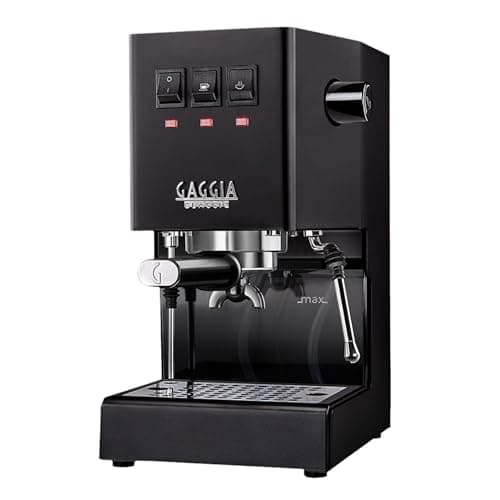
The Gaggia Classic has been the enthusiast's way into real espresso for the better part of three decades, and the Evo Pro is the current version of that idea. Its whole appeal comes down to one thing the spec sheet only hints at: it is the cheapest honest route to a genuine 58mm commercial portafilter— the same diameter used on cafe machines — in a body designed to be opened, serviced, modified and kept for many years. Buy one and you are not really buying an appliance. You are buying into a platform.
What that platform is made of matters. The Evo Pro is built around a single-piece 17-gauge stainless steel body, a lead-free brass boiler, and a 15-bar Ulka vibratory pump — the same class of components that keep older Classics running long after their warranties expire. The “Evo” revisions moved the group to fully lead-free materials and refined the brew path; the “Pro” part refers to the commercial-style 58mm group and steam wand. Together they make a machine that behaves less like a sealed kitchen gadget and more like a small piece of equipment you maintain. Parts are cheap and widely stocked, exploded diagrams are everywhere, and there is a decades-deep community that has documented every screw.
The honest limits are the flip side of that same design. There is no PID from the factory, so you either learn to temperature-surf (more on that below) or fit an aftermarket controller. There is no grinder in the box, and the grinder matters as much as the machine — budget for one separately. The two-hole commercial-style steam wand makes properly textured milk possible but demands practice, and the small single boiler means you wait between pulling a shot and steaming. None of this is a defect; it is the deal. If you want to press a button and walk away, this is the wrong machine, and we will point you at the Breville Bambino instead. If you want to learn the craft and tinker, few machines give you more room to grow. See where it sits in the wider field in our best espresso machines under $500 roundup.
Why the 58mm portafilter matters
If you take one thing from this review, make it this: the Evo Pro carries a genuine 58mm commercial portafilter— the same diameter used on the espresso machines behind most cafe counters. That number is not vanity. It is the difference between being locked into whatever proprietary basket a manufacturer ships and being able to reach an entire ecosystem of standard, cafe-grade parts: precision baskets, competition tampers, funnels, distribution tools and bottomless portafilters that all just fit. Most machines at this price use smaller, non-standard baskets, which quietly caps how far you can improve. The Classic hands you the commercial standard on day one, which is the single biggest reason enthusiasts keep steering beginners toward it. It is also why the upgrade path is so cheap: a better basket or a bottomless portafilter costs little and teaches you to see your extraction, because a naked spout shows exactly where a puck is channeling.
No PID: what temperature surfing means
Here is the limit nobody should hide from you: the Classic Evo Pro does not ship with a PID. A PID is a controller that holds the boiler at a precise, steady brew temperature. Without one, the Gaggia's thermostat lets the boiler swing through a band, and the trick owners use is called temperature surfing— you watch the heat-ready light, wait for it to cycle off, and pull your shot in the predictable window that follows so the water is in the right range. It sounds fiddly, and for the first week it is; then it becomes muscle memory. Plenty of people brew excellent espresso this way for years and never fit anything. The reason the Classic is famous, though, is that if surfing annoys you, the single most popular modification in home espresso is a bolt-on PID kit that gives you a digital, cafe-steady brew temperature. That is the machine's whole philosophy in one example: the factory version is honest and capable, and the door to more is left deliberately open. If you would rather that precision came built in and you never touched a screwdriver, that is a fair reason to look at a pricier machine that ships with a PID already fitted.
The steam wand and milk
The Pro-generation Classic uses a two-hole, commercial-style steam wand, and it is a genuine upgrade over the assisted “panarello” frothers on cheaper machines — but it is also a skill. A commercial wand does not froth milk for you; it gives you a jet of steam and asks you to position the pitcher, introduce air, and roll the milk into glossy microfoam yourself. Once it clicks, you can pour latte art with it. Getting there takes practice, a cold pitcher and a bit of patience. The other honest caveat is the single boiler: the Classic heats one small boiler to brew temperature for the shot and then to a much higher temperature for steam, so there is a wait between the two — pull your espresso first, flip to steam, give it the better part of a minute, then texture. It is a rhythm, not a race, and it is completely workable for one or two drinks at a time. If you are regularly making milk drinks for a crowd, back to back, that wait is the Classic's real friction point, and a dual-boiler or heat-exchanger machine further up the range solves it — at several times the price.
What to pair it with (grinder, tamper, bottomless PF)
The Evo Pro is deliberately sold bare, and the most important thing to understand is that the grinder matters as much as the machine. A semi-automatic can only extract what the grind gives it, so a consistent, espresso-capable grinder is not optional — it is half your setup. Budget for it up front and read our best grinders for espressobefore you spend a cent on accessories. After the grinder, the highest-value additions are a properly fitted 58mm tamper so your dose is level and evenly compressed, and a bottomless portafilter that turns the machine into a teaching tool by showing you channeling in real time. Those two, plus fresh beans and a scale, will take you further than any machine upgrade. If assembling all of that sounds like more project than you want, that is a useful signal — compare it against a grinder-and-machine-in-one path in our Breville Bambino vs Gaggia Classic comparison.
What we did not test
We have not run this machine on a bench for months, and we do not claim to have. This review compiles Gaggia's published specifications, cross-checks the component and materials claims against the manufacturer and authorized-retailer documentation, and weighs aggregated owner reports and the long, well-documented modding record against our scoring rubric. The boiler material, portafilter size, wattage, tank capacity and pump rating come from Gaggia's own materials, listed in Sources. Where hands-on time would tell you more than a spec sheet — exactly how forgiving the temperature-surf window feels day to day, how quickly you learn the steam wand, how a specific PID kit installs — we say so rather than invent a number. Our scores are judgments from that documented research, not lab measurements; we do not have a lab, and our methodology says exactly that.
The rest of the Gaggia range
The Classic Evo Pro is the machine Gaggia is known for, but it is not the only one worth considering — the bean-to-cup models answer a completely different question. Best Gaggia espresso machines ranks the whole range, from this machine up to the Accademia.
Which grinder to put next to it
Because the Classic has no grinder and no factory PID, the grinder you pair with it does more for the cup than any mod you can fit. We built a page for exactly that decision: the best grinders for the Gaggia Classic ranks six by what this machine actually needs — fine adjustment inside the espresso range, a repeatable 18-20g dose for the 58mm basket, and low enough retention that a grind change lands on the next shot rather than the one after it.