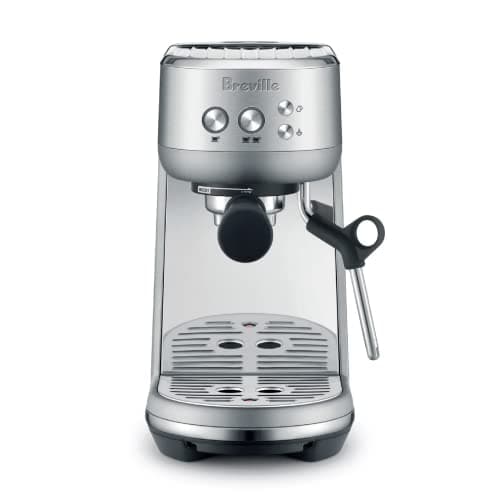
The Breville Bambino is the machine we point most first-time buyers toward when counter space is tight and the budget is real but not unlimited. It strips the enthusiast Breville formula down to its essentials — a fast, temperature-stable brew system and a proper steam wand — drops the built-in grinder to shrink the body to about the width of a paperback, and sells for meaningfully less than its bigger siblings. What is left is one of the best value-for-space buys in home espresso, provided you understand the one thing it does not include.
The headline is the heat-up. The Bambino uses Breville's ThermoJet system, which reaches espresso temperature in a few seconds rather than the several minutes a traditional boiler needs — so the machine is genuinely ready before you have finished grinding. Underneath that is the part that matters more for the cup: digital temperature control and low-pressure pre-infusion, the same ideas that make Breville's pricier machines pull consistent shots. It is a 54mm system with a 15-bar Italian pump, and crucially it ships with real single-wall (non-pressurized) baskets alongside the beginner-friendly pressurized ones, which is what lets it grow with you.
The honest catch is right there in the small size: the Bambino has no grinder, and espresso is more sensitive to grind than to almost anything else. Pairing it with a cheap blade grinder wastes the machine entirely. Budget from the start for a real burr grinder — see our best grinders for espresso and the best grinders under $200 — and read do you need a grinder for espresso if you are tempted to skip that step. Please do not skip that step.
If you are coming to the Bambino from a capsule machine, the Bambino is the step up we recommend most often, and Nespresso vs an espresso machine sets out exactly what the switch costs and gains — including the per-drink arithmetic.
Who the Bambino is for
The Bambino suits a specific, common buyer: someone who wants to make genuinely good espresso and milk drinks at home, has limited counter space, and is willing to learn a little technique in exchange for cafe-adjacent results. If that is you, it is close to ideal. If you want a machine that hands you a latte at the push of one button with no skill at all, you are looking at the wrong category — that is a super-automatic, and we cover those in the best super-automatic machines roundup. The Bambino is a manual-workflow machine that happens to be small, fast and forgiving, not a hands-off appliance.
The single-wall basket is the whole point
Here is the detail that separates the Bambino from cheaper machines that look similar on paper. It ships with both pressurized (dual-wall) baskets, which fake crema and forgive an imperfect grind, and non-pressurized (single-wall) baskets, which demand a good grind and a proper tamp but reward you with real, cafe-quality extraction. Most sub-$200 machines only give you the pressurized kind. The single-wall baskets are the reason the Bambino is worth stepping up to: they are the ceiling being raised. You start on the forgiving baskets while you dial in, then switch to single-wall once your grinder and technique are ready.
Bambino vs Bambino Plus vs Barista Express
Three Breville machines get cross-shopped constantly, and the differences are simple. The Bambino (BES450) reviewed here has a manualsteam wand — you texture the milk by hand. The Bambino Plus (BES500) adds automatic milk texturing with temperature and texture settings, for people who want a flat white without learning to steam. The Barista Expressis a different animal: it builds a conical burr grinder into the body, so it is an all-in-one at the cost of a much larger footprint and a higher price — see the best machines under $1,000 and the Barista Express vs Barista Pro comparison. If counter space is your constraint, the Bambino wins; if an integrated grinder is the priority, step up to the Barista Express.
What you will need to pair with it
Budget for a few things beyond the machine. A real burr grinderis non-negotiable — it matters more to the cup than the machine does. A 54mm tamper that fits the basket, a WDT tool to stop channeling, and a scale to weigh your dose and yield will each do more for your espresso than any machine upgrade at this price. If you want to watch your extraction and diagnose channeling, a 54mm bottomless portafilter is a cheap, worthwhile add later. Our accessories starter kit lays out the whole set in order of priority.
What we did not test
We have not run this machine on a bench for months, and we will not pretend otherwise. This review compiles Breville's published specifications, cross-checks the manual, and weighs aggregated owner reports against our scoring rubric. The specs — heat-up system, basket sizes, pump, steam wand type — come from Breville's own documentation, listed in Sources. Where hands-on time would tell you more than a spec sheet (exactly how the steam wand feels on a small pitcher, say), we say so rather than invent a number.
Which grinder to put next to it
The Bambino's one requirement is a grinder, and the choice is narrower than “any good grinder”: it has no pressure gauge, so you need fine adjustment inside the espresso range, and it takes a 54mm basket, so dose precision around 18-19g matters. Our five picks for the Bambino specifically rank the field on those criteria, from a hand grinder that costs a fraction of the machine to the flat-burr electric that raises its ceiling.
How we picked
We did not lab-test this gear
Everyone in this category says they tested twenty machines. We have not pulled shots on every product here, and we say so. What we did instead: compiled the published specifications, cross-checked the manufacturer manuals, computed the running cost (wattage to energy, grams-per-shot to cost-per-cup), weighed aggregated owner reports, and scored each product against a published rubric. The scores are judgments from documented research — not measurements we took, because we do not have a test lab and we will not pretend we do. Where hands-on time would tell you more than a spec sheet, we flag it. Where a number came from someone else's work, we name them in Sources.