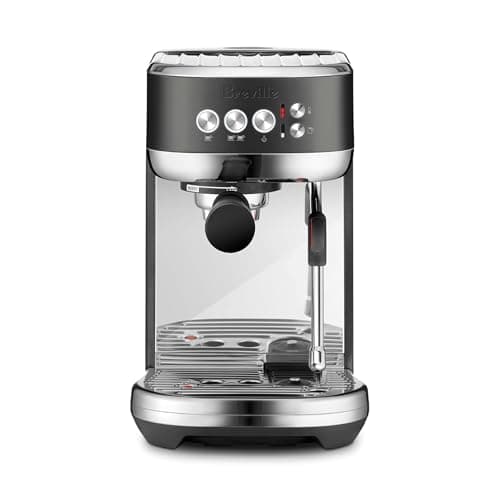
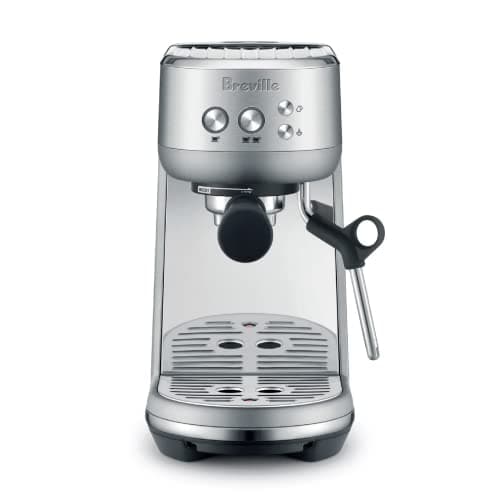
Here is the thing almost no one tells you up front: the Breville Bambino and the Bambino Plus are the same espresso machinein two different bodies. They share the exact same near-instant ThermoJet heater that is ready in around three seconds, the same 54mm portafilter, the same 15-bar pump, the same single-wall pressurized baskets, and — importantly — neither one has a built-in grinder. Pull a shot on either machine with the same beans, the same grind and the same dose, and what lands in the cup is identical. So this comparison is not really about espresso at all. It is about one thing: milk.
The base Bambino (BES450) gives you a manual steam wand. You hold the pitcher, you position the wand, and you texture the milk yourself — the same skill a barista uses. The Bambino Plus (BES500) gives you an automatic steam wand: you pick a milk temperature and a froth level, drop the wand in, press a button, and it foams and heats the milk hands-free while you do something else. The Plus also adds programmable shot volumes and is a slightly larger machine with a bigger drip tray. That is the entire difference. Everything else is the same hardware.
So the decision is genuinely simple, and it comes down to a question about you rather than about the machines: do you want to learn to steam milk, or do you want the machine to do it for you?If you are happy to practice microfoam — or you mostly drink straight espresso and americanos — the base Bambino saves you money and takes the least counter space of any machine Breville makes. If you make lattes and cappuccinos every morning and would rather not think about milk technique, the Plus pays for its extra cost in convenience. Neither makes better coffee. You are paying purely for milk automation. If you want the deeper single-machine writeup, our Breville Bambino review covers the shared engine in detail, and both machines sit comfortably inside our best espresso machines under $500 picks.
The head-to-head, point by point
The milk system — the only real difference: this is the whole decision. The base Bambino has a manual steam wand: you hold the pitcher, angle the wand to spin the milk, and judge temperature and foam by hand and ear. It is the same skill a cafe barista uses, and once you have it, you have complete control over texture. The Bambino Plus has an automatic steam wand: you choose one of three milk temperatures and three froth levels, insert the temperature probe, press start, and it heats and textures the milk to your setting with no hands and no technique. If you make milk drinks daily and want them foolproof, that is the feature you are buying. If you want to learn latte art or you rarely drink milk, the manual wand on the base model is more than capable — and a decent milk pitcher matters more to your foam than which of these two machines you own.
Shot quality — identical: we want to be blunt here because it is the most misunderstood part of this comparison. The espresso is the same. Both machines use the same ThermoJet heating system, the same 54mm portafilter, the same 15-bar pump and the same single-wall baskets. There is no secret upgraded group head or better pressure profile on the Plus. Pull the same beans at the same grind and dose and the two shots are indistinguishable. Do not buy the Plus expecting better crema or a richer shot; buy it for the milk.
Size and footprint:the base Bambino is the more compact of the two — it is the smallest machine in Breville's lineup and the winner if counter space is tight. The Plus is slightly larger with a bigger drip tray to accommodate the automatic milk hardware. Neither is big, but if you are wedging a machine into a corner, the base model gives you a little more room to breathe.
Extras: the Plus adds programmable shot volumes, so you can set a single and double and get the same pour at one touch; on the base Bambino you stop the shot yourself, which is trivially easy but not automated. Both ship with the same accessory kit — portafilter, single- and double-wall baskets, a tamper and the milk jug — and, again, neither includes a grinder.
Price: the base Bambino costs less; the Plus costs meaningfully more. Since the espresso is identical, that premium is entirely the price of milk automation, the programmable shots and the slightly larger build. Both land well within reach for a first serious machine — see where they sit against the field in our best under $500 roundup, and if you are completely new to espresso, our best machines for beginners guide puts both in context.
Both still need a grinder — do not skip this
Whichever Bambino you choose, you are buying half a setup. Neither machine grinds coffee, and on a 54mm single-wall basket the grinder is the single biggest thing that decides whether your espresso is good or sour. Pre-ground coffee will not let you dial in a proper shot on either machine; you need a grinder that can hold a fine, adjustable espresso setting. Budget for one from the start — it matters more than the choice between these two bodies. Our best grinders for espresso roundup is the place to start, and the Baratza Encore ESP review covers the most popular affordable match for a Bambino specifically.
Which one should you buy
- Buy the base Bambino (BES450) ifyou want to spend less for exactly the same espresso, you drink mostly straight shots or americanos, or you actively want to learn to steam milk yourself. It is also the pick if counter space is tight — it is the smallest machine here.
- Buy the Bambino Plus (BES500) if you make lattes or cappuccinos most mornings and want the milk textured hands-free, you would rather not learn steaming technique, or you value programmable one-touch shots. You are paying the premium for convenience, not for better coffee.
- Still deciding on the whole setup?If you think you will outgrow either Bambino and want a grinder built in, it is worth comparing up the range — our Barista Express vs Pro comparison covers Breville's all-in-one machines that include a grinder.
Honestly, most milk-drink households will be happiest with the Plus and most espresso-first drinkers with the base — and either way the money you save (or the money you have left) is best spent on a good grinder and fresh beans.
What we did — and did not — test
We did not run these two machines side by side in a lab. This comparison is compiled from Breville's published specifications for the BES450 and BES500 and from aggregated owner reportsabout the manual versus automatic steam wands, the heat-up time and the footprint. Our scores are editorial judgments from that documented research, not measured numbers — there is no crema-density rig or milk-temperature probe behind them. The one claim we are most confident in is also the simplest: because both machines use the same heating system, pump and portafilter, the espresso they produce is the same, and every published spec and owner account we found supports that. Our methodology explains exactly how we research and score.