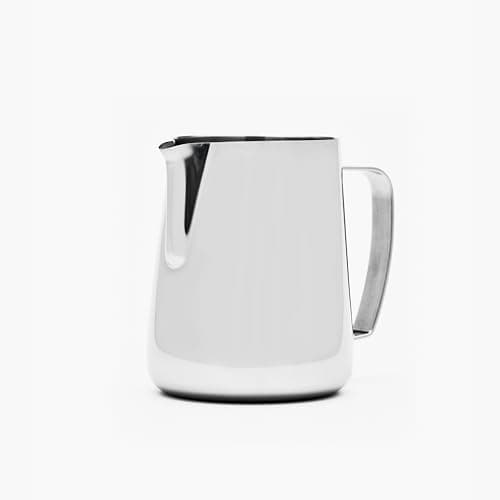
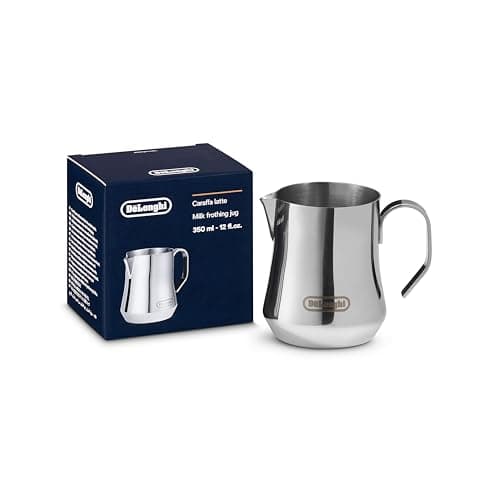
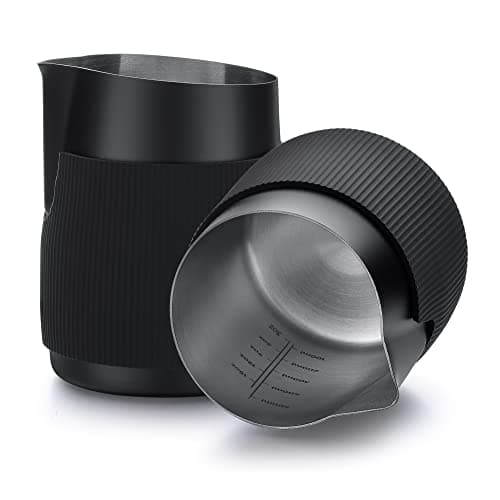
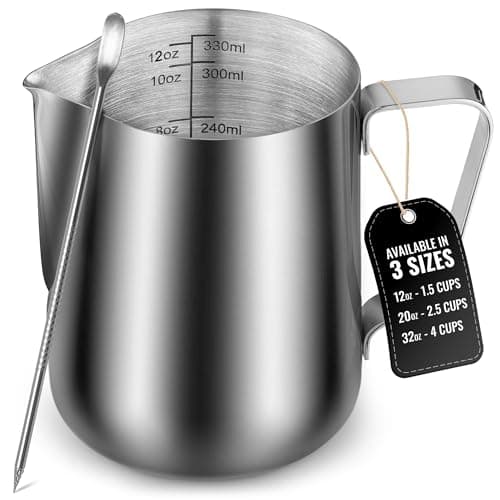
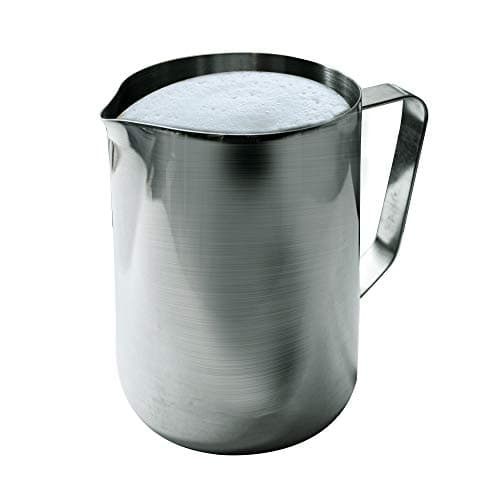
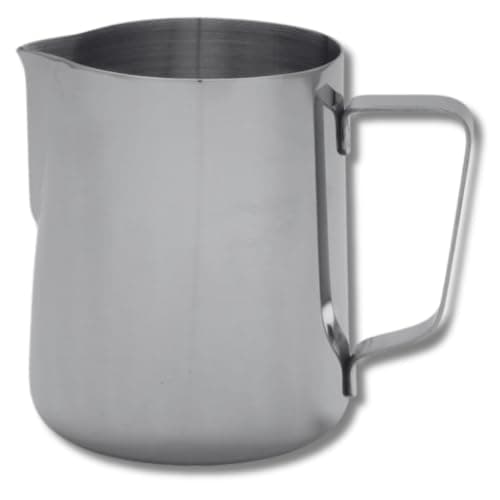
A milk pitcher is the jug you steam and pour milk from, and it does more work than it looks like it should. The steam wand spins milk into a glossy microfoam inside it; then the shape of the spout and the size of the jug decide whether that microfoam lands on the espresso as latte art or as a shapeless blob. A pitcher matched to your drink and a spout you can aim are the difference between pouring a rosetta and pouring a puddle — which is why baristas own several, and why the cheap jug bundled with a machine is usually the first thing they replace.
The honest truth about buying one is that size is the decision that matters, and it is a simpler decision than the spec chips suggest. A 12 oz pitcher is the right tool for a single or double drink; a 20 oz (roughly 600 ml) pitcher suits two drinks at once or one larger latte or cappuccino. Steam milk in a jug that is too big and it never climbs the walls enough to texture properly; steam it in one too small and it erupts over the top. After size comes the spout: a sharp, narrow spout drops fine, detailed art, while a rounded spout pours faster with a broader stream. Everything else — the exact steel, the finish, the branding — is a rounding error next to those two.
So this roundup is organized around getting those two right for you rather than chasing a single winner. If you are still assembling your setup, our espresso-accessories starter kit covers the tamper, scale and jug together, and if you do not yet own a machine with a steam wand, the beginner espresso machines roundup is the place to start — a pitcher is only as good as the wand feeding it. Every pick below is a real, currently-available stainless jug, ranked on pour control, build, how well the spout serves latte art, versatility and value, with the cons stated plainly.
How we picked
Every pitcher here is a real, currently-available stainless steel steaming jug you can buy in the US today. We ranked them on five things, in this order.
- Pour control. How predictably the spout releases milk. A spout that drips, dumps or wanders is the difference between art and a mess, and it is the single most important thing a pitcher does once the milk is textured.
- Build quality. Gauge and rigidity of the steel, the handle weld, and how the jug holds its shape over years of thermal cycling. A thin jug dents and flexes; a rigid one pours the same on day one and year five.
- Latte-art suitability. Whether the spout is shaped and tapered for detailed free-pour, or is a general pouring spout that favors durability over fine lines.
- Versatility. Whether the size and design suit a range of drinks or lock you into one. A 12 oz jug and a 20 oz jug each do one job well; a jug that only suits experienced pourers is narrower still.
- Value. What you pay for what you get, in plain terms. A budget jug that punches above its price and a premium jug whose precision you will actually use both score well; a jug you pay a brand premium for and never grow into does not.
We did not lab-test these pitchers — we do not have a lab. Scores are judgments from published manufacturer specs, the design details each brand documents, and how these jugs are used in practice; our methodology spells out exactly what the numbers do and do not mean.
What size pitcher should you buy?
This is the whole game, so get it right first. Match the jug to the number of drinks you make at once, not to the size of your milk carton. A 12 oz (350 ml) pitcher is the correct size for a single or double drink — one flat white, one latte, one cappuccino. A 20 oz (roughly 600 ml) pitcher is for two drinks at a time or one large latte. If you routinely make two milk drinks back to back, the 20 oz saves you steaming twice; if you make one small drink, the 12 oz gives you finer control over that smaller amount of milk.
The reason size matters so much is physics, not preference. Fill a pitcher only about a third to halfway — up to the base of the spout — before you steam. Steam too little milk in too big a jug and the wand cannot get enough purchase to roll it into microfoam; you get warm milk and big bubbles. Overfill a jug and the expanding foam climbs over the rim and onto your counter. Underfilling and overfilling are the two most common texturing mistakes, and both are really a size mismatch between the jug and the drink.
Spout shape and handle
After size, the spout is what your latte art lives or dies on. A sharp, narrow spout — the tapered tip on the Rattleware, Barista Hustle, De'Longhi and Zulay jugs — releases a thin, controllable stream that drops fine detail: tight rosetta leaves, defined tulips. A rounded spout, like the Normcore's, pushes a broader, faster stream that experienced pourers use for speed and bold shapes but that is less forgiving of a shaky hand. Neither is wrong; the sharp spout is the safer place to learn.
The handle is the other physical choice. Most jugs have a handle, which is the sane default: it keeps your hand off hot steel and gives you leverage to angle the pour. A handleless jug, like the Normcore, trades that for a direct, hand-on-the-metal connection some advanced pourers swear by; it comes with a silicone band and an exposed patch so you can still feel the milk heat up, but there is a genuine learning curve. One honest note about handled jugs too: bare-steel handles conduct heat, so during long steaming sessions a cloth around the handle is worth keeping nearby.
What we would skip
Skip buying a pitcher purely for the bundled extras. A latte-art pen thrown in with a jug (as with the Zulay) is a pleasant bonus, but it is not a reason to choose one pitcher over a better one — etching art with a pen is a different, lower skill than free-pouring, and most people stop using the pen once they can pour. Skip non-stick coatings unless you specifically want one; they are a wear surface you have to treat gently, and a plain polished stainless interior cleans up fine and lasts longer. And skip buying a second size before you have mastered the first — one jug that matches your usual drink, used until pouring is second nature, beats a drawer of jugs you switch between and never learn. If you would rather the machine make the foam for you entirely, a pitcher is the wrong purchase — see our milk frothers roundup instead.
Which pitcher fits you
- Want one jug that does most things well? Rattleware 20 oz — the barista-standard, and the safest all-round buy.
- Chasing symmetrical, precise latte art? Barista Hustle 600 ml — alignment-tested and marked inside.
- Mostly make one small drink?De'Longhi DLSC060 12 oz, or the Zulay 12 oz if you want to spend less.
- An experienced pourer who wants a handleless jug? Normcore 600 ml round spout.
- Just want the cheapest tough jug that works? Update International EP-12.
Whichever you pick, a pitcher is one piece of the setup. Pair it with a machine that has a real steam wand from our beginner machines roundup, the rest of the kit in the starter kit, and fresh espresso beans underneath the milk. Great microfoam on a bad shot is still a bad drink.