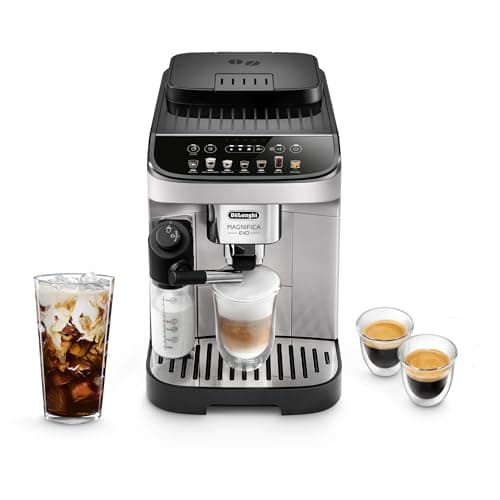
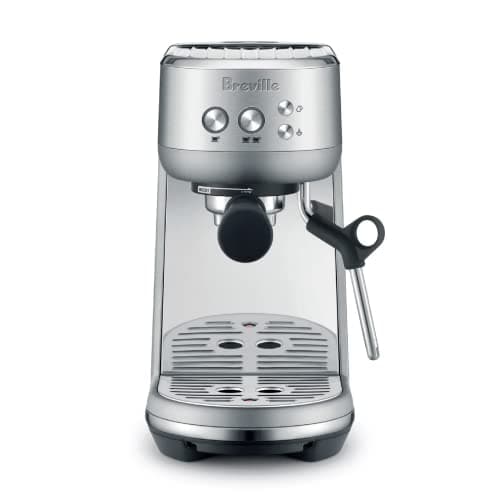
This is the single most common fork a first-time buyer stands at, and the two machines could hardly be more different in what they ask of you. The Breville Bambino is a compact semi-automatic: it heats water, pumps it through a portafilter you pack yourself, and gives you a steam wand to texture milk by hand. It is the cheapest honest route into realespresso and latte art — but you supply the grinder and you supply the skill. The De'Longhi Magnifica Evo is a super-automatic bean-to-cup: the grinder, the brewing and the milk frother are all sealed inside one box, so a latte is a single button and about ninety seconds with no technique at all. One machine wants you to learn; the other wants you to walk away. That, more than any spec, is the choice.
There is a money point underneath the two philosophies, and it is easy to get backwards. The Bambino has the lower sticker of the pair, but the sticker is not the setup cost: espresso is more sensitive to grind than to almost anything else, so the Bambino only makes sense once you budget for a real burr grinder alongside it. The Magnifica Evo costs more on the box, but that price already includes the grinding and the milk system — there is nothing else to add. So the honest framing is not “which is cheaper,” because prices move and the answer depends on the grinder you pair; it is “the Bambino is cheaper up front but budget a grinder, while the Magnifica bundles the grinding and the milk into one number.” Compare a manual machine and a bean-to-cup in the abstract in our semi-automatic vs super-automatic explainer if you have not settled that question yet.
We are putting the two flagships of that decision head to head because they are the machines most beginners actually cross-shop. For the deep dives, read our full Breville Bambino review and our De'Longhi Magnifica Evo review, and if you are still deciding what kind of first machine suits you at all, our best espresso machines for beginners roundup lays out the whole field. Below we settle the fork on the four things that actually decide it: total setup cost, control versus convenience, milk, and maintenance.
Control vs convenience: the choice underneath everything
Every other difference between these two machines flows from one design decision, so it is worth stating plainly. The Bambino is a semi-automatic: it does the parts that require power and precision — heating, pressure, pre-infusion — and hands you the parts that require judgment. You grind, you dose and tamp, you texture the milk. That is the control, and control is a double-edged thing: it is the reason the Bambino can climb to a genuinely cafe-grade shot, and the reason a careless one can be sour or bitter. The Magnifica Evo is a super-automatic: it takes over the whole chain behind a sealed brew group, so every cup is consistent, hot and hands-off, but the process cannot be pushed the way a manual one can. The trade is exact and unavoidable — the super-automatic raises the floor (no bad shots, no dialing-in) and lowers the ceiling (you cannot chase the last ten percent). Neither is a compromise; they are two different goals. If you want a hobby and a great shot, buy control. If you want reliable coffee and your morning back, buy convenience. The abstract version of this decision is laid out in our semi-automatic vs super-automatic guide.
The honest money math: what each one really costs to set up
This is where beginners overspend or underspend, so read it before you compare stickers. The Bambino carries the lower price on the box, but a bare Bambino cannot make good espresso, because espresso lives and dies on the grind and the Bambino has no grinder. Pairing it with a cheap blade grinder wastes the machine entirely; you need a real burr grinderto feed it, and that is a mandatory second purchase, not an optional upgrade. So the Bambino's true setup cost is the machine plusa grinder — often a meaningful add on top. The Magnifica Evo costs more up front, but that single number already bundles the grinding and the milk system: a conical burr grinder with 13 settings and the LatteCrema carafe are both inside the box, with nothing else to buy. That is why “which is cheaper” is the wrong question. We do not quote prices here because they move, and the winner on cost depends entirely on the grinder you choose for the Bambino. The honest structural facts are these: the Bambino is cheaper to start and can be built up slowly, but you must budget a grinder before it performs; the Magnifica is a higher single price that is genuinely all-in. If your budget is tight this month and you are happy to add a grinder later, the Bambino stages the spend. If you want one purchase and never think about it again, the Magnifica is the cleaner number.
Milk: hand-textured microfoam vs one-touch carafe
Milk is the daily deciding factor for most buyers, and the two machines answer it in opposite ways. The Bambino gives you a manual steam wand: you purge it, submerge the tip in a pitcher, and texture the milk yourself. Done well, that is how you get true silky microfoam and pour actual latte art — the ceiling here is a cafe pour. Done badly, it is big bubbles and a learning curve, and it is a genuine skill that takes a couple of weeks to get comfortable with. The Magnifica Evo gives you the LatteCrema carafe: it draws milk from a sealed jug, aerates and heats it, and pours textured milk into the cup on one touch, with nothing for you to learn. De'Longhi states it handles oat, almond and soy as well as dairy, and the carafe lifts off into the fridge between drinks so nothing sits out. It will not give you latte-art microfoam — the texture is a hair looser and you are not steering the pour — but for a hands-off cappuccino or flat white every morning it is genuinely good. So the milk question mirrors the whole comparison: the Bambino has the higher milk ceiling if you will practice; the Magnifica has the higher milk floor if you will not.
Maintenance and living with each
Day to day, the two machines ask for different chores. The Bambino is mechanically simple to keep clean — knock the puck out of the portafilter, rinse the basket, wipe and purge the steam wand after every milk drink, and backflush occasionally — but the milk wand discipline is on you, and a small water tank and drip tray fill fast with daily use. The Magnifica automates most of its housekeeping: it runs a rinse cycle when you switch it on and off, compacts the used grounds into a dry puck you empty every few days, and the LatteCrema carafe has its own clean cycle. The catch on the super-automatic side is the sealed brew group: unlike some rivals it does not pull out for hand-cleaning, so you rely on the automatic cycles and periodic descaling rather than servicing the heart of the machine yourself. One more shared rule that matters more on the Magnifica: keep oily dark roasts and flavored beans out of any built-in hopper — they gum up the grinder and the chute and are the most common way a bean-to-cup gets damaged. Both machines need periodic descaling like any pump machine; neither is high-effort once you settle into its rhythm.
Which should you buy
- Buy the Breville Bambino if the idea of pulling your own shots and pouring your own latte art sounds like fun rather than work, you want the cheapest honest entry into real espresso, and you are willing to add a burr grinderand learn to steam milk. It is the higher-ceiling, lower-start-cost, more hands-on choice — and the full case for it is in our Bambino review.
- Buy the De'Longhi Magnifica Evo ifyou want a good milk drink on one button with zero skill and one all-in purchase, and you would rather have your mornings back than a new hobby. It is the higher-floor, all-in-one, hands-off choice — the details are in our Magnifica Evo review.
- Still unsure? Ask yourself one question: do you want to make coffee, or do you want coffee made? If you genuinely enjoy the process, buy the Bambino; if the process is the part you want to skip, buy the Magnifica. Our best espresso machines for beginners roundup and our methodology can help you sanity-check the pick.
How we picked
We did not lab-test this gear
Everyone in this category says they tested twenty machines. We have not pulled shots on every product here, and we say so. What we did instead: compiled the published specifications, cross-checked the manufacturer manuals, computed the running cost (wattage to energy, grams-per-shot to cost-per-cup), weighed aggregated owner reports, and scored each product against a published rubric. The scores are judgments from documented research — not measurements we took, because we do not have a test lab and we will not pretend we do. Where hands-on time would tell you more than a spec sheet, we flag it. Where a number came from someone else's work, we name them in Sources.