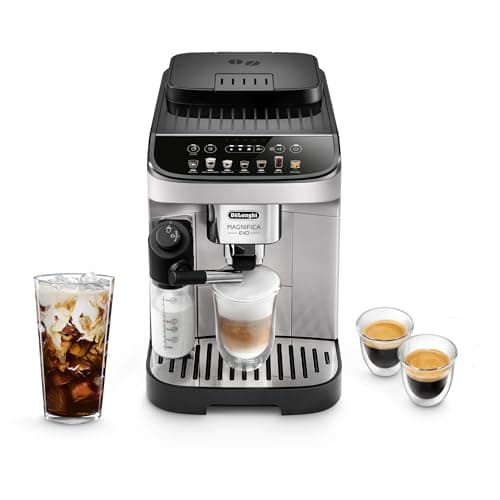
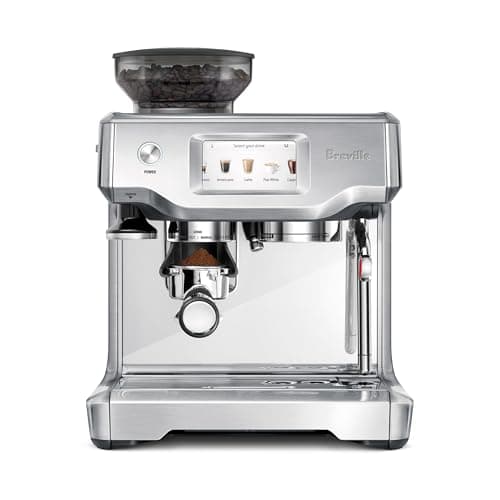
These two machines are chasing the same customer — someone who wants a cafe-style milk drink at home without learning to texture milk by hand — but they get there from opposite directions. The Breville Barista Touch is a semi-automatic machine with a real 54mm portafilter, a color touchscreen and an automatic steam wand: you still grind, dose and lock a portafilter into the group head yourself, so you stay involved in the espresso, but the milk is hands-free. The De'Longhi Magnifica Evo is a full super-automatic bean-to-cup: it grinds, doses, tamps, brews and froths behind a sealed brew group, so a whole latte lands in the cup on one button with nothing to hold, learn or clean up mid-drink.
The important word in both descriptions is "automatic," and it means two very different things. On the Touch, only the milk and the on-screen guidance are automated — the shot itself is a manual, hands-on act, which is exactly why you can dial it in and even pour latte art once you learn to steam by hand. On the Magnifica, the espresso is automated too: there is no portafilter to hold, no puck to prep, no wand to angle. That is the whole trade in one sentence — the Touch gives you cafe-style control plushands-free milk; the Magnifica gives you the least effort and the least control of any machine that still grinds fresh beans. Neither is "better" in the abstract; they suit different people.
So the honest way to choose is to be clear about how involved you want to be. If part of the appeal is standing at the machine, pulling a shot and watching it pour — but you never want to fuss with milk — the Touch is built for you. If the appeal is pressing one button on your way past the counter and walking off with a finished flat white, the Magnifica is built for you, and it shrugs off multiple users far more gracefully. Read our full Breville Barista Touch review and De'Longhi Magnifica Evo review for the deep dives, and see where each lands in our best espresso machines for lattes guide. If the semi- versus super-automatic distinction is still fuzzy, our semi-automatic vs super-automatic guide is the place to start.
The core difference: semi-automatic vs super-automatic
Everything else follows from this one distinction, so it is worth getting right. The Barista Touch is a semi-automatic machine: it grinds and helps you brew, but you lock a real 54mm portafilter into the group head, and you decide the dose and the timing. The Magnifica Evo is a super-automatic, or bean-to-cup: there is no portafilter at all, and a sealed internal brew group grinds, tamps and brews on its own the instant you press a button. On the Touch you are the barista and the machine is your assistant; on the Magnifica the machine is the barista and you are the customer. That is not a value judgment — it is the whole decision. If you enjoy the act of making espresso, the Touch keeps you in it; if the act is a chore you would rather skip, the Magnifica removes it entirely. Our semi-automatic vs super-automatic guide unpacks the two categories in full, and this pairing is close to the cleanest head-to-head example of them you can buy.
Espresso: control vs convenience
Because you hold a real portafilter, the Barista Touch lets you influence the shot the way a cafe barista does — grind finer or coarser, dose more or less, watch the pour and adjust next time. That control is why a semi-automatic can, with practice, out-pour a super-automatic, and it is the ceiling the Magnifica cannot reach: its espresso is genuinely good, clean and hot with real crema from freshly ground beans, but it is good rather than great, and the sealed brew group cannot be pushed the way a portafilter can. The Magnifica answers with a different strength — the floor. Every cup it makes is consistent, with no bad shots, no dialing-in and no learning curve, which matters enormously in a house where several people make coffee and none of them want to think about it. So the espresso question is really a question about you: do you want the chance to make a better shot (Touch), or a guaranteed good one with zero effort (Magnifica)? Neither machine, it is worth adding, is the equal of a manual machine paired with a dedicated grinderif absolute cup quality is your one priority — both trade some ceiling for convenience, just by different amounts.
Milk: two ways to go hands-free
Both machines free you from steaming milk by hand, which is the single hardest skill in home espresso, but they do it differently and the difference matters. The Touch uses an automatic steam wand: you set a target temperature and foam level on the screen, put the wand into your own pitcher, and it textures microfoam hands-free, then stops. Because it is a real wand working a real pitcher, the milk is closer to cafe microfoam, and you keep the option of switching to manual steaming later to learn latte art — the wand is automation you can graduate out of. The Magnifica uses the LatteCrema carafe: it draws milk from a sealed jug, aerates and heats it, and pours it straight into the cup on one touch, with no pitcher and nothing to hold. It also textures oat, almond and soy milks, per De'Longhi, and the carafe lifts off into the fridge between drinks. The carafe is more convenient and more foolproof, but it hands you a fixed result and will never pour latte art. In short: the Touch's milk is more capable and upgradeable; the Magnifica's is more effortless and more repeatable across users.
Effort, maintenance and living with each one
Day to day, the Magnifica asks less of you per drink — press a button, and later empty a dry-puck bin and run the automatic rinse and the carafe's clean cycle. The Touch asks more per drink — grind, dose, tamp, lock in, brew, then position the wand — but that "more" is the involvement some buyers are paying for, not a downside. On upkeep, the honest points cut both ways: the Magnifica's brew group is sealed and does not pull out for hand-cleaning, and its milk carafe is one more bulky part to wash and store; the Touch has a color touchscreen, which is one more electronic component that can eventually fail where a simpler machine has fewer. Both need periodic descaling like any pump machine, and both want medium roasts rather than oily dark or flavored beans in the hopper, because oils clog a built-in grinder over time. On size, both are large — the Touch is tall with its hopper and screen stack; the Magnifica is deeper front-to-back — so measure your counter and any cabinet clearance before you commit to either. We did not lab-test these machines; our methodology explains how we judge.
Which should you buy
- Buy the Breville Barista Touch ifyou want cafe-style control over the espresso — a real portafilter, the ability to dial in a shot and eventually pour latte art — but you never want to fuss with milk. It is the machine for someone who enjoys making coffee and only wants the hardest skill, milk texturing, handed off. Read the full Barista Touch review.
- Buy the De'Longhi Magnifica Evo if pure one-touch convenience is the goal, several people will use it, and you would rather receive a finished latte than make one. It is the lowest-effort, most repeatable of the two, with nothing to hold or learn. Read the full Magnifica Evo review.
- Consider neither ifyour one priority is the best possible shot — a manual machine and a standalone grinder will out-pour both, at the cost of learning to steam milk yourself. See the alternatives in our best espresso machines for lattes.