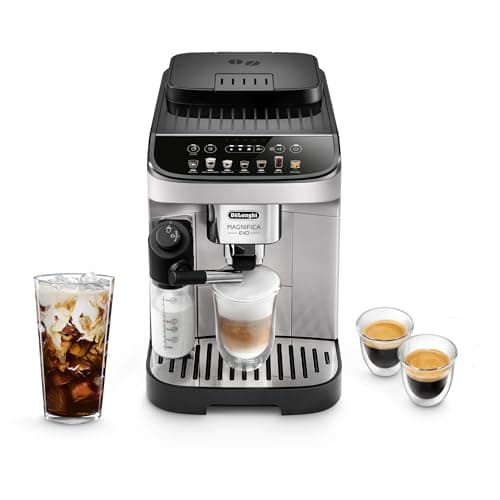
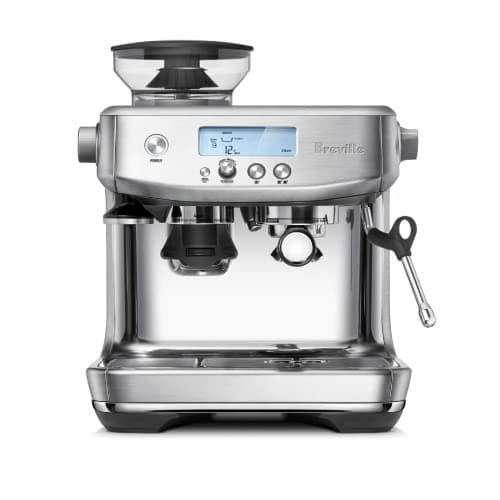
The Breville Barista Pro and the De'Longhi Magnifica Evo answer the same question — how do I get a cafe-style milk drink at home? — in almost opposite ways. The Pro is a semi-automatic all-in-one: it grinds fresh into a 54mm portafilter, but you dose, tamp, lock the group in, pull the shot and texture the milk at a manual wand yourself. The Magnifica Evo is a super-automatic bean-to-cup: it grinds, doses, tamps, brews and, on this LatteCrema model, froths the milk from a carafe at the push of one button, with no portafilter and no technique. This is not two versions of one machine; it is two philosophies. One asks you to be the barista. The other replaces the barista entirely.
That fork is the whole decision, so it is worth naming plainly before the specs. The Pro keeps you hands-on, and that is the point: you control the dose, the grind and the yield, and you texture the milk yourself, so you can genuinely improve the cup over time and chase a better shot. Near-instant ThermoJet heat-up and an on-screen LCD guide make that hands-on workflow fast and forgiving for a beginner rather than intimidating. The ceiling is higher than any bean-to-cup — a well-dialed Pro out-pulls a sealed super-automatic — but you have to meet it halfway. Read the machine in full in our Breville Barista Pro review before you decide whether the process appeals or puts you off.
The Magnifica Evo removes every one of those steps. You add whole beans and milk, press a drink button, and about ninety seconds later a latte lands in the cup with no dialing, no tamping and no wand to learn. That convenience is real and, for a lot of households, exactly the right trade: you give up the control that makes a manual machine capable of a truly excellent shot, and in return you never make a bad one. The espresso is good rather than great, and the LatteCrema carafe textures plant milks as well as dairy and lifts off into the fridge between drinks. Read our De'Longhi Magnifica Evo review for the full picture, and if you are still deciding between the two whole categories, our semi-automatic vs super-automatic guide is the place to start.
Semi-automatic vs super-automatic: the real fork
Before any spec, be clear about the categories, because the name of each machine hides the most important difference. The Barista Pro is a semi-automatic: it grinds for you, but you still dose, tamp, lock the portafilter into the group head and pull the shot, and you steam the milk yourself at a manual wand. You are involved at every step, which is exactly why you can influence the result. The Magnifica Evo is a super-automatic, also called bean-to-cup: there is no portafilter at all, and the machine grinds, doses, tamps, brews and froths behind a sealed brew group at the press of one button. That single structural difference decides everything downstream — how good the espresso can get, how much you have to learn, and how much you have to clean. Our semi-automatic vs super-automatic guide lays out which kind of drinker each category actually suits; this page is the specific head-to-head within that choice.
The ceiling vs the floor: espresso quality
Here is the honest way to frame the cup: a super-automatic raises the floor, and a semi-automatic raises the ceiling. The Magnifica Evo makes espresso that is genuinely good — clean, hot, with real crema from freshly ground beans — and, crucially, it makes it consistently, with no bad shots and nothing to dial. But the sealed brew group and fixed process cannot be pushed: you cannot meaningfully change the dose, the grind window or the yield, so the espresso tops out at good. The Barista Pro starts rougher — a beginner will pull a few sour or gushing shots while learning — but because you control the dose, the grind and the shot, a dialed-in Pro climbs past what any bean-to-cup at this level can reach. So the real question is not which makes better espresso in the abstract, but whether you want a machine that guarantees a good cup with zero effort, or one that rewards effort with a better cup. Neither answer is wrong; they are different goals.
Milk, cleaning and who each machine is really for
The milk is where the two philosophies show most clearly. The Pro gives you a manual steam wand: more control, the ability to pour real latte art once you learn, and the single hardest beginner skill to acquire. The Magnifica's LatteCrema carafe draws, heats and textures the milk for you on one touch, handles oat and almond as well as dairy, and lifts off into the fridge between drinks — effortless, if not quite latte-art microfoam. Cleaning follows the same split: the Pro is a wand to purge and a portafilter to knock out, while the Magnifica runs an automatic rinse and compacts grounds into a dry puck, though its carafe is one more bulky part to wash and its brew group is sealed rather than removable. So the recommendation is clean. Buy the Barista Pro if you want to be hands-on, value control and a higher ceiling, and see the process as part of the appeal. Buy the Magnifica Evoif you drink milk-based coffee, want it on one button with no learning curve, and would rather have your mornings back than chase a better shot — and see where it ranks in our best super-automatic machines roundup.
Both grind for you — the built-in grinder, and how we score
One thing both machines share: neither needs a separate grinder, because each has a conical burr grinder built in that grinds fresh for every cup. That is a genuine convenience and part of why both count as complete setups out of the box — both appear in our best espresso machines with a built-in grinder roundup for that reason. The honest caveat applies to each: a built-in grinder has to fit inside the body and hit a price, so it does not match a good dedicated unit, and you cannot upgrade it on its own. On the Pro, if you later chase light-roast single origins, a standalone grinder from our best grinders for espresso is the upgrade path; on the Magnifica the grinder is sealed into the workflow and simply is what it is. As for how we reached these verdicts: we did not bench-test either machine. Our methodology explains how we score from published manufacturer specifications, decoded manuals and aggregated owner reports rather than from lab measurements we did not take.
How we picked
We did not lab-test this gear
Everyone in this category says they tested twenty machines. We have not pulled shots on every product here, and we say so. What we did instead: compiled the published specifications, cross-checked the manufacturer manuals, computed the running cost (wattage to energy, grams-per-shot to cost-per-cup), weighed aggregated owner reports, and scored each product against a published rubric. The scores are judgments from documented research — not measurements we took, because we do not have a test lab and we will not pretend we do. Where hands-on time would tell you more than a spec sheet, we flag it. Where a number came from someone else's work, we name them in Sources.