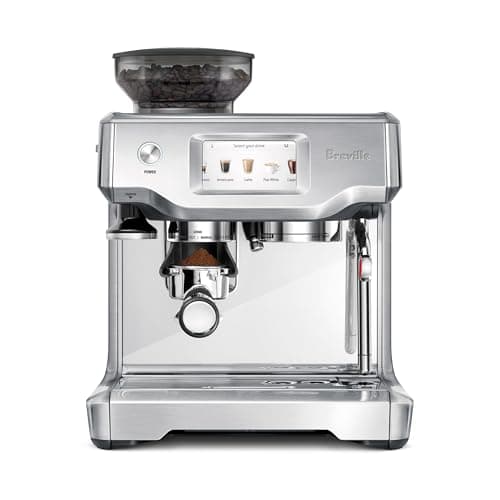
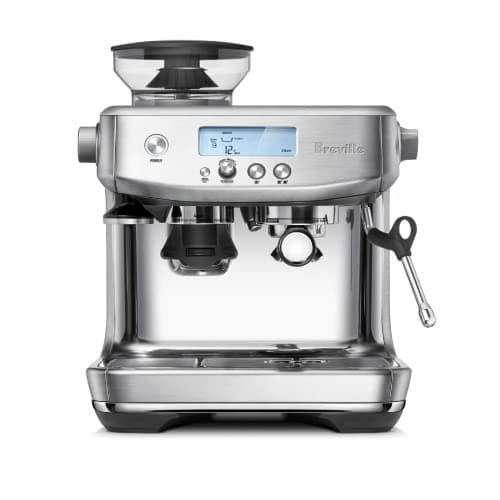
The Breville Barista Pro and Barista Touch are the top two rungs of Breville's all-in-one "Barista" ladder, and buyers cross-shop them constantly because, on paper, they look almost the same machine at two very different prices. They are more alike than the gap suggests. Both build a conical burr grinder, a 54mm brew system and a steam wand into one body; both heat with Breville's ThermoJet system that reaches temperature in about three seconds; both run the same 15-bar pump with 9-bar extraction. The espresso they pull is, for practical purposes, identical. The premium you pay for the Touch does not buy a better shot — it buys two specific conveniences, and whether you need them is the whole decision.
The Barista Pro is the value end of this particular pair. It textures milk with a manual steam wand— the same hands-on wand that lets you learn latte art — and it guides grind, dose and shot time on a compact LCD screen. The Barista Touch swaps in Breville's Auto MilQ automatic milk wand, which textures milk hands-free to a temperature and one of eight foam levels you set, and a full color touchscreen with a menu of saved drinks. That is the entire meaningful difference between them. If you have already read our Barista Express vs Pro comparison, this is the same story pushed one machine higher: not a better cup, just more automation wrapped around it.
So the question is refreshingly narrow. Do you want to steam milk yourself — and possibly learn to pour latte art — or do you want the machine to do it for you every morning without any technique? Answer that honestly and the winner is obvious. This page walks through the milk wand, the interface and the things that are genuinely identical, then tells you who each machine is for. Both sit in our best espresso machines under $1,000roundup, and both are reviewed in full — the Barista Pro review and the Barista Touch review— if you want the deeper single-machine read after this head-to-head.
The one difference that matters: the milk wand
Strip away the marketing and almost the entire case for spending up on the Touch comes down to how it handles milk. On the Barista Pro you texture milk yourself with a manual steam wand: you angle the pitcher, listen for the paper-tearing hiss, and stop at the right temperature by feel. It is a genuine skill, and it is the part of home espresso that beginners find hardest — but it is also the part that, once learned, lets you pour real latte art and fine-tune texture to the drink. The Barista Touch replaces that skill with a setting. Its Auto MilQ wand textures milk hands-free: you pick a target temperature and one of eight foam levels on the touchscreen, drop the wand into the pitcher, and the machine heats and textures the milk on its own, then stops. Breville designs it to produce microfoam without any technique at all. That is the whole premium, and it is a real, repeatable convenience for a cappuccino-and-latte household that does not want to learn the wand.
The honest trade is control versus consistency. The automatic wand hands you the same result every time with zero effort, which is exactly what a lot of people want. But a manual wand, once you are past the learning curve, gives you finer command over texture and the ability to actually pour art — a craft you can keep improving rather than a fixed outcome. If the milk ritual is part of the appeal, the Pro's manual wand will teach you more and take you further; our guide to steaming milk at home shows what that learning curve actually looks like before you decide it is not for you.
The interface: color touchscreen vs LCD
The second difference is the screen. The Touch has a full color touchscreen that stores a menu of preset cafe drinks — espresso, long black, latte, flat white, cappuccino and more — and lets you save up to eight personalized coffees, adjusting strength, milk texture and temperature by tapping through clear on-screen prompts. The Pro uses a smaller LCDthat still shows grind size, shot time and dose and walks you through the basics, just without the touch menu and the saved-drink library. For a first-time user the Touch's screen genuinely flattens the learning curve, and in a multi-person household the saved drinks are a nice touch. But it is worth being level-headed: the LCD on the Pro already does the important job of coaching you, and a touchscreen is one more electronic component that can eventually fail where a simpler display largely will not. You are paying for polish and presets, not for a screen that makes better coffee.
What is genuinely identical
This is the part the price gap hides. On Breville's own current product pages, the Pro and the Touch share the things that actually determine the shot: the same style of integrated conical burr grinder with 30 grind settings and single-touch grind and dose, the same 54mm portafilter and brew system, the same 15-bar pump with low-pressure pre-infusion and 9-bar extraction, and the same ThermoJet heating that reaches temperature in about three seconds. That last point is worth underlining, because it is different from the Express-versus-Pro decision: there, the Pro's faster heat-up was a real reason to upgrade. Here, both machines heat identically, so speed is off the table entirely. The espresso in the cup is the same from either machine. When two machines share the grinder, the brew group, the pump and the heater, they make the same coffee — and these two do. If grind quality is the thing you care about most, note that a dedicated espresso grinder will out-grind the built-in unit on either machine, which is the argument for the separates route over any all-in-one.
Size, footprint and living with them
Both are large machines, and they are within a hair of each other: the Pro measures roughly 16.1 inches deep and the Touch about 12.6, with both around 15 to 16 inches wide and tall once you account for the bean hopper up top. The built-in grinder and hopper are what make either machine tall and deep, so measure your counter — and the clearance under any wall cabinets, since the hopper sits on top — before you buy. Neither is a small machine. If counter space is tight, that is an argument for the separates route: a compact machine like the Breville Bambino plus a small standalone grinder can be easier to fit than one tall all-in-one, and it lets you upgrade the grinder later without replacing the machine. We did not bench-test either unit; our methodology explains how we judge.
What we did not test
We have not run either machine on a bench for months, and we do not claim to. This comparison compiles Breville's published specifications for the BES878 and BES880, cross-checks them against each other and against the shared Barista platform, and weighs aggregated owner reports against our scoring rubric. The grinder, the 54mm brew system, the ThermoJet heat-up, the manual wand on the Pro and the Auto MilQ automatic wand and color touchscreen on the Touch all come from Breville's own materials, listed in Sources. Where hands-on time would tell you more than a spec sheet — exactly how consistent the automatic wand is across dairy and plant milks, how each grinder holds its setting over months — we say so rather than invent a figure. Prices are never quoted from memory; the live price renders from our pipeline with the date it was checked.
Which Breville fits you
- Buy the Barista Pro ifyou are happy to steam milk by hand — or want to learn latte art — and you would rather not pay extra for automation you will not use. It pulls the identical shot for less, and the savings buy a scale and better beans that improve your coffee more than a screen does.
- Buy the Barista Touch if you want cafe-style milk drinks with zero technique, you like a guided color touchscreen with saved drinks, and the hands-free Auto MilQ wand is worth a clear premium to you. That automation is the only real thing the extra money buys.
- Consider the Barista Express instead ifyou are on a tighter budget and can live with a slower heat-up — it pulls the same espresso for the least money, and the Express vs Pro comparison covers that lower step in detail.
- Consider neither ifgrind quality and flexibility matter more than single-box simplicity — a compact machine plus a dedicated grinderis the better long-term setup — or if you want the whole process automated, in which case a super-automatic machine is the category you actually want.
Whichever you choose, the accessories that make espresso repeatable still apply — a basket-matched tamper, a WDT tool and fresh beans. For the wider field at this price, see best espresso machines under $1,000.