Skip to content
Portafilter Co

Machines · Espresso Machines

Breville Barista Pro vs De'Longhi La Specialista Arte Evo

Two mid-premium all-in-ones that grind, brew and steam from one body. The Barista Pro heats in seconds and coaches you on an LCD screen; the Arte Evo guides your grinding, dosing and tamping. Here is which one fits your counter and your mornings.

By Stephen V.Updated How we pick
#ad

We earn a commission when you buy through our Amazon links, at no extra cost to you. It never changes a verdict, and we say so when the cheaper product is the better buy. How this works.

The Breville Barista Pro and the De'Longhi La Specialista Arte Evo are the two machines most first-time buyers cross-shop once they decide they want one box that does everything— grinder, brew group and steam wand in a single body, so whole beans go in and espresso comes out without a separate grinder eating the counter. Both are mid-premium all-in-ones, both roughly the same money, and both try to hold your hand through the parts of espresso that scare a beginner. Where they split is how they help you, and that is the whole decision.

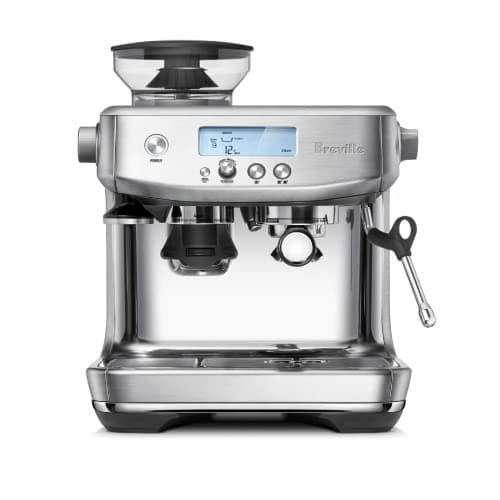
The Breville Barista Pro is the speed-and-screen machine. Its ThermoJet heater reaches espresso temperature in seconds rather than the few minutes an older thermocoil needs, so it is ready almost before you have finished dosing, and an LCD screen replaces a fussy analog gauge with grind size, dose and shot time shown as numbers you can read and repeat. It is guidance by information: the machine tells you what is happening and lets you drive.

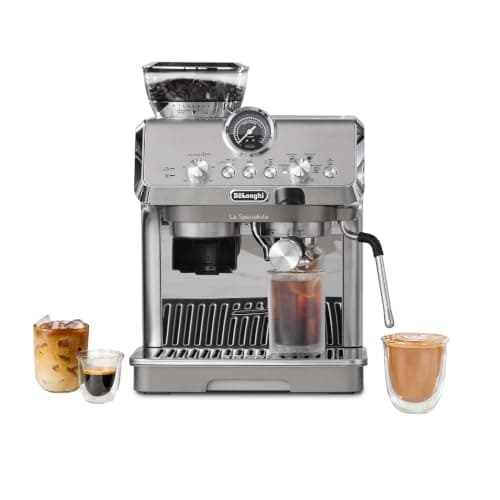
The De'Longhi La Specialista Arte Evo takes the opposite tack. It guides by doing— sensor-assisted grinding that doses toward the portafilter, a workflow built around De'Longhi's guided grind-and-tamp station, and a set of one-touch presets (Espresso, Americano, Cold Brew, Hot Water) that make it feel like an appliance rather than a bare lever machine. It hands more of the physical fiddling — the grinding, the dosing, the tamping rhythm — back to the machine, and it adds a commercial-style manual steam wand and a big 2 L tank on top.

So this is not a “which is better” question — it is a temperament question. Do you want a machine that is instantly ready and shows you the numbers while you stay in control (the Pro), or one that walks you through the whole ritual and pours you a cold brew on a Tuesday (the Arte Evo)? Below we rank them, then compare heat-up, the grind-and-dose workflow, milk texturing, footprint and who each one actually suits. If you are also weighing the two brands more broadly, our Breville vs De'Longhi guide is the wider view, and the Barista Express vs Pro comparison settles the in-family Breville question if you are not sure you need the Pro at all.

The short answer

Quick picks

#ProductBest forScorePrice
01
Breville Breville Barista Pro (BES878BSS)
Breville Barista Pro (BES878BSS)

The one to buy if you want to be up and pulling a shot the moment you walk into the kitchen, with the numbers on a screen instead of a needle. ThermoJet heat-up is near-instant, so there is effectively no warm-up wait, and the LCD shows grind size, dose and shot time so you can read a change, make it, and repeat it. It keeps you in the driver's seat: an integrated conical grinder, a 54mm brew system and a manual steam wand you learn rather than a machine that does it for you. Against the Arte Evo it wins on speed, on the wider 54mm accessory world, and on a cleaner information display; it gives up the De'Longhi's one-touch cold brew, its larger tank and its more hand-held grind-and-tamp routine. Buy the Pro for fast, in-control mornings.

Best for speed and display
8.2
$844.99Amazon
02
De'Longhi De'Longhi La Specialista Arte Evo (EC9255)
De'Longhi La Specialista Arte Evo (EC9255)

The one to buy if you want the machine to walk you through the whole ritual rather than just show you numbers. The guided grind-and-tamp workflow doses toward the portafilter and takes much of the fiddly setup off your hands, four presets (Espresso, Americano, Cold Brew, Hot Water) make it feel like an appliance, and a commercial-style manual steam wand still teaches real milk texturing you control by hand. A large 2 L tank means far less refilling, and Active Temperature Control plus a 15-bar pre-infusion give the guided workflow real levers. Against the Barista Pro it wins on hand-holding, on the on-demand cold brew the Breville simply does not offer, and on tank size; it gives up ThermoJet's instant readiness, the wider 54mm accessory world (it is a 51mm group), and the tighter temperature stability of a machine that is not a flow-through thermoblock. Buy the Arte Evo for a guided, do-everything counter.

Best guided workflow
7.5
$499.95Amazon

#ad · Live prices from the Amazon Product API, as of Jul 30, 2026. Where we have no verified live price, we show none — a gap beats a number that has rotted.

In detail

The picks, in full

01
Breville Breville Barista Pro (BES878BSS)

Best for speed and display

Breville Barista Pro (BES878BSS)

Integrated conical burr grinderThermoJet heating (near-instant warm-up)54mm portafilter, manual steam wandLCD screen with shot guidance
8.2/10

The one to buy if you want to be up and pulling a shot the moment you walk into the kitchen, with the numbers on a screen instead of a needle. ThermoJet heat-up is near-instant, so there is effectively no warm-up wait, and the LCD shows grind size, dose and shot time so you can read a change, make it, and repeat it. It keeps you in the driver's seat: an integrated conical grinder, a 54mm brew system and a manual steam wand you learn rather than a machine that does it for you. Against the Arte Evo it wins on speed, on the wider 54mm accessory world, and on a cleaner information display; it gives up the De'Longhi's one-touch cold brew, its larger tank and its more hand-held grind-and-tamp routine. Buy the Pro for fast, in-control mornings.

Heat-up speed
10
Grinder
8
Steam
8
Interface
9
Espresso quality
8
Value
6

Pros

  • Near-instant ThermoJet heat-up — ready in seconds, not minutes
  • LCD screen guides grind size, dose and shot time on a clear display
  • Same grind-to-cup convenience with the grinder built in
  • Manual steam wand textures milk well once you learn it
  • Newer, cleaner interface than the analog Barista Express

Cons

  • Espresso is very similar to the cheaper Barista Express — the upgrade is speed, not the cup
  • Costs meaningfully more than the Express for a near-identical shot
  • Large footprint — the built-in grinder and hopper add height and depth
  • Single boiler means a short pause between brewing and steaming
  • Built-in grinder is convenient but a dedicated grinder still grinds better

Don't buy this if…

you want the machine to shoulder more of the grinding, dosing and tamping for you, or you want cold brew on demand and a big tank — the La Specialista Arte Evo hand-holds harder and pours cold coffee the Pro cannot.

$844.99View on Amazon

Price as of Jul 30, 2026. Prices change — Amazon's at checkout is the one that counts.

#ad · we may earn a commission from this link to Breville Barista Pro (BES878BSS)

02
De'Longhi De'Longhi La Specialista Arte Evo (EC9255)

Best guided workflow

De'Longhi La Specialista Arte Evo (EC9255)

51mm portafilterBuilt-in conical burr grinderThermoblock, 1,550 W2 L tank + cold extraction
7.5/10

The one to buy if you want the machine to walk you through the whole ritual rather than just show you numbers. The guided grind-and-tamp workflow doses toward the portafilter and takes much of the fiddly setup off your hands, four presets (Espresso, Americano, Cold Brew, Hot Water) make it feel like an appliance, and a commercial-style manual steam wand still teaches real milk texturing you control by hand. A large 2 L tank means far less refilling, and Active Temperature Control plus a 15-bar pre-infusion give the guided workflow real levers. Against the Barista Pro it wins on hand-holding, on the on-demand cold brew the Breville simply does not offer, and on tank size; it gives up ThermoJet's instant readiness, the wider 54mm accessory world (it is a 51mm group), and the tighter temperature stability of a machine that is not a flow-through thermoblock. Buy the Arte Evo for a guided, do-everything counter.

Espresso quality
7
Steaming & milk texturing
7
Ease of use
8
Build & reliability
6
All-in-one convenience
9
Value
8

Pros

  • A genuinely complete setup out of the box — built-in conical burr grinder, tamping tools and a manual steam wand, nothing else to buy to start pulling shots
  • Large 2 L water tank means noticeably less refilling than most machines in this bracket
  • Cold Extraction Technology and a dedicated Cold Brew preset (plus Americano and hot water) that the Brevilles simply do not offer
  • Commercial-style manual steam wand heats quickly and teaches real milk texturing you control by hand, rather than an auto-frother
  • Active Temperature Control with three selectable infusion temperatures and a 15-bar pre-infusion, so the guided workflow still gives you levers to dial in

Cons

  • 51mm portafilter — far fewer bottomless portafilters, precision baskets and tampers than 54mm (Breville) or 58mm
  • Thermoblock heating, even with Active Temperature Control, is less thermally stable across back-to-back shots than a PID-managed thermocoil or boiler
  • Only eight stepped grind settings — a narrow range next to the dozens of steps, or stepless adjustment, on a dedicated espresso grinder, so fine dial-in is limited
  • Mostly plastic housing over metal accents, so it does not feel as solid as an all-metal machine at this price
  • Cold Extraction is a genuine novelty but not something most espresso drinkers use daily, and it is part of what you are paying for

Don't buy this if…

you value instant readiness and the widest room to grow an accessory habit — the Barista Pro's ThermoJet is ready in seconds and its 54mm group opens a much larger world of baskets and portafilters than this 51mm one.

$499.95View on Amazon

Price as of Jul 30, 2026. Prices change — Amazon's at checkout is the one that counts.

#ad · we may earn a commission from this link to De'Longhi La Specialista Arte Evo (EC9255)

Heat-up: instant vs quick-enough

This is the cleanest win on the board, and it goes to the Breville. The Barista Pro's ThermoJetsystem reaches espresso temperature in seconds — effectively no warm-up at all — so you walk up, and the machine is ready before you have finished dosing and tamping. If you make coffee in a rush on a work morning, or you simply hate watching a light blink, that near-zero wait is the single feature owners notice most. The Arte Evo heats with a thermoblock, a flow-through heater that also warms quickly — it is not slow, and for a drink or two you will not feel deprived — but “ready in a moment” is not the same as “ready instantly.”

Heat-up speed and heat stabilityare two different things, and it is worth separating them. The Pro is faster to get going; the Arte Evo answers with Active Temperature Control, three selectable infusion temperatures that let a pickier drinker pick how hot the water runs. But a thermoblock holds brew temperature a little less tightly across back-to-back shots than a PID-managed system, so when guests are over and you are pulling a run of drinks, the more thermally stable machine has the quieter edge. For one or two cups a morning — how most people actually drink — neither limit shows. Buy the Pro if the morning clock matters most; lean De'Longhi if you would rather choose your temperature than shave seconds.

The grind-and-dose workflow: numbers vs hand-holding

Both machines grind fresh into the basket — that is the point of an all-in-one — but the experience is philosophically different. The Barista Pro gives you an integrated conical burr grinder and puts the data on the LCD: grind size, dose and shot time shown as numbers, so the loop becomes read, adjust, repeat. Grind ran too fast? Go finer, watch the timer, dial it in. It is guidance for someone who wants to learn the levers and stay in control of them, which is exactly what a lot of first machines fail to make legible.

The Arte Evo instead builds the whole grind-dose-tamp routine into a guided station and doses a single or double straight toward the portafilter, taking much of the fiddly physical setup off your hands. If the part of espresso that intimidates you is the tamping-and-distribution ritual rather than reading a gauge, this hand-holding is the more reassuring of the two. The honest trade is resolution: De'Longhi gives the grinder eight stepped settings, plenty to find a workable grind for a bag of medium roast but coarse if you like to make small, deliberate adjustments or chase very light single origins. The Breville's grinder is not a stepless competition unit either, but between the two the Pro leaves a little more room to fine-tune, and its numbers-on-screen approach makes those tweaks repeatable. Whichever you pick, the grinder inside any all-in-one is a step below a good standalone unit — if grind quality becomes your obsession, our best grinders for espresso is the upgrade path, and it pulls either machine further than its own burrs can.

Milk texturing and the portafilter question

Both machines steam milk the honest way — a manual steam wandyou learn, not an auto-frother that does it for you — so a flat white or a cappuccino is a skill you build on either. The Pro's wand textures well once you find the rhythm; the Arte Evo's commercial-style wand heats quickly and, by most owner accounts, is a touch more powerful, which some beginners find easier to learn microfoam on. Call this one close, with a slight nod to the De'Longhi wand for raw steam and a slight nod to the Pro for how quickly the single-boiler design swaps between brewing and steaming once warm. Both share the single-boiler reality: a short pause between the shot and the steam.

The bigger structural split is the group size. The Barista Pro is a 54mm machine; the Arte Evo is 51mm. On day one this barely matters — a good 51mm basket pulls a perfectly enjoyable shot — but it quietly decides how far you can grow. Bottomless portafilters, precision baskets, better tampers and distribution tools are far more plentiful for 54mm than for 51mm. If you suspect you will fall down the espresso rabbit hole, the Pro's wider group is the safer buy; if you will never own a second basket, the 51mm ceiling is invisible and the Arte Evo's extras (tank, presets, cold brew) matter more. We unpack this exact 54-vs-51 trade in the brand-level Breville vs De'Longhi comparison.

Footprint, tank and the extras

Neither of these is a small machine — both stack a grinder and hopper on top of a brew group and steam wand, so both want depth on the counter and clearance under the cabinets. Measure before you buy either. The practical difference in daily living is the water: the Arte Evo carries a large 2 L tankthat means noticeably less refilling if the machine gets used all day, a small quality-of-life win that adds up. The Pro's tank is the more ordinary size for the class.

Then there are the extras only the De'Longhi has: Cold Extraction Technologywith a dedicated Cold Brew preset that pulls cold coffee in minutes rather than steeping overnight, plus Americano and Hot Water presets. If cold coffee is genuinely part of your routine, no Breville in this bracket offers it, and that tips the Arte Evo ahead. Be honest with yourself about it, though — for a dedicated espresso drinker cold extraction is a feature you either use constantly or almost never, with little middle ground, and you pay for it either way. The Pro answers not with more presets but with speed and a cleaner display: fewer party tricks, faster mornings, tighter feedback. That is the trade in miniature — the Arte Evo does more things, the Pro does the core thing quicker and clearer.

Which should you buy

  • Buy the Breville Barista Pro ifyou want to be ready to pull a shot the second you walk in, you like seeing grind, dose and shot time as numbers you can repeat, and you want the wider 54mm accessory world to grow into. It is the fast, in-control, upgrade-friendly choice — the full case is in our Barista Pro review, and if you are not sure you even need the Pro over its cheaper sibling, the Barista Express vs Pro comparison is the tie-breaker.
  • Buy the De'Longhi La Specialista Arte Evo ifyou want the machine to walk you through the grinding, dosing and tamping, you would use a one-touch cold brew, and a big 2 L tank and a strong manual steam wand appeal more than shaving seconds off warm-up. It is the guided, do-everything choice — the full breakdown, 51mm ceiling and all, is in our La Specialista Arte Evo review.
  • Consider neither all-in-one ifgrind quality and long-term flexibility matter more than single-box simplicity. A compact machine paired with a dedicated grinder makes better espresso and outgrows either built-in unit — start with our best grinders for espresso.

What we did not test

We have not run either machine on a bench for months, and we do not claim to have. This comparison compiles Breville's published specifications for the Barista Pro and De'Longhi's for the La Specialista Arte Evo — the ThermoJet and thermoblock heating, the 54mm and 51mm brew systems, the two integrated conical grinders, the manual steam wands, the LCD interface and the cold-brew presets — and weighs them against aggregated owner reports using our scoring rubric. Where hands-on time would tell you more than a spec sheet — exactly how each steam wand behaves under load, how tightly the thermoblock holds temperature shot to shot, how each grinder retains its setting over months — we say so rather than invent a figure we did not measure.
How we picked

We did not lab-test this gear

Everyone in this category says they tested twenty machines. We have not pulled shots on every product here, and we say so. What we did instead: compiled the published specifications, cross-checked the manufacturer manuals, computed the running cost (wattage to energy, grams-per-shot to cost-per-cup), weighed aggregated owner reports, and scored each product against a published rubric. The scores are judgments from documented research — not measurements we took, because we do not have a test lab and we will not pretend we do. Where hands-on time would tell you more than a spec sheet, we flag it. Where a number came from someone else's work, we name them in Sources.

Questions

Frequently asked

Barista Pro vs La Specialista Arte Evo — which is better?
Neither is strictly better; they hand-hold differently. The Breville Barista Prois the speed-and-display machine — near-instant ThermoJet heat-up and an LCD that shows grind, dose and shot time, keeping you in control. The De'Longhi La Specialista Arte Evois the guided-workflow machine — it shoulders more of the grinding, dosing and tamping, adds a big tank and pours cold brew on demand. Pick the Pro for fast, in-control mornings; the Arte Evo for the machine to walk you through the ritual.
Which heats up faster, the Barista Pro or the Arte Evo?
The Barista Pro, clearly. Its ThermoJet system reaches espresso temperature in seconds — effectively no warm-up wait — so it is ready almost as fast as you are. The Arte Evo's thermoblock also heats quickly and is far from slow, but it is not instant. If a rushed morning clock is your main concern, the Pro is the machine built for it. Note that heat-up speed and temperature stability differ: the Arte Evo answers with three selectable infusion temperatures, while the Pro's strength is simply being ready right now.
Do both machines have a built-in grinder, and is one better?
Yes — both are true all-in-ones with an integrated conical burr grinder, so you go from whole beans to a filled basket with nothing else on the counter. The Barista Pro shows grind size on its LCD and leaves a little more room to fine-tune, which makes adjustments easy to read and repeat. The Arte Evo builds the grinding and dosing into a more guided station but offers eight stepped settings, which is workable for medium roasts and tight for very light single origins. Either grinder is a step below a dedicated unit — see our best grinders for espresso for the upgrade path.
Why does the 54mm vs 51mm portafilter difference matter?
The Barista Pro uses a 54mm group and the Arte Evo a 51mm one. On day one it barely changes the shot — a good 51mm basket brews a perfectly enjoyable espresso. What it changes is how far you can grow: bottomless portafilters, precision baskets and better tampers are far more plentiful for 54mm than for 51mm. If you expect to build an accessory habit, the Pro's wider group is the safer buy; if you will never own a second basket, the 51mm ceiling is invisible. Our Breville vs De'Longhi guide walks this trade-off in full.
Can either machine make cold brew or milk drinks?
Only the De'Longhi La Specialista Arte Evo makes cold brew on demand — its Cold Extraction Technology has a dedicated Cold Brew preset that pulls cold coffee in minutes, alongside Americano and Hot Water presets the Breville does not offer. For milk drinks, both use a manual steam wand you learn by hand rather than an auto-frother, so a cappuccino or flat white is a skill you build on either; the Arte Evo's commercial-style wand is a touch more powerful for raw steam, while the Pro swaps between brewing and steaming a little more briskly once warm.

Keep reading

Receipts

Sources

We do not run a testing lab, and we do not pretend to. Where a measured number came from someone else's work, we name them and link them. Where we could not verify something, we say so on the page rather than quietly leaving it out. Read our full method.