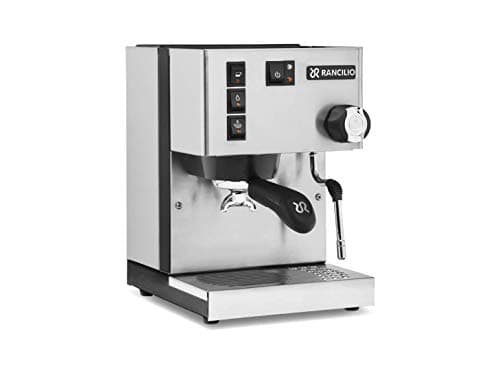
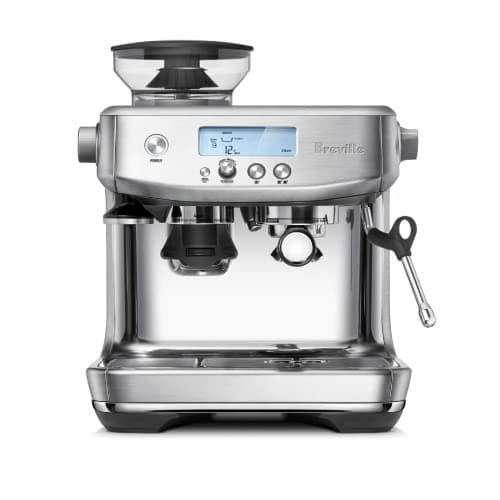
The Breville Barista Pro and the Rancilio Silvia are both machines you can pull a genuinely good shot on, and almost everything else about them points in opposite directions. The Pro is a modern all-in-one: a conical burr grinder built into the body, ThermoJet heating that is ready in seconds, an LCD screen that guides each shot, and a manual steam wand — a complete beans-to-cup setup in one box that a beginner can run on day one. The Silvia is a heavy slab of commercial-grade metal: a chromed-brass group head, an insulated brass boiler, a genuine 58mm portafilter and a full-motion steam wand, in a machine designed to be opened, serviced, modified and kept for years. Same category on paper, two completely different relationships with espresso.
The Pro is built to remove friction. It grinds for you, heats almost instantly, coaches you on a screen, and asks for nothing you do not already own — no separate grinder, no warm-up ritual, no temperature surfing. That convenience is the entire point, and for a lot of people it is exactly the right trade. What you give up is the top end: the built-in grinder is good rather than great and cannot be upgraded on its own, the 54mm platform is a slightly smaller accessory world than the cafe standard, and it is a consumer all-in-one rather than a serviceable benchmark. Read it in full in our Breville Barista Pro review before you decide whether convenience is what you are actually shopping for.
The Silvia removes nothing and adds craft. It takes commercial parts from Rancilio's cafe line and asks you to bring the skill, the warm-up and the patience, repaying you with a machine that feels permanent: once warm the brass is a thermal rock, the 58mm portafilter takes every cafe-grade basket and tamper, and a bolt-on PID is the single most popular home-espresso upgrade there is. The honest costs are the mirror image of the Pro's convenience — no factory PID, a long warm-up, no grinder in the box, and a single boiler that makes you wait between brewing and steaming. Read our Rancilio Silvia review for the full picture; this page is about which of the two suits you. If you are weighing the Silvia against the grinder-included Breville all-in-one from the other direction, our Rancilio Silvia vs Barista Express comparison covers that angle too.
All-in-one convenience vs a machine you build around
The clearest way to frame this pairing is what each machine assumes about you. The Barista Pro assumes you want espresso with the least possible friction: it builds the grinder into the body, so there is nothing else to buy or house, and it hands you an on-screen guide so you are not interpreting anything on your own. It is a complete, self-contained appliance. The Silvia assumes the opposite — that you want to assemble and understand your own setup. It is deliberately sold bare, on the 58mm cafe standard, so you choose your grinder, your baskets, your tamper and, if you like, a dedicated espresso grinderthat out-grinds anything built into a machine. One path is a single box that works out of the crate; the other is a platform you grow into and service for years. That difference — appliance versus platform — is the real decision, and it decides everything else on this page.
Heat-up and thermal stability: ThermoJet speed vs brass mass
Both are single boilers, but they behave like opposites every morning. The Pro's ThermoJet system reaches brew temperature in seconds, so it is ready almost as fast as you are — a grab-and-go machine with no warm-up tax. The Silvia is the reverse by design: its heavy brass group and insulated brass boiler are exactly what make it thermally stable once hot, but that same mass takes real time to come fully up to temperature, well beyond when the ready light first turns on, and many owners run it on a timer so it is warm when they wake. The pay-off is stability — a warmed-up Silvia holds shot temperature like a thermal battery, and without a factory PID you learn to temperature-surf that steadiness or fit a controller later. So the Pro wins on speed and convenience; the Silvia wins on the kind of rock-steady thermal behavior that only real metal mass provides, if you are willing to wait for it and work with it.
Build, the 58mm ecosystem and the long game — which do you buy?
This is where the machines stop pretending to be in the same conversation. The Pro is a modern consumer all-in-one on the 54mm Breville platform, built to be affordable, convenient and easy to live with now; it is not designed to be unscrewed and serviced for twenty years. The Silvia is a single-piece stainless body wrapped around commercial brass on the 58mm cafe standard, explicitly designed to be maintained, modded and kept — parts are stocked, exploded diagrams are everywhere, and that 58mm number unlocks the full ecosystem of cafe-grade baskets, tampers, distribution tools and bottomless portafilters. So the recommendation is clean. Buy the Barista Pro if you want one modern box that grinds, heats fast and just works, and you would rather not think about warm-up, grinders or servicing. Buy the Rancilio Silviaif you want a heavy, serviceable, commercial-brass machine you will learn, temperature-surf, maybe PID and keep for a decade — and you enjoy that ritual rather than resenting it. See where both land against the wider field in our best espresso machines under $1,000 roundup.
The grinder is half the setup — and how we score
Do not let the machine choice distract from the part that actually decides your cup. On the Silvia the grinder is a required separate purchase, and on a machine this capable it matters as much as the machine itself — a poor grinder wastes the brass entirely, so budget for a consistent, espresso-capable burr grinder from our best grinders for espressobefore you spend anything on tampers or a nicer portafilter. On the Pro the grinder is built in and good for most roasts, but it is still not the equal of a dedicated unit and you cannot upgrade it on its own; the pickier your beans, the more that ceiling shows. Either way, a Silvia fed by a bad grinder loses to a Pro fed by a good one — the grind is that decisive. As for how we reached these verdicts: we did not bench-test either machine. Our methodology explains how we score from published manufacturer specifications, decoded manuals and aggregated owner reports rather than from lab measurements we did not take.
How we picked
We did not lab-test this gear
Everyone in this category says they tested twenty machines. We have not pulled shots on every product here, and we say so. What we did instead: compiled the published specifications, cross-checked the manufacturer manuals, computed the running cost (wattage to energy, grams-per-shot to cost-per-cup), weighed aggregated owner reports, and scored each product against a published rubric. The scores are judgments from documented research — not measurements we took, because we do not have a test lab and we will not pretend we do. Where hands-on time would tell you more than a spec sheet, we flag it. Where a number came from someone else's work, we name them in Sources.