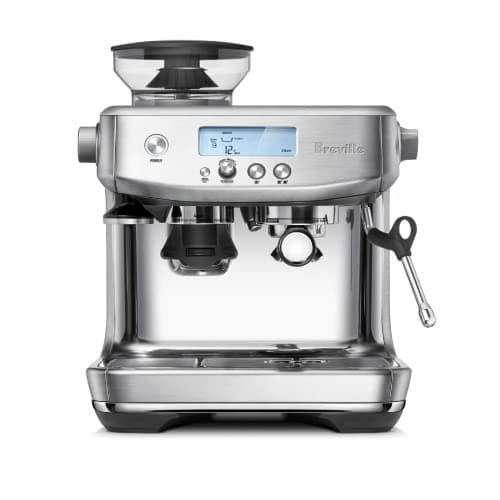
The Breville Barista Pro is an all-in-one espresso machine — a conical burr grinder, brew group and steam wand built into one body, so you go from whole beans to a shot without a separate grinder taking up the counter. In the simplest terms, it is the hugely popular Barista Express with two upgrades bolted on: a near-instant ThermoJet heating system and an LCD screen. Almost everything else that matters — the integrated grinder, the 54mm portafilter, the manual steam wand — carries straight over.
Those two changes are genuinely useful. ThermoJet reaches espresso temperature in seconds rather than the few minutes the Express's ThermoCoil needs, so the Pro is ready almost as fast as you are — a real daily convenience if you make coffee in a hurry. The LCD screen replaces the Express's analog pressure gauge and walks you through grind size, dose and shot time on a display, which flattens the learning curve for a first-time user. If you are weighing the two head-to-head, our Barista Express vs Pro comparison is the tie-breaker, but the short version is that the Pro is the faster, more guided of the two.
The honest part is what does not change. The espresso the Pro pulls is very close to the Express's — same 54mm brew system, same integrated grinder, same manual steam wand — so you are paying the premium for heat-up speed and the screen, not for a better cup. It is also a large machine, and the built-in grinder, while convenient, is not the equal of a good standalone unit; if grind quality is your priority, a dedicated espresso grinder still beats it. See where the Pro sits against the wider field in our best espresso machines under $1,000 roundup.
What ThermoJet actually changes
The headline upgrade over the Express is Breville's ThermoJet heating system. Where the Express's ThermoCoil wants a few minutes to come up to temperature, ThermoJet is ready in seconds — effectively no warm-up wait at all. That sounds minor written down, but it is the change owners notice most in daily use: you walk up, and the machine is ready to pull a shot before you have finished dosing and tamping. If you make coffee in a rush before work, or you simply hate standing around waiting for a light to stop blinking, this is the feature you are buying. It does not make the espresso taste different — it removes the wait around it.
The LCD screen: real help or a gimmick?
The second upgrade is the LCD screen that replaces the Express's analog pressure gauge. It shows grind size, shot time and dose settings on a display, and it is genuinely useful for a beginner: instead of interpreting a needle, you get numbers you can read, adjust and repeat. For someone learning the rhythm of espresso — grind finer if the shot runs too fast, dose a little more, watch the timer — the on-screen coaching lowers the barrier. Experienced users will lean on it less, and it does not do anything the Express cannot with a little know-how, but it is a real convenience rather than decoration.
Same cup as the Barista Express
Here is the part the marketing will not lead with: the Pro and the Express pull very similar espresso. They share the same 54mm portafilter and brew logic and the same style of integrated conical burr grinder, so the shot in the cup is not where the extra money goes. If you have read our Barista Express vs Pro comparison, this is the conclusion it reaches too: the Pro is faster and friendlier, not a better brewer. For most buyers that means the decision is really about how much you value speed and the screen — if a few minutes of warm-up does not bother you, the Express is the smarter spend and the cup will be the same.
The built-in grinder, honestly
The integrated grinder is the whole point of an all-in-one: no separate box on the counter, and you grind fresh straight into the portafilter. It is good, and for a lot of people it is all the grinder they will ever need. But be clear-eyed about the trade-off — a machine grinder has to fit inside the body and hit a price, so it is not the equal of a dedicated espresso grinder, and you cannot upgrade it on its own later. If grind quality is the thing you care about most, the honest path is a smaller machine paired with a proper standalone unit from our best grinders for espresso. The all-in-one trades a little grind ceiling for a lot of convenience; whether that is the right trade is the real question behind buying either Breville.
Size and counter space
Like the Express, the Barista Pro is a large machine. The built-in grinder and bean hopper add height and depth on top of the brew group and steam wand, and the hopper sits up top, so you need clearance under any wall cabinets as well as depth on the counter. Measure before you buy. If space is tight, this is another argument for the separates route — a compact machine plus a small grinder can be easier to fit than one tall all-in-one, and it appears in our best machines under $1,000 alongside the Pro so you can weigh footprints side by side.
Who it is for
- Buy the Barista Pro if you want an all-in-one, you value near-instant heat-up and an on-screen guide, and you would rather not wait for the machine every morning. That convenience is exactly what the premium over the Express buys.
- Buy the Barista Express instead ifyou are on a budget and a few minutes of warm-up is no hardship — it pulls a near-identical shot for less, and you can put the savings toward beans and a scale.
- Skip both ifgrind quality and flexibility matter more than single-box simplicity — a compact machine plus a dedicated grinder is the better long-term setup.
What we did not test
We have not run this machine for months on a bench, and we do not claim to have. This review compiles Breville's published specifications for the Barista Pro, cross-checks them against the Barista Express it is based on, and weighs aggregated owner reports against our scoring rubric. The ThermoJet heat-up behavior, the 54mm brew system, the integrated grinder and the LCD interface all come from Breville's own materials, listed in Sources. Where hands-on time would tell you more than a spec sheet — exactly how the steam wand behaves under load, how the grinder holds its setting over months — we say so rather than invent a figure.
How we picked
We did not lab-test this gear
Everyone in this category says they tested twenty machines. We have not pulled shots on every product here, and we say so. What we did instead: compiled the published specifications, cross-checked the manufacturer manuals, computed the running cost (wattage to energy, grams-per-shot to cost-per-cup), weighed aggregated owner reports, and scored each product against a published rubric. The scores are judgments from documented research — not measurements we took, because we do not have a test lab and we will not pretend we do. Where hands-on time would tell you more than a spec sheet, we flag it. Where a number came from someone else's work, we name them in Sources.