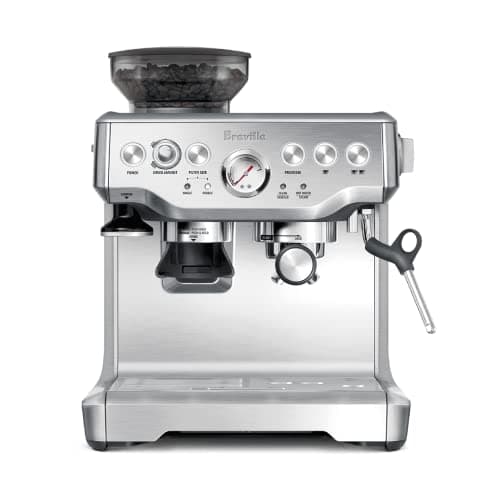
The Breville Barista Express and Barista Pro are the two machines almost every first-time all-in-one buyer ends up comparing. Both do the same thing — a conical burr grinder, brew group and steam wand in one body, so you go from beans to a shot without a separate grinder on the counter. They pull very similar espresso, too. The differences that decide the purchase are narrower than the price gap suggests, and they come down to two things: how fast the machine gets to temperature, and how you interact with it.
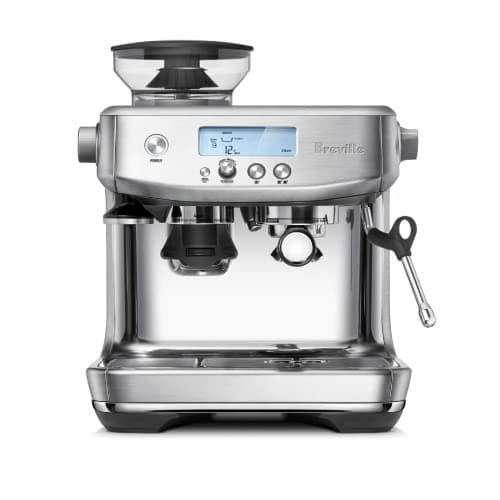
The Barista Express is the long-running value champion. It heats with a ThermoCoil system, shows pressure on an analog gauge, and has powered more first home setups than almost any machine on the market. The Barista Prois the newer, pricier sibling: it swaps in Breville's ThermoJet heating for a near-instant warm-up and replaces the gauge with an LCD screen that walks you through grind, dose and shot time. Both are 54mm machines with a manual steam wand and the grinder built in; both appear in our best machines under $1,000 roundup.
If you want the grinder built in and cannot decide between them, this page is the tie-breaker. And if you are open to a smaller machine with a separate grinder — often the better value and the better long-term setup — read the case for that in our Breville Bambino review before you commit, because a Bambino plus a good standalone grinder is a genuinely different path to the same cup.
The short answer
Quick picks
| # | Product | Best for | Score | Price |
|---|
| 01 | Breville Barista Express (BES870XL)The one to buy if value is the priority and a couple of minutes of warm-up does not bother you. You get the same integrated grinder, the same 54mm brew system and the same manual steam wand as the Pro, for meaningfully less money. What you give up is speed — the ThermoCoil takes a few minutes to reach temperature where the Pro is ready in seconds — and the analog pressure gauge instead of a guided LCD. For most households pulling a couple of shots a morning, neither is a real hardship, which is exactly why the Express has stayed the default recommendation for years. | Best value all-in-one | | $549.95·Amazon |
| 02 | Breville Barista Pro (BES878BSS)The one to buy if speed and a friendlier interface are worth the premium. The ThermoJet heating system reaches espresso temperature in seconds rather than minutes, so the Pro is ready almost as fast as you are — a genuine daily convenience if you are impatient in the morning. The LCD screen shows grind size, shot time and dose settings, which flattens the learning curve for a new user. The espresso itself is not dramatically better than the Express's; you are paying for the fast heat-up and the guidance, not a different cup. | Best for speed & display | | $849.95·Amazon |
#ad · Live prices from the Amazon Product API, as of Jul 26, 2026. Where we have no verified live price, we show none — a gap beats a number that has rotted.
In detail
The picks, in full
Best value all-in-one
Breville Barista Express (BES870XL)
Integrated conical burr grinderThermoCoil heating (few-minute warm-up)54mm portafilter, manual steam wandAnalog pressure gauge
The one to buy if value is the priority and a couple of minutes of warm-up does not bother you. You get the same integrated grinder, the same 54mm brew system and the same manual steam wand as the Pro, for meaningfully less money. What you give up is speed — the ThermoCoil takes a few minutes to reach temperature where the Pro is ready in seconds — and the analog pressure gauge instead of a guided LCD. For most households pulling a couple of shots a morning, neither is a real hardship, which is exactly why the Express has stayed the default recommendation for years.
- Heat-up speed
- 7
- Grinder
- 8
- Steam
- 8
- Interface
- 8
- Value
- 10
Pros
- +Same grind-to-cup convenience as the Pro for less money
- +Integrated conical burr grinder with dose control
- +Proven, hugely popular design with deep community support
- +Manual steam wand textures milk well once you learn it
Cons
- −ThermoCoil takes a few minutes to reach temperature — no instant shots
- −Analog gauge instead of the Pro's guided LCD
- −Large footprint (the built-in grinder makes it tall and deep)
- −Single boiler means a short wait between brewing and steaming
Don't buy this if…
…you want near-instant heat-up and an on-screen guide to grind and shot time — that is exactly what the Barista Pro adds.
Best for speed & display
Breville Barista Pro (BES878BSS)
Integrated conical burr grinderThermoJet heating (~3-second warm-up)54mm portafilter, manual steam wandLCD interface with shot guidance
The one to buy if speed and a friendlier interface are worth the premium. The ThermoJet heating system reaches espresso temperature in seconds rather than minutes, so the Pro is ready almost as fast as you are — a genuine daily convenience if you are impatient in the morning. The LCD screen shows grind size, shot time and dose settings, which flattens the learning curve for a new user. The espresso itself is not dramatically better than the Express's; you are paying for the fast heat-up and the guidance, not a different cup.
- Heat-up speed
- 10
- Grinder
- 8
- Steam
- 8
- Interface
- 9
- Value
- 6
Pros
- +Near-instant ThermoJet heat-up — no waiting for the machine
- +LCD screen guides grind size, dose and shot time
- +Same integrated grinder convenience, with a slightly wider grind range
- +Newer design with a cleaner, more modern interface
Cons
- −Costs meaningfully more than the Express for a similar cup
- −Still a single boiler — a brief pause between shot and steam
- −Large footprint, like the Express
- −The upgrade is speed and interface, not espresso quality
Don't buy this if…
…you are on a budget and do not mind a few minutes of warm-up — the cheaper Barista Express pulls a near-identical shot.
The head-to-head, point by point
Heat-up:the Pro wins clearly — its ThermoJet system is at temperature in seconds, where the Express's ThermoCoil wants a few minutes. Grinder: effectively a tie; both have the same style of integrated conical burr grinder with dose control, though the Pro offers a slightly wider grind range. Steam:a wash — both use a manual steam wand of similar power, and both make you learn to texture milk yourself. Interface:the Pro's LCD is more helpful for a beginner than the Express's analog pressure gauge, showing grind, dose and shot time on screen. Espresso quality:genuinely close — same 54mm system, same brew logic, so the cup is not where your money goes. Value: the Express wins on price; the Pro justifies its premium only if speed and guidance matter to you.
Which one is worth the money?
For most buyers, the Barista Express remains the smarter spend: it pulls the same shot and the few-minute warm-up is a small price for the savings. Choose the Barista Pro if you value convenience highly — if you make coffee in a rush, will appreciate a machine that is ready in seconds every single morning, or want the on-screen coaching while you learn. Neither is a wrong answer; they are the same espresso with different amounts of speed and hand-holding wrapped around it.
The alternative: a smaller machine and a separate grinder
Before you buy either, it is worth knowing the case against both. An all-in-one puts the grinder inside the machine, which is convenient but also means a built-in grinder you cannot upgrade independently and a large footprint. The other path — a compact machine like the Breville Bambino plus a dedicated standalone grinder— often costs about the same, takes a similar amount of counter space overall, and lets you upgrade the grinder later without replacing the machine. If a built-in grinder and single-box simplicity are what you want, the Express or Pro is right; if flexibility and grinder quality matter more, the separates route is worth a serious look. We did not lab-test these machines; our methodology explains how we judge.
Which Breville fits you
- Buy the Barista Express if you want the best value all-in-one, you are fine waiting a few minutes for warm-up, and you would rather put the saved money toward beans or accessories. It is the default pick for a reason.
- Buy the Barista Pro ifnear-instant heat-up and an on-screen guide are worth a premium to you — especially if you make coffee in a hurry or want the extra hand-holding while you learn.
- Consider neither ifyou would rather have a compact machine and a separate, upgradeable grinder — start with the Bambino and a good grinder.
Whichever way you go, the accessories that make espresso repeatable still apply — a basket-matched tamper, a WDT tool, a scale, and fresh beans. For the wider field of machines at this price, see best espresso machines under $1,000.
How we picked
We did not lab-test this gear
Everyone in this category says they tested twenty machines. We have not pulled shots on every product here, and we say so. What we did instead: compiled the published specifications, cross-checked the manufacturer manuals, computed the running cost (wattage to energy, grams-per-shot to cost-per-cup), weighed aggregated owner reports, and scored each product against a published rubric. The scores are judgments from documented research — not measurements we took, because we do not have a test lab and we will not pretend we do. Where hands-on time would tell you more than a spec sheet, we flag it. Where a number came from someone else's work, we name them in Sources.
Questions
Frequently asked
What is the difference between the Barista Express and Barista Pro?+
The two main differences are heating and interface. The Barista Pro uses Breville's ThermoJet system to reach temperature in seconds, while the Barista Express uses a ThermoCoil that takes a few minutes; and the Pro has an LCD screen that guides grind, dose and shot time where the Express has an analog pressure gauge. Both have the same integrated grinder, 54mm brew system and manual steam wand, and they pull very similar espresso.
Is the Barista Pro worth the extra money over the Express?+
Only if you value speed and guidance. The Pro's espresso is not meaningfully better than the Express's — you are paying for the near-instant heat-up and the on-screen coaching, not a better cup. If a few minutes of warm-up does not bother you, the Express is the smarter buy. Both are ranked in our
best machines under $1,000.
Do the Barista Express and Pro have a built-in grinder?+
Yes — both are all-in-one machines with an integrated conical burr grinder, so you do not need a separate grinder to get started. The trade-off is a large footprint and a grinder you cannot upgrade on its own. If you would rather pair a smaller machine with a separate, upgradeable grinder, see our
best grinders for espresso.
Which is better for a beginner, the Express or the Pro?+
The Pro's LCD screen makes the learning curve a little gentler by showing grind size and shot time on screen, so a nervous beginner may prefer it. But the Express is just as capable once you learn its rhythm, and the money saved can go toward a scale and good beans that improve your shots more than the screen does. Both are solid first machines; pick on budget and how much on-screen guidance you want.
How big are the Barista Express and Pro?+
Both are large machines, because the built-in grinder and bean hopper add height and depth on top of the brew group and steam wand. Measure your counter (and the clearance under any cabinets, since the hopper sits up top) before buying. If space is tight, a compact machine with a separate grinder — like the
Bambino— may fit better.
Receipts
Sources
We do not run a testing lab, and we do not pretend to. Where a measured number came from someone else's work, we name them and link them. Where we could not verify something, we say so on the page rather than quietly leaving it out. Read our full method.