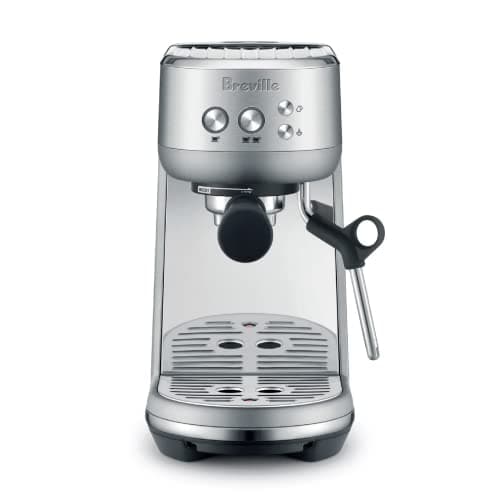
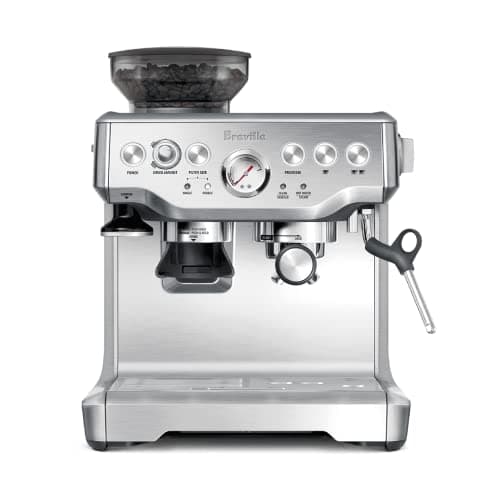
The Breville Barista Express and Breville Bambino are the two machines most people weigh against each other when they want real, cafe-style espresso at home but do not want to build a full prosumer setup. They pull a very similar shot — both are 54mm systems with a manual steam wand, and the espresso in the cup is close enough that it is not the deciding factor. The decision that actually matters, and the one this page is built around, is a single question: do you want the grinder built into the machine, or a separate grinder sitting next to it?
That is the whole comparison in one line. The Barista Express (BES870XL) is a true all-in-one: a conical burr grinder lives inside the body, so you go from whole beans to a pulled shot in one appliance, on one footprint, with nothing else to buy. The Bambino (BES450)takes the opposite approach — it is one of the smallest serious machines you can buy, near-instant to heat, and it has no grinder at all, so you pair it with a dedicated standalone grinder. Same cup, two very different setups on your counter and in your workflow.
Neither is better in the abstract; they solve different problems. If you want the simplest possible setup — one box, no decisions, no second appliance to research — the Express is built for you, and you can read the deep-dive in our Breville Barista Express review. If you would rather have the smallest machine and the best grind you can get for the money, the Bambino plus a real grinder is the stronger long-term setup; the case for it is in our Breville Bambino review. The rest of this page is the honest tie-breaker between those two paths.
The head-to-head, point by point
Espresso in the cup:a genuine tie — both are 54mm systems with a manual steam wand and similar brew logic, so the shot is not where these two separate. Grind quality:the Bambino path wins, but only because you add a dedicated grinder — the Express's built-in conical burr grinder is good, not great, and a standalone grinder in the same money will out-grind it. Heat-up:the Bambino wins clearly; its ThermoJet system is at temperature in seconds where the Express's ThermoCoil wants a few minutes. Counter and simplicity:the Express wins — it is one appliance on one footprint, where the Bambino needs a separate grinder beside it. Steam and milk:a wash — both use a manual wand you learn to texture with. Cost: close once you count a grinder into the Bambino side; the two paths often land near each other, so price rarely breaks the tie.
The built-in grinder is the whole decision
Strip everything else away and this comes down to one component: the grinder, and whether it lives inside the machine. The Barista Express puts a conical burr grinder in the body, and that single choice is what makes it large, what makes it an all-in-one, and what caps the grind at good-not-great. It is genuinely convenient — beans in the hopper, dose into the portafilter, pull the shot — and you never think about a second appliance. But espresso is more sensitive to grind than to almost anything else, and a grinder built to share a chassis with a brew group and steam boiler will not match a dedicated grinder that does nothing but grind. The Bambino removes the grinder entirely, which is why it is tiny, and hands that job to a standalone grinder you choose yourself — see our best grinders for espresso. Pair the Bambino with a good one and you get a better, more consistent grind than the Express's built-in unit delivers. The catch is equally real: that grinder is a second thing to buy, and a second thing to place.
Counter space: one big box vs two small ones
People assume the Bambino wins on space because it is so small, and the machine alone certainly is — about the width of a paperback. But the honest comparison counts the grinder. The Bambino plus a dedicated grinder is two appliances that together can take up as much room as the one large Barista Express, sometimes more, and they need two power outlets instead of one. What the Bambino setup gives you is flexibility: you can put the grinder wherever it fits, upgrade it later without touching the machine, and start with a smaller grinder and trade up. The Express gives you the opposite virtue — everything in one place, one plug, one thing to clean around, and no second purchase decision. If your constraint is having the least stuff and the simplest counter, the Express is the honest winner despite being the bigger single object.
What we did not test
We have not run these two machines side by side on a bench for months, and we are not going to pretend we did. This comparison compiles Breville's published specifications for both machines, cross-checks the manuals, and weighs aggregated owner reports against our scoring rubric — it is documented research, not a lab result. Where hands-on time would tell you more than a spec sheet, we say so instead of inventing a number. Our methodology explains exactly how we score and where the judgments come from.
Which one is right for you
- Buy the Barista Express ifyou want espresso from one appliance, value a simple counter and a single purchase over a perfect grind, and would rather not research and place a separate grinder. It is the all-in-one, and it is a good one — the full write-up is in our Barista Express review.
- Buy the Bambino plus a grinder if you want the smallest, fastest machine and the best grind your budget allows, and you do not mind buying and placing a second appliance. It is the stronger long-term setup for grind quality, because you can upgrade the grinder without replacing the machine.
- Still deciding on the all-in-one side? If the Express appeals but you are not sure it is the right Breville, the Barista Express vs Barista Pro comparison covers the faster, screen-guided sibling.
How we picked
We did not lab-test this gear
Everyone in this category says they tested twenty machines. We have not pulled shots on every product here, and we say so. What we did instead: compiled the published specifications, cross-checked the manufacturer manuals, computed the running cost (wattage to energy, grams-per-shot to cost-per-cup), weighed aggregated owner reports, and scored each product against a published rubric. The scores are judgments from documented research — not measurements we took, because we do not have a test lab and we will not pretend we do. Where hands-on time would tell you more than a spec sheet, we flag it. Where a number came from someone else's work, we name them in Sources.