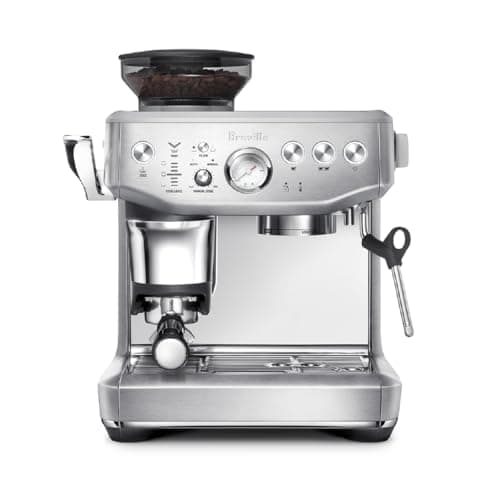
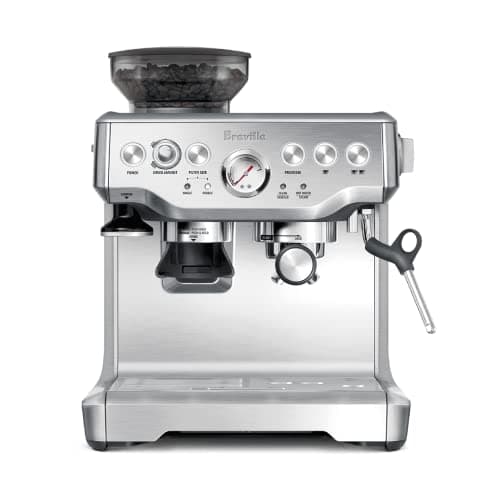
The Breville Barista Express and the Barista Express Impress are the same all-in-one machine with one idea added on top. Both fold the whole workflow — a conical burr grinder, a 54mm brew group and a steam wand — into a single body, so you go from whole beans to a milk drink without a separate grinder on the counter. Both use the same ThermoCoil heater, held at brew temperature by a PID, and both make you texture milk with a manual wand. They pull the same espresso. The decision between them comes down to a single question: do you want the machine to dose and tamp for you?
The Barista Expressis the long-running default — the machine that has started more home espresso setups than almost anything on the market. You grind into the portafilter, dose by eye or by weight, and tamp by hand. The Barista Express Impresskeeps every one of those parts and bolts on Breville's “Impress” puck-prep system: an intelligent dose that measures your last shot and nudges the next one toward an 18-gram target, and an assisted tamp lever that presses the puck with a consistent force (a constant ~22 lb) and finishes with a small 7-degree twist to polish the surface. Both machines appear in our best espresso machines under $1,000 roundup; the Impress carries a modest premium for the assisted puck prep.
If you have narrowed your choice to these two, this page is the tie-breaker. And if you are still open to the faster, screen-guided sibling — the ThermoJet Barista Pro— or to the cheaper path of a compact machine plus a separate grinder, both are worth a look before you commit, because the Impress solves a different problem (puck prep) than either of those does.
The head-to-head, point by point
Dosing:the Impress wins for a beginner — its intelligent dose remembers the shot you just pulled and nudges the next grind toward an 18-gram target, where the Express leaves you to set the dose by eye or on a scale. Tamping:the Impress wins again on consistency — its assisted lever presses the puck at a constant force and polishes it with a 7-degree twist, so you are not fighting a tilted or under-pressed tamp; the Express asks you to tamp by hand. Grinder:effectively a tie — both use the same style of integrated conical burr grinder, though the Impress's adjustment is a touch finer. Heating:identical — both use the ThermoCoil held at ~200°F by a PID, so both want a short warm-up and neither is the near-instant machine. Steam:identical — the same manual steam wand on both, and both make you learn to texture milk yourself. Espresso quality:genuinely the same — same 54mm system, same brew logic, so the cup is not where your money goes. Value: the Express wins on price; the Impress justifies its premium only if you want the puck prep done for you.
What the Impress system actually changes
The entire case for the Impress is the two steps beginners most often get wrong: how much coffee you dose, and how evenly you tamp it. On the plain Express you dose by eye (or, better, by weighing on a scale) and you tamp with your own hand — a level, firm, even press that takes a little practice to get right every time. The Impress hands both of those to the machine: an intelligent dose that converges on ~18 g over a couple of shots, and an assisted tamp that applies a constant ~22 lb and finishes with a small twist to polish the puck. The result is a repeatable, evenly compressed puck without the wrist technique a hand tamp demands. It does not make a perfect shot taste different — it removes the bad shots you would otherwise pull while you are still learning. Our how to tamp espresso guide walks through the manual skill the Impress is standing in for, so you can decide whether you would rather learn it or let the machine do it.
The same cup, and why that matters
Here is the part the marketing will not lead with: the Impress and the plain Express pull very similar espresso. They share the same 54mm portafilter and brew logic, the same style of integrated conical burr grinder, and the same PID-held ThermoCoil, so the shot in the cup is not where the extra money goes. The Impress changes the front end — dosing and tamping — not the group head, the pump behavior or the heater. And because the grind is still what decides how good the shot can be, the assisted tamp cannot rescue coffee that was ground unevenly. If grind quality is your priority, the honest move on either machine is to lean on a dedicated espresso grinderdown the line — and if that is where your head is, a compact machine plus a standalone grinder may serve you better than either all-in-one. We did not lab-test these machines; our methodology explains how we judge.
Which one is worth the money?
For most buyers who are willing to learn, the Barista Express remains the smarter spend: it pulls the same shot, and tamping is a short skill plus a cheap, basket-matched tamperaway. Put the savings toward a scale and better beans and you will improve your coffee more than the assisted lever does. Choose the Impress if consistency you do not have to practice is worth a premium to you — if you are nervous about tamping evenly, buying for a household where several people pull shots, or you simply want the machine to remove the two fiddly steps so a good shot is more repeatable from day one. Neither is a wrong answer; they are the same espresso with different amounts of puck-prep hand-holding wrapped around it.
Which Breville fits you
- Buy the Barista Express ifyou want the best value, you are happy to dose and tamp by hand (or want to learn), and you would rather spend the difference on a scale, a good tamper and fresh beans. It is the default pick for a reason — see the full Barista Express review.
- Buy the Barista Express Impress ifconsistent puck prep you do not have to learn is worth the premium — especially for a nervous beginner or a shared household. The full Barista Express Impress review covers exactly what the assisted system does.
- Consider neither if you want a near-instant heat-up (that is the Barista Pro), or you would rather pair a compact machine with a separate, upgradeable grinder from our best machines for beginners roundup.
Whichever way you go, the accessories that make espresso repeatable still apply — a basket-matched tamper (only needed on the Express), a WDT tool, a scale, and fresh beans. For the wider field of machines at this price, see best espresso machines under $1,000.
How we picked
We did not lab-test this gear
Everyone in this category says they tested twenty machines. We have not pulled shots on every product here, and we say so. What we did instead: compiled the published specifications, cross-checked the manufacturer manuals, computed the running cost (wattage to energy, grams-per-shot to cost-per-cup), weighed aggregated owner reports, and scored each product against a published rubric. The scores are judgments from documented research — not measurements we took, because we do not have a test lab and we will not pretend we do. Where hands-on time would tell you more than a spec sheet, we flag it. Where a number came from someone else's work, we name them in Sources.