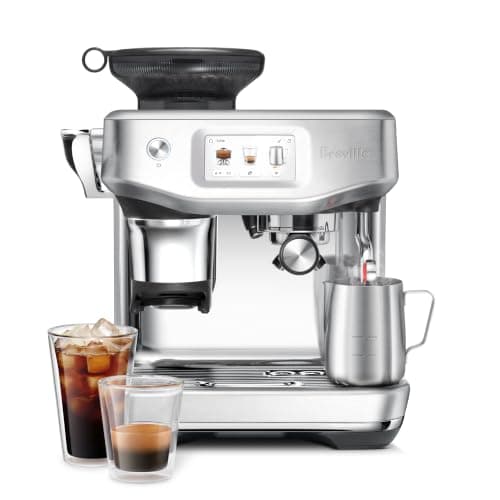
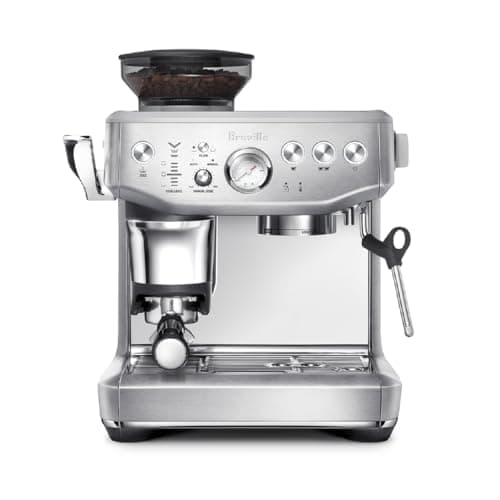
For most buyers the Barista Express Impress is the one to buy. It has the same Impress puck-prep system as the more expensive machine — assisted tamp at a constant ~22 lb finished with a 7-degree twist, and intelligent dosing that auto-corrects toward an 18-gram target — which is the feature people are actually shopping for. The Barista Touch Impress adds a near-instant ThermoJet heater, hands-free Auto MilQ milk texturing with programs for dairy, oat, almond and soy, and a colour touchscreen that walks you through each drink. If you make several milk drinks a day, want them without holding a wand, and the price does not trouble you, that is a real upgrade. It is not a better espresso machine.
That last sentence is the whole point of this page, so it is worth being precise about it. These two machines share the parts that determine what a shot tastes like: a 54mm brew system, an integrated conical burr grinder, a single boiler that brews and then steams, and the Impress puck system. Breville has not given the expensive one a bigger group, a second boiler or a different pump. What the money buys is automation around the shot, not a different shot.
What is identical. The Impress mechanism — the thing both names share — is the same on both. You pull a lever; the machine senses how far it travelled, tamps at a consistent 22 lb with a 7-degree finishing twist, and corrects the next dose if this one came out light or heavy. That engineers out the two steps beginners most often fumble, and it is the reason either of these is a sensible first machine. Both are also 54mm, which matters for accessories — see 54mm portafilter accessories.
Heat-up: ThermoCoil versus ThermoJet.The Express Impress uses a PID-controlled ThermoCoil, which takes the usual couple of minutes to come to temperature. The Touch Impress uses Breville's ThermoJet, which reaches brew temperature in seconds. In day-to-day use this is the difference most owners notice first — not because it changes the coffee, but because it changes whether you wait. If you make one coffee a morning on the way out of the door, it is worth real money. If your machine is on before you are awake, it is worth almost nothing.
Milk: manual wand versus Auto MilQ. The Express Impress has a manual steam wand, which means you learn to texture milk. That is a skill worth having and the ceiling is higher than any automatic system — see how to steam milk. The Touch Impress textures hands-free with four milk programs and eight texture levels. Hands-on reviewers disagree about how good the automatic result is, and we repeat that disagreement rather than resolving it, because we have not run a side-by-side ourselves. What is not in dispute is the convenience: you put the jug under the wand and walk away.
Guidance. The Touch Impress has a colour touchscreen that walks you through each drink and tells you which way to move the grind when a shot runs long or short. For a complete beginner this is genuinely useful — it is a coach, not a gimmick. It is also something our how to dial in espresso guide does for free, which is a fair way to value it.
Grinder. Both have an integrated conical burr grinder. The Express Impress has 25 grind settings; the Touch Impress uses Baratza-made conical burrs with 30 settings. A small edge to the Touch, and not one we would pay the difference for on its own.
Specs side by side
Figures below are Breville's published specifications for the exact listings above. Prices come from the live price layer with the "as of" date in the quick picks table.
| Barista Express Impress (BES876) | Barista Touch Impress (BES881) |
|---|
| Puck prep | Impress: ~22 lb tamp + 7° twist, auto-correcting dose | Impress: ~22 lb tamp + 7° twist, auto-correcting dose |
| Brew group | 54mm | 54mm |
| Heater | ThermoCoil with PID | ThermoJet — brew temperature in seconds |
| Boiler architecture | Single — brew then steam | Single — brew then steam |
| Milk | Manual steam wand | Auto MilQ, 4 milk types, 8 textures |
| Grinder | Integrated conical, 25 settings | Baratza conical, 30 settings |
| Interface | Dials and a pressure gauge | Colour touchscreen with guided drinks |
| Water tank | Standard Barista Express tank | 67.6 oz |
| Who it suits | One or two drinks, happy to steam milk | Several milk drinks, hands-free, no waiting |
What the premium actually buys
Three things, and it is worth pricing each in your own terms.
Seconds instead of minutes. ThermoJet is the single most under-rated Breville feature, because it changes whether the machine gets used on a weekday. If you have ever skipped making coffee because the machine was cold, this is what fixes it. If you flip the switch and then shower, it is worth nothing to you.
Milk without a skill. Auto MilQ handles the step most people find hardest, with programs for the plant milks that behave differently from dairy. The ceiling is lower than a wand in trained hands and reviewers disagree on how close it gets. But the floor is much higher than an untrained hand on a manual wand, and the floor is what you drink for the first six months.
A coach on the front panel. The touchscreen tells you to grind finer when the shot ran fast. That is real help, and it is also written down for free in how to dial in espresso and espresso grind size. Value it according to how likely you are to read a guide.
What the premium does not buy is a second boiler, a 58mm group, a larger pump or a different extraction. If those are what you want, you are shopping in the wrong part of the Breville line — best dual boiler espresso machines is where that search starts, and single boiler vs double boiler explains what it changes.
The third option neither page mentions
A Barista Express Impress plus a separate grinder is not the move — it already has a grinder, and you would be paying twice. But there is a genuine third path worth naming: a cheaper machine without the Impress system, plus a better standalone grinder. The Impress mechanism exists to compensate for inconsistent dosing and tamping; a good grinder plus a distribution tool and a calibrated tamper does the same job for less, and the skills transfer to any machine you own later.
That is the argument our best espresso setup under $500 page makes, and the accessories are covered in best espresso distribution tools and best espresso tampers. It is more work and more learning. It also produces a better-tasting ceiling than either machine here.
Our recommendation, plainly
Buy the Express Impress unless you can name, out loud, which of the Touch Impress's three additions you will use every day. If the answer is "hands-free oat milk, twice every morning", buy the Touch Impress and do not feel bad about it. If the answer is a vague sense that more features is better, you are about to spend a large premium on a shot that tastes the same.
Either way, the first upgrade after purchase is the same on both machines: replace the dual-wall pressurized basket with a single-wall precision basket, because the stock basket manufactures crema through back-pressure instead of extraction. Our best precision baskets page covers it, and pressurized vs unpressurized baskets explains why it matters more than anything else you can buy for either machine.