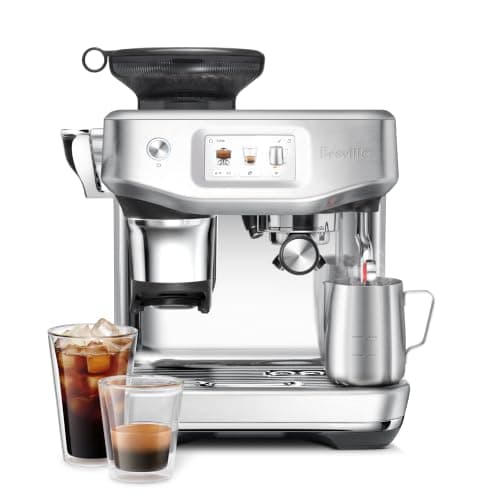
The Breville Barista Touch Impress is the top of Breville's "Barista" line of all-in-one espresso machines — a built-in conical burr grinder, a 54mm brew system and a steam wand in one stainless body — and it earns that spot by automating more of the process than any Barista machine before it. It keeps the color touchscreen and the hands-free automatic milk wand of the Barista Touch, then adds the assisted-tamping Impress puck system from the Barista Express Impress: the machine measures your dose, tamps the puck for you with a lever at a consistent 22 lb of force, and corrects the next dose if the last one was off. Breville pairs that with its ThermoJet heater, which the company rates at three seconds to extraction temperature.
That combination matters because of who gives up on home espresso and why. The two steps beginners get wrong most are dosing and tamping — too much or too little coffee, an uneven or inconsistent tamp — and the third is steaming milk. The Barista Touch Impress takes all three off your hands. You still grind, lock the portafilter into the group head and press the button, so it is a semi-automatic, not a bean-to-cup super-automatic; but the parts that require skill are now guided or done for you, and the screen tells you in plain words when the grind is too coarse or too fine.
Here is the honest part, and it will be familiar if you have read our other Breville reviews: the espresso in the cup is very close to what the much cheaper Barista Express, Barista Pro and Barista Touch make. All of them share the same 54mm portafilter, the same class of integrated conical burr grinder and the same single-boiler layout. What you are paying the Barista Touch Impress premium for is consistency and hand-holding — a puck that is right every time and milk you do not have to learn to texture — not a better shot. That is a real, daily benefit for the right buyer and a poor use of money for the wrong one, and the rest of this review is about telling those two buyers apart. See where it sits against its siblings in our best Breville espresso machines guide, and against the wider field in our best espresso machines with a built-in grinder roundup.
What the Impress puck system actually does
The name on the box is the feature, so start there. On an ordinary machine you dose coffee into the basket by eye or by scale, level it, and tamp it with a hand tamper — and the quality of that puck decides whether the shot runs evenly or channels. The Impress system replaces the judgment with a mechanism. You grind directly into the portafilter, then pull a lever on the front of the machine. The lever tamps the coffee at what Breville specifies as an assisted 22 lb of force and finishes with a 7-degree rotation, the "barista twist" that polishes the top of the puck. Breville calls the dosing side of it intelligent dosing: the machine senses how far the tamp lever travels — effectively how tall the puck is — and uses that to judge whether the dose was right. If it was short, it prompts you to grind a little more and tamp again; and it adjusts the next dose automatically so you converge on the right amount over a few shots. The touchscreen shows a green check when the dose is where it should be.
In practice that means the two variables beginners fight hardest are taken care of, and the puck comes out the same every time. It also means the machine, not you, decides how much coffee goes in. Hands-on reviewers note that the adaptive dosing is not perfect — one reported it "sometimes overdoses," and owner reports mention discrepancies of around a gram — but a gram of drift on a consistent, level, evenly tamped puck is a far smaller problem than the uneven hand tamps it replaces. If you want to understand what the machine is doing for you, our guides to tamping and puck prep cover the manual version of every step.
Auto MilQ: where the hands-on reviews disagree
The second automated step is milk. The Barista Touch already had Breville's hands-free Auto MilQ wand; the Touch Impress keeps it and adds settings the company says are optimized for dairy, soy, almond and oat, alongside the same adjustable temperature range of 104°F to 167°F and eight texture levels. You choose the milk, the temperature and the texture on the screen, sink the wand in the jug and walk away; the machine textures the milk and stops on its own. A manual mode is there if you want to steam yourself.
We would be doing you a disservice if we pretended the reports on it agree. One hands-on review found that the default milk textures with dairy and oat were "pretty much perfect" and got flat-white microfoam and pourable latte-art milk from auto mode. Another long-term reviewer found auto mode "lacking" — the aerated milk "doesn't incorporate very well" — tried whole, skim, oat and soy, never got what they would call proper microfoam from the automatic program, and recommended using the excellent steam wand in manual mode instead. Some owners also report the automatic program running milk hotter than the target. The fair reading is that Auto MilQ produces good, consistent cafe-style milk for most people most of the time, that results vary by milk and by expectation, and that if your standard is competition latte art you will end up steaming by hand anyway — in which case a cheaper Breville with a manual wand and our how to steam milk guide gets you there for less.
The touchscreen and Barista Guidance
The screen is the same idea as the Barista Touch's, with more to say. It stores a menu of cafe drinks — Breville's page currently lists 13 presets, while some retailer spec sheets still show the original eight, so the menu you see depends on firmware — and lets you create, name and save your own. More useful than the presets is what Breville calls Barista Guidance: after a shot, the screen tells you whether the extraction ran fast or slow and prompts you to move the grind finer or coarser, which is the whole of dialing in reduced to following an instruction. It also walks you through cleaning cycles, backflushing and descaling step by step. Two honest caveats: reviewers note the preset drinks cannot be edited, only copied into custom slots, and at least one group of owners describes the screen as slow to respond. A touchscreen is also one more electronic part that can fail, where an analog gauge largely cannot.
Heater, grinder and the same 54mm cup
Under the automation the Barista Touch Impress is a familiar Breville. The heater is a ThermoJet, which Breville rates at three seconds to extraction temperature and up to 32% more energy-efficient than a thermoblock; there is no waiting for a warm-up, though the group and portafilter still benefit from a flush before the first shot. It is a single-boiler machine, so you brew and then steam, not both at once — fine for one or two drinks, slow for a round of four, and the reason enthusiasts who make a lot of milk drinks look at a dual boiler instead. Our single vs double boiler guide explains the trade.
The grinder is an integrated conical burr unit that Breville describes as Baratza European Precision Burrs with 30 grind settings and dose control. On paper that is a step up from the burr sets in the older Barista Express and Pro, and hands-on reviewers report good body in the cup; one also notes the grinder needs fine-tuning to stop grounds clumping. It is still a grinder built to fit inside a machine and hit a price, and you cannot upgrade it on its own. If grind quality is what you care about most, a compact machine plus a standalone unit from our best grinders for espressowill out-grind any all-in-one. The brew system is Breville's 54mm portafilter with single- and dual-wall baskets in the box — a well-supported size with a real accessory ecosystem, but not the 58mm commercial standard, so if you ever move up to a prosumer machine your baskets and tools stay behind. Our portafilter sizes guide covers why that matters.
Cold Brew and Cold Espresso
One feature the cheaper Barista machines do not list: the Touch Impress has programs for Cold Brew, which Breville says extracts in under three minutes, and a crema-topped Cold Espresso in under two. These are low-temperature, slow-pressure extractions rather than a hot shot poured over ice, and they are aimed squarely at iced-latte drinkers. We have not tasted them and will not pretend to; if iced drinks are most of what you make, it is a genuine differentiator worth weighing, and our iced latte guide covers the conventional route.
Size, capacity and what is in the box
This is a big machine: roughly 13 inches wide, 13 inches deep and 16 inches tall with the hopper on, and about 23 lb. Breville's own page and the retailers we checked disagree on the exact cabinet figures by about an inch in each direction, so treat those as approximate and measure your cabinet clearance — the hopper lid sits on top and the tamp lever is on the front, so you need height and a clear reach. The removable water tank holds 67.6 fl oz; retailers list the bean hopper at 8 oz and 12 oz respectively, so we will only say it holds roughly a week of beans for a one-drink household. It draws 1,750 W on a standard 120 V outlet. In the box: the 54mm stainless portafilter, 1- and 2-cup single- and dual-wall baskets, a 480 ml stainless milk jug, a water filter holder and filter, a hardness test strip, the Razor dose-trimming tool, cleaning tablets, a steam-wand cleaning tool, cleaning disc and brush, and descale powder. On warranty, Prima Coffee lists two years parts and labor for the US model and Whole Latte Love lists one; confirm on Breville's page before you buy.
Barista Touch Impress vs Barista Touch vs Barista Express Impress vs Oracle Jet
The Barista Touch Impress sits between three machines, and the buying decision is really about which of its automations you would actually use.
- Against the Barista Touch: the plain Touch already has the touchscreen and an automatic milk wand. The Impress adds the assisted tamp and intelligent dosing, the newer Baratza-branded burrs, the plant-milk programs and the cold programs, at a meaningful premium. If you are happy to tamp by hand, the Touch is the smarter spend; our Barista Touch review covers it.
- Against the Barista Express Impress: the Express Impress has the same assisted puck system but a manual steam wand, an analog gauge instead of a screen and a ThermoCoil heater that takes a few minutes to warm. It is the pick if the puck is what you want automated and you are willing to learn milk. Our Barista Express vs Impress comparison explains the Impress system in depth.
- Against the Oracle Jet:Breville's step above is the Oracle Jet, which automates grinding, dosing and tamping entirely (no lever), moves to a 58mm portafilter with a larger dose and a 45-setting grinder, and costs more again. It is the machine for someone who wants the Impress idea taken to its conclusion; the Touch Impress keeps you one lever pull more involved for less. We cover the fully automated route in our Oracle Touch review.
Who it is for
- Buy the Barista Touch Impress if you want cafe milk drinks every morning with the least possible skill involved, you value a puck that comes out the same every time, and you would use the plant-milk programs or the cold-brew modes. This is the gentlest semi-automatic Breville makes, and for that buyer the premium is buying something real.
- Buy the Barista Touch instead ifthe screen and automatic milk are what you want and you do not mind tamping by hand — the shot is the same and the saving is substantial.
- Buy the Barista Express Impress instead if the assisted tamp is the feature you want and you are willing to learn to steam milk yourself.
- Skip the whole idea ifyou want the craft — a compact machine such as the Bambino Plusplus a dedicated grinder, a scale and our guides will teach you more and make better espresso for the same money — or if you want the process fully hands-off including the grinding, in which case a super-automatic is the right category.
What we did not test
We have not run this machine on a bench, and we do not claim to have. This review compiles Breville's published specifications for the BES881, cross-checks them against two US retailers' spec sheets, and weighs three named hands-on reviews and aggregated owner reports against our scoring rubric. The 22 lb assisted tamp, the 7-degree twist, the intelligent dosing and auto-correction, the Auto MilQ milk programs and temperature range, the 30-setting Baratza burrs, the ThermoJet rating and the cold programs all come from Breville's own page. Where the published sources disagree — cabinet dimensions, hopper capacity, warranty length, the number of drink presets — we have said so rather than picked a number. Where hands-on time would tell you more than a spec sheet — how consistent Auto MilQ really is across milks, how much the intelligent dosing drifts over weeks, how the burrs hold their setting — we have quoted the people who have that time and flagged where they disagree.