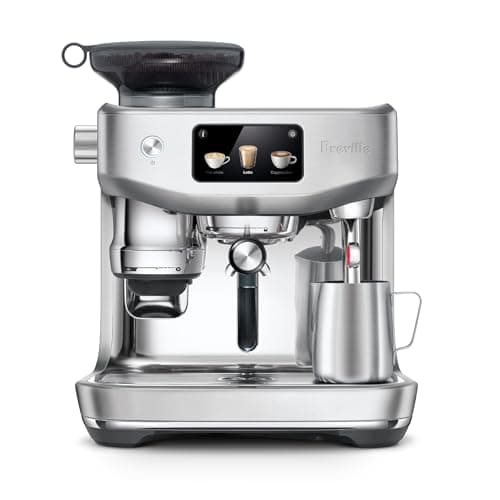
The Breville Oracle Jet is the most interesting machine Breville has released in years, because it takes the one feature that separates an "Oracle" from the rest of the range — a grinder that doses and tamps foryou, straight into a real 58mm portafilter — and stops charging Oracle Touch money for it. You put beans in the hopper, lock the portafilter into the cradle, and the machine grinds a 22 gram dose and tamps it flat with no lever, no hand tamper and no technique required. Then you lock it into the group head like any semi-automatic and pull the shot. What you do not get, and what the spec sheets are quiet about, is the dual boiler: the Jet runs Breville's ThermoJet heating instead, so it is ready in seconds but it brews and steams one after the other.
That single design decision is the whole review. Everything else about the Oracle Jet is straightforwardly good and most of it is better than what Breville sells above it: a sharper, faster 5-inch touchscreen, a 45-setting grinder with Baratza-designed burrs, an Auto MilQ wand with its own temperature sensor and settings for dairy, soy, almond and oat, cold brew and cold espresso programs that no other Breville at this level has, a front-filling water tank, and hidden wheels under the chassis so a 27 pound machine slides across a counter with one finger. Against all of that sits one honest limitation, and two hands-on reviewers who spent months with the machine both list it as a con: you cannot brew a shot and steam milk at the same time.
So this review is about telling two buyers apart. If you make one or two drinks in the morning, the Oracle Jet removes every skill barrier in home espresso while keeping the 58mm platform and the manual override that let you grow into it — and it does that for meaningfully less than the Oracle Touch above it. If you make four milk drinks back to back on a weekend morning, sequencing brew and steam will annoy you every single time, and the money is better spent on a genuine dual boiler. And if you are the kind of buyer this site usually argues for — someone happy to learn the craft — a compact machine plus a serious standalone grinder still makes a better shot for less than half the money. See where the Jet sits among its siblings in our best Breville espresso machines guide, and against the wider field in our best espresso machines with a built-in grinder roundup.
What "auto grind, dose and tamp" actually means here
Breville uses the word Oracle for one specific thing: a machine that prepares the puck for you inside a real portafilter. The Oracle Jet does it with no lever at all, which is what separates it from the Impress machines further down the range. You seat the 58mm portafilter in the grinder cradle and the machine grinds, doses to Breville's stated 22 gram target and tamps the bed flat before you take it out. There is no hand tamper in the box because there is nothing for you to tamp. Compared with the Barista Touch Impress, where you pull an assisted lever yourself, this is one step further removed — and compared with any ordinary semi-automatic, it removes the two variables that decide whether a shot runs evenly or channels.
The dose is measured rather than timed, which matters. Grinding "for four seconds" gives you a different amount of coffee every time the beans change; the Jet stops when it has delivered the dose, so a change of roast does not quietly change your recipe. Hands-on reports back this up — Tom's Guide describes the grinder stopping automatically at the target amount and concluded that you will never grind too much or too little for the basket. What the automation does not do is eliminate dialing in. The same reviewer needed about five attempts before the machine accepted a shot as well-extracted, and the grind dial still has to move when you change beans. Our how to dial in espresso guide explains what the screen is asking you to do, and our espresso grind size guide covers which way to turn the dial and why.
The honest complaint about the grinder is mess, and it is unanimous. TechRadar found it "could be a little messy, occasionally leaving stray grounds on the portafilter and even on the worktop." Tom's Guide found the same thing more precisely: a consistent sprinkle of loose grounds on top of the finished puck, and an extra sprinkle onto the drip tray whenever the machine was moved. Neither reviewer thought it changed the coffee. Both mentioned it because on a machine at this price you notice it every day.
ThermoJet instead of a dual boiler: the trade at the center of this machine
The Oracle Touch runs two boilers, which is why it can pull a shot and steam milk at the same moment and why it takes minutes to get there. The Oracle Jet replaces that with Breville's ThermoJet system: a fast-heating element for the water path, plus a ThermoJet heated group head that you can trim in one-degree increments. Breville claims it reaches optimal temperature in seconds and is up to 32% more energy efficient than a thermoblock. In practice TechRadar put the real figure at around 30 seconds from switch-on, against three or more minutes for the Oracle Touch it replaced in their office.
For most households that is an unambiguous win. You do not plan around a warm-up, you do not leave the machine on all morning, and the daily friction of owning an espresso machine drops sharply. The cost lands entirely on one workflow: because brewing and steaming share the heating path, they happen in sequence. Breville's answer is Auto Queue, which starts texturing milk automatically the moment the shot finishes, so a single latte needs no input from you at all — but a sequence is still a sequence. Making four milk drinks in a row takes noticeably longer than on a dual boiler, and both hands-on reviews list the lack of simultaneous brew-and-steam in their cons. This is also exactly why the Jet does not appear in our best dual boiler espresso machines roundup: simultaneous operation is the category's defining feature. Our single vs double boiler guide explains what you actually gain and lose.
One warning about the spec sheets, because it caused us trouble while researching this page. Breville's own materials and at least one US retailer describe two ThermoJet heating elements — one for the water, one for the group head — and some third-party coverage has turned that into "dual heating," which reads like a dual boiler and is not one. Two heaters on one brew path is not the same as two boilers running in parallel. If simultaneous brew and steam is your requirement, the Oracle Jet does not do it, whatever the marketing word is on the box that week.
Auto MilQ, and where a trained reviewer preferred to do it herself
The Jet's steam wand is hands-free. You pick the drink, pick the milk — dairy, soy, almond or oat — and set a temperature, which Breville publishes as adjustable from 104°F to 167°F across eight texture levels, then sink the wand and walk away. The upgrade over earlier Breville machines is that the temperature sensor is in the wand itself rather than under the drip tray, so even manual steaming gets a live reading and a warning before you scald the milk. Manual mode is there, which matters more than it sounds: this is the rare automated machine that does not take the skill route away from you.
On results, our sources genuinely differ, and you should know that before you buy. TechRadar found the textures "always silky smooth" and good enough for latte art. Tom's Guide — whose reviewer had recently completed SCA barista training — called the milk "brilliantly glossy" but got more precise results steaming by hand, and said plainly that the automatic milk on her own cheaper Barista Touch Impress came out slightly better. She also flagged a practical detail nobody markets: the included jug's minimum fill line is high, so a single short drink means steaming more milk than you need. The fair reading is that Auto MilQ gives you consistently good cafe-style milk with no skill involved, and that if your standard is competition latte art you will end up on the manual wand with our how to steam milk guide anyway. Retailer spec sheets that rate steam power across machines put this one at the modest end of the scale rather than the powerful end, which is consistent with a single-heater design.
The screen, the guidance and the cold programs
The 5-inch touchscreen is the part reviewers are least equivocal about. It has light and dark modes, it walks you through each drink with text and images, and TechRadar explicitly contrasted its responsiveness with the "frustratingly sluggish" screen on Breville's previous flagship. Barista Guidance is the useful half: a live shot timer that turns green when the extraction lands in range and red when it does not, followed by a prompt telling you which way to move the grind for the next one. That is the whole of dialing in, reduced to following an instruction. What it is not is control — there is no pressure gauge, no flow profiling and nothing to steer mid-shot. If manipulating pressure is the hobby you are buying into, this is the wrong machine and our prosumer roundup is the right page.
The cold programs are the Jet's genuine differentiator. Breville publishes Cold Brew at under three minutes and a crema-topped Cold Espresso at just over one, both low-temperature extractions rather than hot coffee poured over ice. Reviewers who tried them describe the cold brew as a slow, room-temperature extraction that reads lighter and fruitier than the hot shot, and the cold espresso as holding up under milk and syrup without being watered out by melting ice. We have not tasted either and will not pretend otherwise. If iced drinks are most of what you make, this is a real reason to choose this machine over its siblings; our iced latte and cold brewguides cover the conventional routes. Reviewers also note the machine takes Wi-Fi updates, which is how the cold functionality reached some earlier units — a nice idea, and one more connected component in a kitchen appliance you expect to keep for a decade.
Size, capacity and the numbers that disagree
This is a big machine and you must measure before you buy, because the published figures do not agree with each other. Breville's US page lists 16.6 x 14.2 x 14.9 inches; a US retailer spec sheet lists 14 inches wide, 16.5 tall and 14 deep; and both hands-on reviewers were given 19.2 x 15 x 14.5 inches. That is roughly three inches of height between sources, which is the difference between fitting under a wall cabinet and not. Weight is more consistent at about 26.7 to 27 pounds — heavy enough that reviewers suggest a second pair of hands to unbox it, and the reason the pop-down casters are more than a gimmick.
On capacities and power, the retailer spec sheet for the US model lists a 12 ounce bean hopper, an 80 ounce reservoir, 1500 W at 120 V on a 15 amp circuit, a stainless-steel-lined aluminum boiler, a solenoid valve, a cup warmer and a two-year manufacturer warranty; it also notes the machine is not certified to NSF/ANSI standards, which rules it out of genuine commercial service. Breville's own page and one reviewer put the tank at 77 fluid ounces (2.3 liters), so treat the tank figure as approximately two quarts either way. It fills from the front through a flip-up spout, which is the single most underrated feature on the machine. The number of drink presets is another moving target — reviewers counted ten and eleven, retail listings say thirteen with a wider custom menu — so expect "the cafe menu plus room for your own," not a fixed number. In the box: the 58mm stainless portafilter, filter baskets, a 480 ml milk jug, a knock box, a drip-tray guard and a cleaning kit.
The 58mm platform is the quiet argument for this machine
Every Breville below the Oracle line uses a 54mm portafilter. The Oracle Jet uses 58mm, the commercial standard, and that is worth more over time than any single feature on the screen. It means precision baskets, tampers, dosing funnels, puck screens and bottomless portafilters from the whole aftermarket fit your machine, and it means the parts and habits carry over if you ever move to a prosumer machine. Our 58mm portafilter accessories page covers what the ecosystem actually contains, and our portafilter sizes explained guide covers why the number matters at all. One caveat worth stating because it catches Breville owners out constantly: 54mm parts bought for a Barista machine do not fit this one, and accessory makers name the Oracle Jet explicitly as the exception in the Breville range.
Oracle Jet vs Oracle Touch vs Barista Touch Impress vs separates
- Against the Oracle Touch: the Touch keeps the dual boiler, so it brews and steams at once and is the better machine for a household making several milk drinks back to back. It also costs substantially more, takes minutes to heat rather than seconds, has no cold programs and runs an older screen. On our rubric the Touch edges ahead on the strength of the boilers alone; for most one- and two-drink households the Jet is the smarter spend. Our Oracle Touch review covers it in full.
- Against the Barista Touch Impress:the Touch Impress is a 54mm machine where you pull an assisted tamp lever yourself. It is significantly cheaper, its automatic milk impressed at least one reviewer more than the Jet's did, and for a beginner the difference in the cup is small. What the Jet buys is the 58mm platform, the fully automatic tamp, the faster screen, the finer grinder and the cold programs. Our Barista Touch Impress review makes the case for the cheaper route.
- Against the Breville Dual Boiler: the Dual Boileris the enthusiast's answer at similar money — two boilers, a 58mm portafilter, PID control and no automation whatsoever. It asks you to grind, dose and tamp yourself, and rewards you with more control than the Jet will ever offer. Choose by temperament, not by spec sheet.
- Against separates: the argument this site makes on every machine page holds here too. A grinderless machine such as the Bambino Plus plus a standalone grinder from our best grinders for espresso roundup costs far less than the Jet and will out-grind it, because a grinder built to live inside a machine is always a compromise. What you give up is every convenience the Jet exists to provide. That is a real choice, not a trick question.
- Against the cheap automated challengers: the Ninja Luxe Cafeand De'Longhi's La Specialista family offer assisted brewing and automatic milk for a fraction of the money, with coarser grinders, smaller portafilters and less refined automation. If the Jet's price is the obstacle, those are where to look first.
Who it is for
- Buy the Oracle Jet if you want cafe drinks with no technique, you make one or two at a time, you value a machine that is ready in seconds, and you want to stay on the 58mm platform so the accessories and the upgrade path stay open. Iced-drink households get a genuine bonus in the cold programs.
- Buy the Oracle Touch instead if simultaneous brewing and steaming is non-negotiable and you want the same automated front end on top of it.
- Buy the Barista Touch Impress instead if the budget is the constraint and you can live with a 54mm portafilter and pulling a tamp lever.
- Skip the category ifyou want to learn espresso. A compact machine, a real grinder, a scale and our guides will make better coffee for less money — or, if you want the process fully hands-off including the portafilter, a super-automatic is the honest answer instead.
What we did not test
We have not run this machine on a bench, and we do not claim to have. This review compiles Breville's published specifications for the BES985, cross-checks them against a US retailer's spec sheet, and weighs two named long-form hands-on reviews against our scoring rubric. The 58mm portafilter and 22 gram dose, the 45 grind settings, the ThermoJet heating and heated group head with one-degree adjustment, the Auto MilQ milk types, temperature range and texture levels, and the cold brew and cold espresso timings all come from Breville. The hopper, reservoir, wattage, boiler material, warranty and NSF status come from the retailer spec sheet. Where the published sources disagree — cabinet dimensions, tank capacity, the number of drink presets — we have said so rather than picked a number. Where living with the machine tells you more than a spec sheet — how messy the grinder really is, how good Auto MilQ is across different milks, how the sequential workflow feels on a busy morning — we have quoted the people who did that and flagged where they disagree with each other.