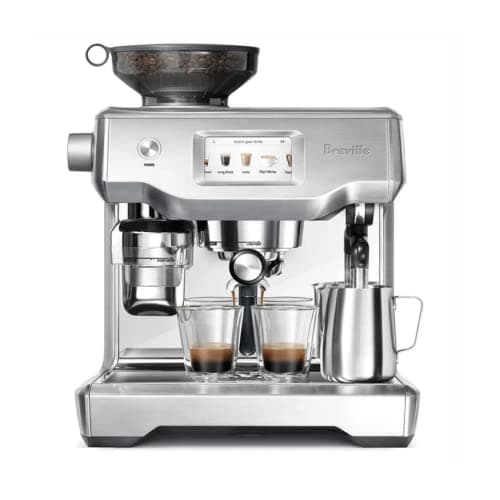
The Breville Oracle Touch answers a very real question: what if you want the temperature stability and simultaneous steaming of a dual boiler, but you have no interest in becoming a home barista to get it? Most machines make you learn the craft; the Oracle Touch automates it. It bolts a full super-automatic front end onto genuine dual-boiler hardware, so a touchscreen walks you through each drink, an integrated conical grinder auto-grinds, doses and tamps 22 grams straight into a real 58mm portafilter, and the Auto MilQ steam wand textures your milk hands-free to a temperature and foam level you set. It is the closest thing on a real portafilter to pressing a button and getting a cafe drink — and, crucially, the espresso underneath is legitimately good rather than merely easy.
The reason that distinction matters is the machine's whole pitch. The Oracle Touch automates the three things that separate good home espresso from bad — grinding to the right fineness, dosing the right weight, and tamping level and consistent — and then automates the milk on top. Those are precisely the steps beginners get wrong, and the ones that make most first attempts sour, weak or thin. By taking them off your plate and running them consistently, drink after drink, the machine turns a flat white into a couple of taps rather than a skill you spend months acquiring. If your honest alternative is a sealed bean-to-cup super-automatic, the Oracle Touch makes noticeably better espresso, because it brews through a genuine 58mm portafilter over a real dual boiler instead of a hidden brew unit. See where it sits among the automated machines in our best dual boiler espresso machines roundup.
Underneath all that automation, the hardware is the real thing. Two stainless steel boilers with PID control feed a heated 58mm group, so you get true simultaneous brew and steam with the temperature held steady — the same architecture that makes a bare prosumer dual boiler worth buying. The touchscreen is genuinely useful in a household with mixed tastes, where one person wants a long black and another wants a cortado: the drinks are stored, adjustable and one-touch, so nobody has to remember a recipe. And the Auto MilQ wand means the milk is not a lottery — it climbs to your chosen temperature and texture and stops on its own, which is why the Oracle Touch also lands near the top of our best espresso machines for lattes picks. Because it grinds in the box, it also appears in our best espresso machines with a grinder guide.
The catch is philosophical as much as financial, and it is worth stating plainly before you spend. You pay a lot — this is top of the home range — and stripped of the automation, the underlying hardware sits below a bare enthusiast dual boiler on pure build. More importantly, enthusiasts buy a dual boiler partly to do the work themselves, and the Oracle Touch takes that away by design. If dialing in and steaming milk by hand is the part you find satisfying, you are paying a premium to have the machine do the interesting bit for you. And the grinder, tamper and touchscreen add electronics and moving parts that can eventually need service. Accept those trade-offs — you want cafe drinks with almost no learning curve, and you are happy to let the machine handle the craft — and nothing else on a real portafilter gets you this close, this easily.
Automated, but still a real portafilter machine
The most important thing to understand about the Oracle Touch is what kind of machine it is, because it sits in a category almost by itself. A true super-automatic hides everything behind a sealed brew unit: beans go in one end, a drink comes out the other, and you never touch a portafilter. The Oracle Touch does not do that. It automates the steps — grinding, dosing, tamping and steaming — but it still brews through a genuine 58mm portafilter over a real dual boiler, which is why the espresso ceiling is meaningfully higher than a bean-to-cup machine can reach. You get the convenience of a super-automatic with the extraction quality of a real prosumer machine, and that combination is the entire reason to pay what it costs. If the portafilter, the grind and the puck are not something you ever want to think about, a sealed super-automatic is cheaper and simpler; if you want the drink to actually taste like a cafe pulled it, the real-portafilter approach is why the Oracle Touch is worth the premium.
How the automation actually works — grind, tamp, and Auto MilQ
It is worth being precise about what the machine does for you, because it is a lot. The integrated conical burr grinder doses and grinds directly into the portafilter, then an automatic tamping mechanism tamps the 22-gram puck level and to a consistent pressure — removing channeling and uneven extraction, the two faults that ruin most beginner shots. You then lock in the portafilter and the touchscreen pulls the shot to a stored recipe. For milk, the Auto MilQ wand carries a temperature probe: you drop it into the jug, choose your target temperature and foam level on the screen, and the machine draws air, rolls the milk into microfoam and stops on its own when it hits temperature, so you are not holding the pitcher or judging anything by ear. The result is repeatable milk you could not reliably make by hand without practice, which is exactly the point. What it is not is a teacher: because the machine does the interesting parts, you learn less about the craft than you would on a manual machine. If steaming milk by hand is something you actively want to master, our Breville Barista Touch review covers a cheaper touchscreen sibling with more hands-on milk work, and the Oracle Touch is arguably more machine than you need.
Who it is really for — and who should look elsewhere
The Oracle Touch suits a specific and genuinely common buyer: someone who wants cafe-grade milk drinks every morning, has the budget for a premium machine, and would rather spend their time drinking coffee than learning to make it. For a busy household with mixed tastes, or for anyone who finds the ritual a chore rather than a pleasure, it is close to ideal — the drinks are consistent, one-touch and forgiving. Where it is the wrong pick is at two extremes. If you enjoy the craft — dialing in a grind, feeling the milk come together under the wand, chasing your own latte art — the automation actively holds you back, and the hands-on Breville Dual Boiler or a Rancilio give you more machine for the money to do exactly that. And if value per dollar is your priority, remember that stripped of its automation the Oracle Touch is a mid-tier dual boiler wrapped in convenience electronics; you are paying for the ease, not for class-leading hardware. Be honest about which buyer you are, because the machine is superb for one and frustrating for the other.
What we did not test
We have not run this machine on a bench for months, and we will not pretend otherwise. This review compiles Breville's published specifications, cross-checks the manual, and weighs aggregated owner reports against our scoring rubric. The specs — the dual stainless boilers with PID, the heated 58mm group, the auto grind-dose-tamp system, the 22g dose and the Auto MilQ hands-free steam wand — come from Breville's own documentation, listed in Sources. Our scores are editorial judgments from that documented research, not measured numbers: there is no crema-density rig or milk-temperature probe behind them, because we do not have a lab. Where hands-on time would genuinely tell you more than a spec sheet — exactly how level the automatic tamp lands across different beans, or how the Auto MilQ microfoam compares with a skilled manual pour — we say so rather than invent a number. The claim we are most confident in is the architectural one: this is a real dual boiler brewing through a real 58mm portafilter, so its espresso ceiling is genuinely above a sealed super-automatic, and every published spec and owner account we found supports that.