Skip to content
Portafilter Co

Machines · Espresso Machines

Breville Barista Touch vs Oracle Touch: what the price jump actually buys

Two Breville touchscreen machines that share a screen and a hands-free milk wand but sit a class apart on hardware - a single-heater 54mm all-in-one against an automated dual boiler that grinds, doses and tamps a 58mm group for you. Here is what the money between them pays for.

By Stephen V.Updated How we pick
#ad

We earn a commission when you buy through our Amazon links, at no extra cost to you. It never changes a verdict, and we say so when the cheaper product is the better buy. How this works.

The Breville Barista Touch and the Breville Oracle Touch look, at a glance, like the same idea at two price points: both are all-in-one Breville machines with a color touchscreen and an automatic steam wand that textures milk hands-free, so you tap a drink, drop the wand in the pitcher, and let the machine do the milk. But they sit in genuinely different classes of hardware, and the price gap between them is large. This page is about what that gap actually buys — because it is not the screen and it is not the hands-free milk, both of which you already get on the much cheaper machine.

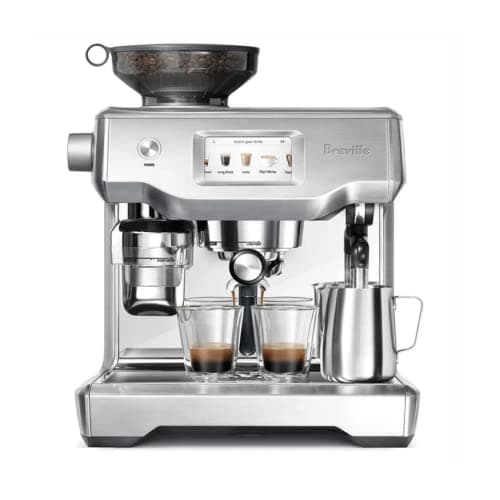
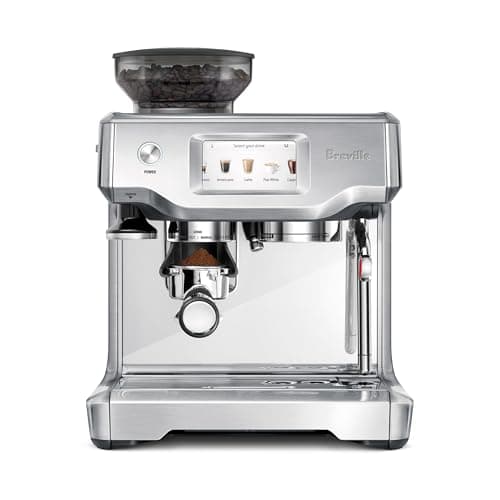
Here is the split in one line, because it drives the whole decision. The Barista Touch is a 54mm single-heater all-in-one: it grinds and doses into the portafilter, you tamp the puck yourself, and because it runs one heating system you pull a shot and then wait a beat for it to switch over to steam. The Oracle Touch is an automated dual boiler: it grinds, doses and auto-tamps 22 grams into a 58mm commercial portafilter, and its two PID-controlled boilers let it brew and steam at the same instant with temperature held to the degree. Same touchscreen philosophy, a full rung apart on the hardware. Read the machines in full in our Breville Barista Touch review and, for the Oracle Touch, our best dual boiler espresso machines roundup, where it takes the Best Automated Dual Boiler spot.

One thing is true of both and worth saying before the details: these are both all-in-one machines with the grinder built in, so unlike a bare machine neither needs a separate grinder to get started — you can see where each sits among the built-in-grinder field in our best espresso machines with a grinder roundup. And if what you actually want is the whole process automated with no portafilter at all — grind, tamp, brew and milk on one button — then neither of these is quite it, and a super-automatic bean-to-cup machine is the category to look at instead. With that framed, here is what the money between the Barista Touch and the Oracle Touch really pays for.

The short answer

Quick picks

#ProductBest forScorePrice
01
Breville Breville Barista Touch (BES880BSS)
Breville Barista Touch (BES880BSS)

The far more affordable way onto this page, and the right Breville touchscreen for most people. The Barista Touch is a 54mm all-in-one - a conical burr grinder, brew system and steam wand in one body - with a color touchscreen that guides each drink and an automatic wand that textures milk hands-free. Crucially, it already gives you the two headline features the Oracle Touch is famous for, the screen and hands-free milk, for a fraction of the price. What it does not have is a dual boiler or an auto-tamp: it runs a single heating system, so you wait a beat between pulling a shot and steaming, and you still dose and tamp the puck yourself. For a home or small setting that wants guided, hands-free-milk espresso without prosumer money, this is the sensible buy, and the shot it makes is closer to the Oracle's than the price gap suggests.

Best value touchscreen all-in-one
8.2
$938.00Amazon
02
Breville Breville Oracle Touch (BES990)
Breville Oracle Touch (BES990)

The machine the big price jump actually buys, and it is a different class of hardware rather than just a nicer Barista Touch. Under the same touchscreen-and-automatic-milk formula sits a real dual boiler with PID, so it brews and steams at the same instant with temperature held to the degree - no waiting between shot and steam - and a 58 mm commercial group fed by a grinder that auto-doses and auto-tamps 22 grams for you. So it removes the last manual step the Barista Touch leaves you, tamping; it adds simultaneous steaming; and it moves up to the cafe-standard portafilter. The catches are honest: it costs a great deal more, it is larger with more electronics and moving parts to service, and if you only make one or two drinks at a time the dual boiler's back-to-back advantage barely shows. Buy it for the dual boiler, the auto-tamp and the 58 mm group - not for the screen or the milk, which the cheaper machine already has.

Best automated dual boiler
8.5
$2,301.47Amazon

#ad · Live prices from the Amazon Product API, as of Jul 30, 2026. Where we have no verified live price, we show none — a gap beats a number that has rotted.

In detail

The picks, in full

01
Breville Breville Barista Touch (BES880BSS)

Best value touchscreen all-in-one

Breville Barista Touch (BES880BSS)

Automatic hands-free milk texturingColor touchscreen with drink presetsIntegrated conical burr grinder54mm portafilter, 15-bar pump
8.2/10

The far more affordable way onto this page, and the right Breville touchscreen for most people. The Barista Touch is a 54mm all-in-one - a conical burr grinder, brew system and steam wand in one body - with a color touchscreen that guides each drink and an automatic wand that textures milk hands-free. Crucially, it already gives you the two headline features the Oracle Touch is famous for, the screen and hands-free milk, for a fraction of the price. What it does not have is a dual boiler or an auto-tamp: it runs a single heating system, so you wait a beat between pulling a shot and steaming, and you still dose and tamp the puck yourself. For a home or small setting that wants guided, hands-free-milk espresso without prosumer money, this is the sensible buy, and the shot it makes is closer to the Oracle's than the price gap suggests.

Milk automation
9
Interface
9
Grinder
8
Espresso quality
8
Ease of use
9
Value
6

Pros

  • Automatic steam wand textures milk hands-free to a set temperature and texture — the easiest milk of any Barista machine
  • Color touchscreen guides each drink and stores a preset cafe menu, the gentlest learning curve in the line
  • Same grind-to-cup convenience with the conical burr grinder built in
  • Large 67oz water tank means fewer refills than a compact machine
  • Genuinely good espresso from the proven 54mm Breville brew system

Cons

  • Espresso is very close to the cheaper Barista Express and Barista Pro — the upgrade is the milk automation and the screen, not the cup
  • The most expensive machine in the Barista line by a clear margin
  • Automatic milk texturing trades away the fine control a manual wand gives you once you learn latte art
  • Large footprint — the built-in grinder, hopper and screen need real counter depth and cabinet clearance
  • A touchscreen is one more electronic part that can fail, and repairs out of warranty are not cheap
  • Built-in grinder is convenient but a dedicated grinder still grinds better

Don't buy this if…

you make milk drinks back to back and hate waiting for a single heater to switch to steam, or you want the machine to grind, dose and tamp for you on a 58mm commercial group - that is the Oracle Touch, and it is a large step up in price.

$938.00View on Amazon

$999.956% off

Price as of Jul 30, 2026. Prices change — Amazon's at checkout is the one that counts.

#ad · we may earn a commission from this link to Breville Barista Touch (BES880BSS)

02
Breville Breville Oracle Touch (BES990)

Best automated dual boiler

Breville Oracle Touch (BES990)

Dual stainless steel boilers, PID controlAuto grind, dose & tamp (22 g)Touchscreen + Auto MilQ hands-free steam58 mm portafilter, heated group
8.5/10

The machine the big price jump actually buys, and it is a different class of hardware rather than just a nicer Barista Touch. Under the same touchscreen-and-automatic-milk formula sits a real dual boiler with PID, so it brews and steams at the same instant with temperature held to the degree - no waiting between shot and steam - and a 58 mm commercial group fed by a grinder that auto-doses and auto-tamps 22 grams for you. So it removes the last manual step the Barista Touch leaves you, tamping; it adds simultaneous steaming; and it moves up to the cafe-standard portafilter. The catches are honest: it costs a great deal more, it is larger with more electronics and moving parts to service, and if you only make one or two drinks at a time the dual boiler's back-to-back advantage barely shows. Buy it for the dual boiler, the auto-tamp and the 58 mm group - not for the screen or the milk, which the cheaper machine already has.

Build quality
8
Espresso quality
8
Steam power
8
Ease of use
10
Features
10
Value
7

Pros

  • Auto grind, dose and tamp removes the three steps beginners get wrong, straight into a 58 mm portafilter
  • Real dual-boiler hardware underneath — true simultaneous brew and steam with PID temperature control
  • Auto MilQ steam wand builds microfoam hands-free to a set temperature and texture, so latte art is repeatable
  • Touchscreen makes multi-drink mornings genuinely one-touch for a household with mixed tastes
  • Gets you cafe-grade milk drinks with almost no learning curve

Cons

  • Expensive for what is, mechanically, a mid-tier dual boiler wrapped in automation
  • The grinder, tamper and touchscreen add electronics and moving parts that can eventually need service
  • Automation takes away the manual control and tinkering enthusiasts specifically want at this price
  • Bigger footprint and more to clean than a bare semi-automatic dual boiler

Don't buy this if…

you mostly make one or two drinks at a time and do not need simultaneous brew-and-steam, or you are watching the budget - the Barista Touch already gives you the touchscreen and hands-free milk, and the shot is closer than the price gap implies.

$2,301.47View on Amazon

$2,799.9518% off

Price as of Jul 30, 2026. Prices change — Amazon's at checkout is the one that counts.

#ad · we may earn a commission from this link to Breville Oracle Touch (BES990)

The heating system: single heater vs dual boiler

This is the biggest hardware difference between the two, and it is where most of the price gap lives. The Barista Touch runs a single heating system: it heats to brew temperature, pulls your shot, and then has to switch over and climb to steam temperature before it can froth milk, so there is a short wait between the espresso and the milk. For one or two drinks that pause is barely noticeable, and it is exactly how the whole Barista line works. The Oracle Touch has a true dual boiler— two separate, PID-controlled boilers, one held at brew temperature and one at steam temperature — so it can extract a shot and texture milk at the same instant, with the brew temperature locked to the degree rather than drifting between shots. The practical payoff shows up in two places: making several milk drinks back to back without waiting on the machine, and temperature stability that takes the machine out of the equation as a variable. If you regularly make three or four cappuccinos in a row, that dual boiler earns its keep; if you make a single latte each morning, you are paying for a capability you will rarely stretch. The wider case for a second boiler, and who genuinely needs one, is laid out in our best dual boiler roundup.

Puck prep: you tamp vs the machine tamps

The second thing the money buys is automation of the puck. Both machines grind fresh, but they hand the coffee over at different points. On the Barista Touch the grinder doses ground coffee into the portafilter and then you tamp it yourselfwith the supplied tamper, which is a small skill — level, consistent pressure — that affects the shot. The Oracle Touch auto grinds, auto doses and auto tamps22 grams for you, so the one manual step the Barista Touch still asks of you is removed entirely; you lock in a prepared portafilter and go. This matters most for two kinds of buyer: someone who wants the most repeatable possible shot without practising their tamp, and a household where several different people make coffee and you want the puck prep to be identical no matter who is standing at the machine. It is genuine convenience. What it is not is a magic upgrade to flavour — a well-tamped Barista Touch puck and an auto-tamped Oracle puck are both good; the Oracle just guarantees the consistency rather than leaving it to your hand.

54mm vs 58mm: the portafilter and the accessory world

The Barista Touch uses Breville's 54mm portafilter; the Oracle Touch steps up to the 58mm commercial standard. In the cup, on day one, this makes little difference — a well-dialled 54mm basket and a well-dialled 58mm basket both pull excellent espresso. Where 58mm matters is the ecosystem: it is the size cafes use, so the Oracle takes the widest range of off-the-shelf precision baskets, competition tampers, distribution tools and bottomless portafilters. The 54mm world is smaller, though Breville supports it well. For most people this is a minor point — the Oracle auto-tamps for you, so you are less likely to be shopping for aftermarket tampers anyway — but if growing an accessory collection is part of the appeal, the 58mm group gives you more room to do it. It is one more way the Oracle is the more “prosumer” of the two, even though its front end is more automated.

What the two machines share — and why that narrows the decision

Here is the point that should anchor the whole choice: the two features people most associate with the Oracle Touch — the color touchscreen and the automatic, hands-free milk wand— are both already on the Barista Touch. Both machines walk you through drinks on a screen, and both texture milk to a temperature and foam level you set without any wand technique. So the jump from one to the other does notbuy you easier milk or a nicer interface; it buys the dual boiler, the auto-tamp and the 58mm group described above. That reframes the decision honestly: if those three hardware upgrades matter to how you actually make coffee, the Oracle is worth it; if they do not, the Barista Touch gives you the same guided, hands-free-milk experience for far less. And if you are happy to steam milk by hand, the step down within the Barista line is the Barista Pro, which drops the automatic wand for a manual one — our Barista Pro vs Barista Touch comparison covers that choice, and it is the cheaper fork worth ruling in or out before you spend up to an Oracle.

Size, build and living with them

Both are large machines that need real counter depth and clearance under a wall cabinet for the bean hopper, so measure before you buy either. The Oracle Touch is the bigger and heavier of the two, with more inside it — a second boiler, an auto-tamping mechanism, more electronics — which is part of why it costs more and also means there is more that can eventually need service. The Barista Touch is simpler under the hood, and simpler tends to mean fewer things to go wrong and cheaper repairs out of warranty. Neither is a machine you rebuild for decades the way you would an all-metal commercial single boiler; both are capable, feature-rich appliances built to be used and enjoyed. Factor the running realities in on either: a built-in grinder to keep clean, a milk system to rinse, and periodic descaling — the same upkeep any pump machine needs.

Which should you buy?

Buy the Barista Touchif you want a guided, touchscreen all-in-one with hands-free milk and you make coffee a drink or two at a time — it gives you the screen and the automatic wand for a fraction of the Oracle's price, pulls a shot that is genuinely close, and it is the sensible pick for most homes. Buy the Oracle Touch if you make milk drinks back to back and want simultaneous brew-and-steam, if you want the machine to tamp for you so the puck is identical every time, or if the 58mm commercial group and to-the- degree temperature stability are worth a large premium to you. We did not bench-test either machine; our methodologyexplains how we score from documented manufacturer and retailer specifications and aggregated owner reports rather than lab measurements. Whichever way you lean, be clear that the extra money is buying hardware — the boiler count, the auto-tamp and the group size — not the touchscreen or the milk, which come on both.
How we picked

We did not lab-test this gear

Everyone in this category says they tested twenty machines. We have not pulled shots on every product here, and we say so. What we did instead: compiled the published specifications, cross-checked the manufacturer manuals, computed the running cost (wattage to energy, grams-per-shot to cost-per-cup), weighed aggregated owner reports, and scored each product against a published rubric. The scores are judgments from documented research — not measurements we took, because we do not have a test lab and we will not pretend we do. Where hands-on time would tell you more than a spec sheet, we flag it. Where a number came from someone else's work, we name them in Sources.

Questions

Frequently asked

What is the difference between the Breville Barista Touch and the Oracle Touch?
Both have a color touchscreen and an automatic hands-free milk wand, so those are not the difference. The Barista Touch is a 54mm single-heater all-in-one where you tamp the puck yourself and wait a beat between brewing and steaming. The Oracle Touch is an automated dual boiler: it grinds, doses and auto-tamps 22 grams into a 58mm commercial group, and its two boilers brew and steam at once with temperature held to the degree. The price jump buys the dual boiler, the auto-tamp and the bigger group — read the full Barista Touch review and our dual boiler roundup for each in depth.
Is the Oracle Touch worth the extra money over the Barista Touch?
It depends entirely on how you make coffee. The Oracle Touch is worth it if you make several milk drinks back to back and want simultaneous brew-and-steam, if you want the machine to tamp for you, or if you value the 58mm commercial group and to-the-degree temperature stability. It is not worth it if you make one or two drinks at a time, because the Barista Touch already gives you the touchscreen and hands-free milk, and its shot is close. Steam milk by hand instead? Consider the cheaper Barista Pro via our Barista Pro vs Barista Touch comparison.
Do both the Barista Touch and Oracle Touch steam milk automatically?
Yes — both have an automatic, hands-free steam wand. You set a target milk temperature and a foam level on the touchscreen, drop the wand into the pitcher, and the machine textures the milk and stops on its own, producing microfoam with no wand technique to learn. This is why the milk system is not a reason to choose one over the other; it is essentially the same experience on both. The Oracle's advantage is that its dual boiler lets it steam while a shot is running, so it does not make you wait between the espresso and the milk.
Does the Oracle Touch tamp the coffee for you?
Yes. The Oracle Touch auto grinds, auto doses and auto tamps 22 grams straight into a 58mm portafilter, so you lock in a prepared puck without touching a tamper. The Barista Touch grinds and doses into the portafilter but leaves the tamping to you with the supplied tamper. That auto-tamp is one of the main things the price jump buys, and it makes the shot more repeatable across different people using the machine. Both are all-in-ones with the grinder built in — see the wider field in our best machines with a grinder roundup.
Are either of these bean-to-cup super-automatic machines?
No. Both are semi-automatic machines that use a real portafilter — the Barista Touch leaves the tamp to you, and even the Oracle Touch, which auto-tamps, still brews through a portafilter you lock into the group. A true super-automatic (bean-to-cup) machine grinds, tamps and brews at one button press with no portafilter at all and is the most hands-off category there is. If that is what you actually want, see our best super-automatic machines instead.

Keep reading

Receipts

Sources

We do not run a testing lab, and we do not pretend to. Where a measured number came from someone else's work, we name them and link them. Where we could not verify something, we say so on the page rather than quietly leaving it out. Read our full method.