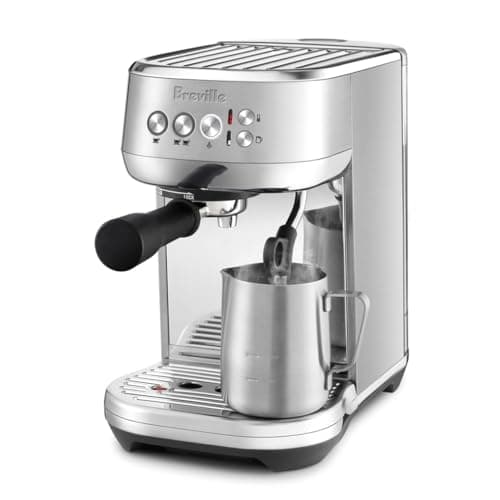
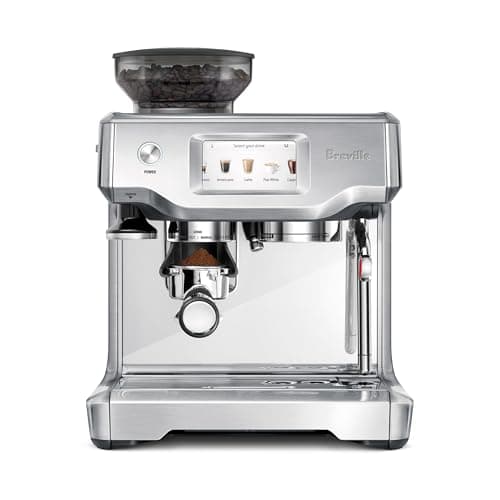
The Breville Barista Touch and Breville Bambino Plus get cross-shopped for one very good reason: both will texture your milk for you, hands-free, with no wand technique to learn. That shared feature is what draws milk-drink beginners to each of them — so it is worth saying up front that milk is not the thing that separates these two. The real difference is everything around the shot. The Barista Touch is a large all-in-one: it builds a conical burr grinder and a color touchscreen into the same body, so one purchase is the whole setup. The Bambino Plusis a paperback-width compact that grinds nothing at all — you bring your own grinder. Both use the same 54mm brew system, so the espresso is close; what you are really choosing between is one box or the smallest possible footprint.
Put simply, the Touch answers "I want the machine to do everything, including grind," and the Bambino Plus answers "I have almost no counter space and I am happy to own a separate grinder." The Touch's built-in grinder and touchscreen add real convenience — you grind fresh into the portafilter and tap through guided, saved drinks on a screen — but they also add height, depth and a clear premium. The Bambino Plus strips all of that away for a machine that hides in a corner and heats in seconds, at the cost of needing a second appliance to make it any good. If you are brand new and weighing the whole field, both appear in our best espresso machines for beginners guide, and both are strong picks for milk drinks specifically.
So the question is narrow and practical. Do you want a single machine that grinds, guides and froths — and do you have the counter space and the budget for it? Or do you want the tiniest possible footprint and are willing to buy and house a separate grinder to reach the same, or better, cup? Answer that honestly and the winner is obvious. This page walks through the grinder, the interface, the milk systems and the footprint, then tells you who each machine is for. If you want the deeper single-machine reads after this head-to-head, see the Barista Touch review and the Bambino Plus review.
The one difference that matters: the grinder (and the screen)
Strip away the marketing and the entire case for the Touch over the Bambino Plus comes down to two things it has that the Bambino Plus does not: a built-in conical burr grinder and a color touchscreen. The grinder is the big one. On the Touch you tip whole beans into a hopper, and the machine grinds fresh straight into the portafilter — one appliance, one purchase, one thing on the counter. On the Bambino Plus there is no grinder at all; it is a brew-and-steam machine, and it is only as good as whatever grinder you feed it. That is not a footnote, because espresso is more sensitive to grind than to almost anything else. Buy a Bambino Plus and you are committing to buying a separate burr grinder too, which our best grinders for espressocovers. The touchscreen is the smaller difference: it guides each drink, stores saved coffees and makes the Touch the friendliest machine here to learn, where the Bambino Plus uses simple buttons and a dial. Neither the grinder nor the screen makes the espresso itself better — but the grinder does decide whether you have one box or two, and that is the real fork in this decision.
Milk: both automatic, and that is the point
This is the part that surprises people cross-shopping these two: they both froth milk for you. The Touch uses Breville's Auto MilQ wand, and the Bambino Plus uses its own automatic steam wand with a temperature probe. On either machine you pour cold milk into a pitcher, choose a target temperature and a foam level, drop the wand in and press start; the machine heats and textures the milk hands-free and stops on its own. So going small with the Bambino Plus does notmean giving up automatic milk — the compact machine keeps the feature that beginners most want. The Touch's milk routine is a little more integrated with its touchscreen presets, and its larger body and tank suit making several milk drinks in a row a bit better, but in the cup both produce hands-free microfoam without wand technique. If you want to understand what that automation is standing in for — and why some people still prefer to learn the manual skill — our guide to steaming milk shows the craft both machines are automating away.
The espresso and the shared 54mm platform
Both machines are built on Breville's 54mm brew systemwith a 15-bar pump, so the espresso they can pull is genuinely close. The Touch heats with a system that comes up to temperature quickly; the Bambino Plus uses ThermoJet and is ready in about three seconds. Neither has a fundamentally better group head than the other, which means the cup comes down to the two things you control: the grind and the beans. And that is exactly where the Bambino Plus's missing grinder matters. Paired with a genuinely good standalone grinder, the little Bambino Plus can match — and by some measures beat — the Touch, because a dedicated grinder out-grinds the compact burr set Breville can fit inside an all-in-one. Paired with pre-ground coffee or a cheap blade grinder, it will disappoint no matter how good its milk foam looks. The Touch's built-in grinder removes that risk by being competent and always present; the Bambino Plus hands you a higher ceiling and a real obligation. Whichever route you pick, fresh espresso beans finish the setup.
Size, counter space and total cost
This is where the two could not be more different. The Barista Touch is a large all-in-one: the built-in grinder and bean hopper add height and depth, and the hopper sits up top, so you need clearance under any wall cabinets as well as depth on the counter. The Bambino Plusis about the width of a paperback and slips into a corner almost anything else would not fit. If counter space is your constraint, the Bambino Plus wins outright. The honest complication is total cost. The Touch's price is the whole setup, grinder included. The Bambino Plus is cheaper on its own, but once you add the burr grinder it needs, the combined spend can approach or even exceed the one-box Touch — while taking two footprints instead of one, one of which (the grinder) can be small. So the Bambino Plus is not automatically the budget pick; it is the small-footprint pick that also lets you choose and upgrade the grinder yourself. We did not bench-test either machine; our methodology explains how we judge.
Which Breville fits you
- Buy the Barista Touch if you want one appliance that grinds, guides and froths, you like a color touchscreen with saved drinks, and you have the counter space and budget for a large all-in-one. The built-in grinder and screen are the whole reason to spend up.
- Buy the Bambino Plus ifcounter space or budget is your hard limit and you are happy to own a separate grinder — you still get automatic, hands-free milk in a footprint a fraction of the Touch's, and a good grinderpaired with it can match the Touch's cup.
- Consider a manual-wand machine instead ifyou actually want to learn to steam milk and pour latte art — both of these automate the milk, so neither will teach you that craft, and a manual wand takes you further once you learn it.
Whichever you choose, the accessories that make espresso repeatable still apply — a basket-matched tamper, fresh beans and, on the Bambino Plus, a real grinder from the start. Both machines are strong picks in our best machines for lattes.
What we did not test
We have not run either machine on a bench for months, and we do not claim to. This comparison compiles Breville's published specifications for the BES880 and the BES500, cross-checks them against each other and the shared 54mm platform, and weighs aggregated owner reports against our scoring rubric. The built-in grinder and touchscreen on the Touch, the automatic milk wands on both, the 54mm brew systems and the Bambino Plus's ThermoJet heat-up all come from Breville's own materials, listed in Sources. The Bambino Plus scores lower overall here than it does in its standalone review, and that is deliberate: in a head-to-head with a machine whose whole advantage is a built-in grinder, its grinderless design is a genuine relative weakness — not a sign the espresso is worse. Where hands-on time would tell you more than a spec sheet — exactly how consistent each automatic wand is across dairy and plant milks, how the Touch's grinder holds its setting over months — we say so rather than invent a figure. Prices are never quoted from memory; the live price renders from our pipeline with the date it was checked.