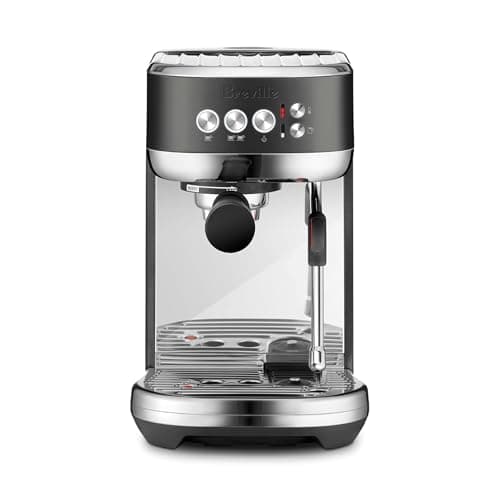
The Breville Bambino Plus exists to answer the one question that stops a lot of would-be home baristas cold: what if you want a proper cafe-style latte every morning but you have no interest in learning to steam milk by hand? On the base Bambino you texture the milk yourself. On the Plus, the machine does it for you. Drop the steam wand into your pitcher, pick a milk temperature and a foam level, press one button, and it heats and froths the milk hands-free while you get on with the rest of your morning. Pair that automatic milk system with a heat-up you can count in seconds and a body about the width of a paperback, and you have the friendliest milk-drink machine Breville makes for a small kitchen.
The headline feature is the automatic steam wand. Instead of a bare jet of steam that asks you to spin and stretch the milk yourself, the Plus adds a temperature probe and a control dial: you select one of a few milk temperatures and one of a few froth levels, insert the wand, and press start. The machine introduces air, rolls the milk, holds it to your chosen temperature, and stops on its own. That is the whole reason the Plus exists, and it is genuinely transformative for a beginner, because microfoam — the glossy, paint-like milk that makes a real latte or flat white — is the single hardest skill to learn on a manual machine. The Plus hands you a repeatable version of it on day one. If you have ever poured a jug of stiff, bubbly, over-hot froth and wondered why your latte looked nothing like the cafe's, this is the machine that removes that particular struggle.
Underneath the milk system sits Breville's ThermoJet heating: it reaches espresso temperature in around three seconds rather than the several minutes a traditional boiler needs, so the machine is ready before you have finished grinding. That near-instant readiness matters more in a tiny machine than it sounds, because it means the Plus never feels like an appliance you have to plan around — you walk up, press, and go. The espresso hardware is a 54mm portafilter with a 15-bar Italian pump and the same single-wall and pressurized baskets as the rest of the small Breville range. Nothing about the shot is exotic; the story here is convenience, and specifically the convenience of milk. If you want to see the two small Bambinos weighed directly against each other, our Breville Bambino vs Bambino Plus comparison is the companion to this review.
The honest catch is the same one every small Breville shares, and it is worth stating before you spend a cent: the Bambino Plus has no grinder, and espresso is more sensitive to grind than to almost anything else. The automatic milk wand will make you lovely foam the first week, but the shot underneath it will only be as good as the coffee you grind for it. Pairing this machine with pre-ground supermarket coffee or a cheap blade grinder wastes most of what you paid for. Budget from the start for a real burr grinder — our best grinders for espresso is the place to start, and if you are brand new to the whole thing, our best espresso machines for beginners guide puts the Plus in context against every other first-machine route.
Who the Bambino Plus is really for
The Plus suits a specific and very common buyer: someone who drinks lattes, cappuccinos or flat whites most mornings, wants them to actually taste and look like cafe drinks, has a small kitchen, and has no desire to spend a month learning to steam milk. If that is you, this is close to the ideal first machine. The automatic wand removes the hardest beginner skill from the equation and does it in a footprint that fits almost any counter. Where the Plus is not the right pick is at the two extremes: if you drink mostly straight espresso and americanos, you will rarely touch the feature you paid extra for, and the base Breville Bambinomakes the identical shot for less. And if you genuinely want to learn to texture milk like a barista — to pour latte art, to feel the milk come together under your hand — the automatic wand will actively hold you back, because it does the interesting part for you. The Plus is a convenience machine, and it is honest about it.
How the automatic milk system actually works
This is the feature the whole page is about, so it is worth being precise about what it does and does not do. The Plus uses a steam wand with a temperature probe on it. You pour your cold milk into the supplied jug, drop the wand in so the probe sits in the milk, use the dial to choose a milk temperature and a froth level, and press start. The machine pulses steam to draw air into the milk for the froth setting you picked, then rolls it to integrate that air into microfoam, and cuts off automatically when the probe reads your target temperature. You do not hold the pitcher, you do not judge the pitch by ear, and you do not have to catch it before it scalds. Because the temperature is measured rather than guessed, it is very hard to burn the milk, which is the mistake that ruins most beginner lattes. The result is not identical to what a skilled barista can coax out of a manual wand — a great hand can pull tighter, glossier microfoam — but for someone with no practice, the Plus produces better, more consistent milk than they could make themselves, which is exactly the point. A decent milk jug and cold, fresh milk still matter; the machine automates the technique, not the ingredients.
The espresso is the same as the base Bambino — the milk is the upgrade
Do not buy the Plus expecting better coffee than the base model, because the shot is identical. Both machines share the same ThermoJet heating system, the same 54mm portafilter, the same 15-bar pump and the same single-wall and pressurized baskets. There is no upgraded group head or richer pressure profile hiding in the Plus. Pull the same beans at the same grind and dose on either machine and what lands in the cup is the same espresso. The Plus adds three things over the base Bambino: the automatic milk wand, programmable shot volumesso you can set a single and a double and get the same pour at one touch, and a slightly larger body with a bigger drip tray to house the extra milk hardware. That is the entire difference, and it means the decision between the two is not about coffee quality at all — it is purely about whether hands-free milk is worth the premium to you. We lay that out drink by drink in our Breville Bambino vs Bambino Plus comparison, and both machines sit near the top of our best espresso machines for lattes picks for exactly this reason.
You still have to buy a grinder — do not skip this
Whichever way you cut it, the Bambino Plus is half a setup. It grinds nothing, and on a 54mm single-wall basket the grinder is the single biggest thing that decides whether your espresso is good or sour. It is genuinely possible to have flawless automatic microfoam sitting on top of a bad, bitter shot, and that is a real risk if you skimp here. Pre-ground coffee goes stale fast and cannot be dialed in to the fine, adjustable setting espresso needs, so a real burr grinder is not optional — it is the other half of the machine. Budget for it from the start; on a small setup like this it matters more to the cup than any feature of the machine itself. Start with our best grinders for espresso, which includes the affordable models most Bambino owners pair with theirs. If the idea of buying a separate grinder puts you off entirely, that is a useful signal that you might want an all-in-one with the grinder built in instead — our best espresso machines for beginners guide covers those routes too.
What we did not test
We have not run this machine on a bench for months, and we will not pretend otherwise. This review compiles Breville's published specifications, cross-checks the manual, and weighs aggregated owner reports against our scoring rubric. The specs — the ThermoJet heat-up, the 54mm portafilter and 15-bar pump, the automatic steam wand with its temperature and froth settings, the programmable shot volumes and the basket set — come from Breville's own documentation, listed in Sources. Our scores are editorial judgments from that documented research, not measured numbers: there is no crema-density rig or milk-temperature probe behind them. Where hands-on time would genuinely tell you more than a spec sheet — exactly how tight the automatic microfoam feels compared with a good manual pour, or how quickly the single boiler recovers between a shot and steaming on a busy morning — we say so rather than invent a number. The one claim we are most confident in is also the simplest: because the Plus shares its heating system, pump and portafilter with the base Bambino, the espresso it makes is the same, and every published spec and owner account we found supports that.