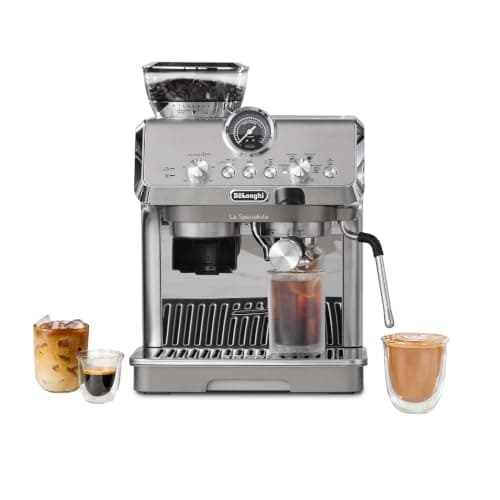
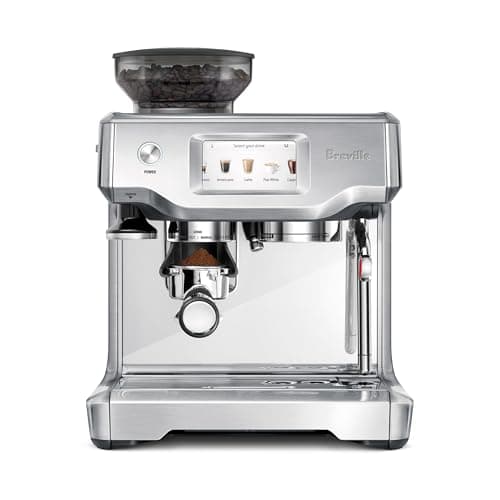
The Breville Barista Touch and the De'Longhi La Specialista Arte Evo are both premium all-in-ones — a grinder, a brew system and a steam wand in one body, so you go from whole beans to a finished latte without a separate grinder on the counter. On paper they do the same job for roughly the same premium money. In practice they answer one question in opposite ways: how much of the milk, and how much of the coffee, do you want the machine to do for you? The Barista Touch is the convenience choice; the Arte Evo is the control choice. That single fork decides which one belongs on your counter far more than any line on the spec sheet.
The clearest difference is the milk. The Barista Touch adds a color touchscreen and a fully automatic steam wand: you pick a drink, set a target temperature and a foam level, drop the wand into the pitcher, and the machine textures the milk hands-free while it grinds and doses — Breville's own words are "quality micro-foam totally hands-free." The Arte Evo keeps a commercial-style manual steam wandyou work by hand, so texturing milk is a skill you learn rather than a button you press. Neither is objectively better: the Touch is effortless and repeatable, while a lot of owners prefer the texture — and the latte-art potential — a manual wand gives once they have put in the practice. If milk drinks are the whole point of the machine, weigh both against our best espresso machines for lattes roundup.
The same convenience-versus-control split runs through the espresso end too. The Touch guides grind, dose and shot on its screen and stores a menu of preset cafe drinks; the Arte Evo guides your dosing and hands you tamping tools, so you stay involved in packing the puck. The Touch uses the larger 54mm brew system, with a deeper world of aftermarket baskets and portafilters to grow into; the Arte Evo uses a smaller 51mmgroup but answers back with a bigger 2 L tank and a dedicated cold-brew setting the Breville simply does not have. Below we compare the milk systems, the espresso control, the learning curve and the footprint in turn. For the full detail on each machine, read our Breville Barista Touch review and our La Specialista Arte Evo review; for the wider brand question, our Breville vs De'Longhi comparison zooms all the way out.
The milk system: automatic wand vs manual wand
This is the fork the whole comparison turns on, so start here. The Barista Touch has a fully automatic steam wand. You set a target milk temperature and a foam level on the touchscreen, put the wand in the pitcher, and the machine heats and textures the milk on its own, then stops — Breville describes the result as "quality micro-foam totally hands-free." There is no angle to hold, no hiss to listen for, no moment to judge. For a household that drinks cappuccinos and lattes and does not want to learn to texture milk, that is a real, repeatable convenience every single morning, and it is the one feature that most clearly separates the Touch from the Arte Evo.
The La Specialista Arte Evo goes the other way with a commercial-style manual steam wandyou operate by hand. Texturing milk on it is a genuine skill: you angle the pitcher, introduce air near the surface, then submerge to spin and heat the milk to the temperature you want. It takes practice, and beginners find it the hardest part of home espresso. But it is also the part a lot of people come to love — a manual wand gives you finer command over texture and the ability to pour real latte art, and many owners prefer the milk it makes once they have learned it. So the honest read is not "automatic is better" or "manual is better": the Touch is for someone who wants the drink, and the Arte Evo is for someone who wants the craft. If milk drinks are the reason you are buying at all, cross-reference both against our best espresso machines for lattes before you decide.
The espresso and the control: 54mm touchscreen vs 51mm guided prep
The two machines also split on how involved you are in the shot itself. The Barista Touch leans on its color touchscreen: it stores a menu of preset cafe drinks — espresso, long black, latte, flat white, cappuccino and more — and walks you through grind, dose and shot with prompts you can adjust and save. It brews through the larger 54mm Breville brew system, which matters less for the cup on day one than for the road ahead: 54mm has a broad world of bottomless portafilters, precision baskets and aftermarket tampers you can grow into. The built-in conical burr grinder is convenient, though a dedicated standalone unit will still out-grind it.
The Arte Evo keeps you more hands-on. It guides your dosing and includes tamping tools, so you pack the puck yourself rather than letting a screen handle it, and it gives you three selectable infusion temperatures plus a 15-bar pump with low-pressure pre-infusion — real levers for a picky drinker. The honest ceilings are structural, and they are the reason to read past the feature list. The 51mm portafilter sits below both the 54mm Breville and the 58mm commercial standard, so the accessory world you can bolt on later is much narrower. The thermoblock heater warms fast but holds temperature a little less tightly across back-to-back shots than a PID-managed thermocoil or boiler. And the grinder offers only eight stepped settings — plenty to dial a bag of medium roast, tight if you chase very light single origins. None of these is a defect; they are trade-offs you should sign up for knowingly. Our Breville vs De'Longhicomparison lays out the same 54mm-versus-51mm question across both brands' wider ranges.
Learning curve: effortless vs rewarding
If your priority is getting a good milk drink on the counter with the least possible friction, the Barista Touch wins the learning curve outright. Between the guided screen and the automatic wand, the two hardest things a beginner faces — interpreting the machine and texturing the milk — are largely handled for you. You can make a consistent latte on day one, and you will make the same one on day three hundred. That is genuinely valuable if espresso is a means to a drink you enjoy, not a hobby you want to sink time into.
The Arte Evo asks more of you and, for the right person, gives more back. You will spend your first weeks learning to steam milk by hand and to read your own dosing, and some of those early drinks will be worse than what the Touch would hand you automatically. But that curve is the point: it teaches you skills that carry to any machine, it rewards you with control the Touch cannot offer, and it is why people who enjoy the ritual gravitate to the manual wand. Ask yourself honestly whether you want a machine that removes the craft or one that teaches it — that answer picks your winner more reliably than any score.
Footprint, tank and cold brew
Both machines are large all-in-ones, so measure your counter — and the clearance under any wall cabinet — before you commit to either. The Barista Touch is roughly 15.5 inches wide, 16 inches tall and 12.5 inches deep, with a bean hopper up top adding height, and it carries a 67oz water tank. The Arte Evo counters with a notably larger 2 L tank, which means meaningfully less refilling if the machine gets used all day. Neither is a small appliance; both need real space.
The one capability that is not a wash is cold coffee. The Arte Evo has Cold Extraction Technologywith a dedicated Cold Brew preset that pulls cold coffee in minutes rather than steeping overnight, alongside Americano and Hot Water presets — and no Breville in this bracket, the Barista Touch included, offers it. If cold brew on demand is part of your routine, that is a genuine, decisive point in the Arte Evo's favor. If it is not, be honest that it is a feature you will leave switched off while still paying for it. Weigh it for how you actually drink, not for how the spec sheet reads.
Which should you buy
- Buy the Breville Barista Touch ifyou want cafe-style milk drinks without learning to steam milk, you like the idea of a guided touchscreen, and effortless, repeatable microfoam every morning is worth a premium. Its automatic wand and the larger, more upgradeable 54mm brew system are exactly what you are paying for — the full detail is in our Barista Touch review.
- Buy the De'Longhi La Specialista Arte Evo ifyou want to stay hands-on — a manual wand you can learn latte art on, guided dosing with real tamping tools, and levers like three infusion temperatures — and if a larger 2 L tank and cold brew on demand appeal. Go in clear-eyed about the 51mm ceiling; the rest is in our Arte Evo review.
- Look wider ifyou are milk-drink-first and want to compare these two against the whole field — start with our best espresso machines for lattes — or if the brand question is really what you are weighing, in which case our Breville vs De'Longhi guide is the better place to begin.
What we did not test
We have not run either machine on a bench for months, and we do not claim to have. This comparison compiles Breville's published specifications for the Barista Touch and De'Longhi's for the La Specialista Arte Evo — the automatic versus manual steam wands, the 54mm versus 51mm brew systems, the touchscreen and guided-dosing interfaces, the thermoblock and Active Temperature Control, the tanks and the Cold Extraction presets — and weighs them against aggregated owner reports using our scoring rubric. The factual specs, pros and cons carry over unchanged from our individual reviews of each machine. Where hands-on time would tell you more than a spec sheet — exactly how consistent the automatic wand is across milk types, how tightly the Arte Evo's thermoblock holds temperature shot to shot — we say so rather than invent a figure we cannot stand behind.