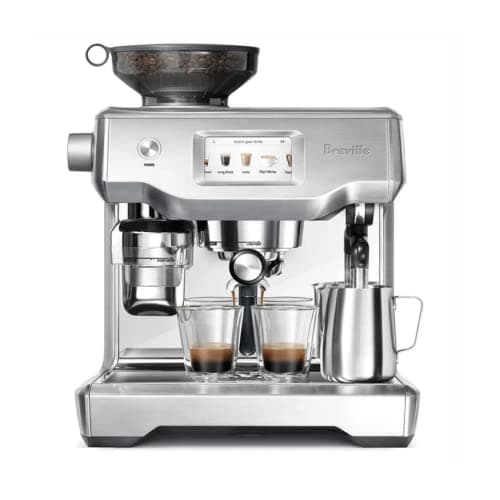
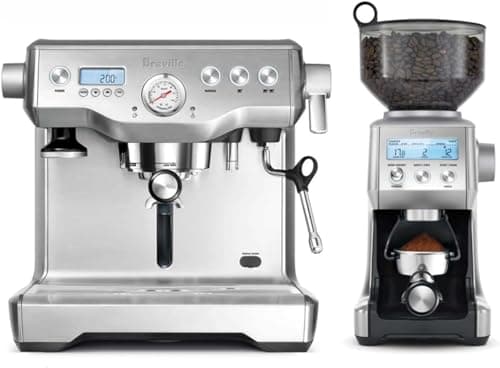
The Breville Dual Boiler and the Breville Oracle Touch are cross-shopped constantly, and the reason is that they share the part that actually makes the coffee. Both are genuine dual boilers — two PID-controlled boilers feeding a heated 58mm portafilter— so both give you true simultaneous brew and steam with the temperature held steady, and the espresso ceiling is broadly similar. The difference is not the hardware; it is how much of the work the machine does for you. The Dual Boiler is a hands-on semi-automatic: you grind, dose, tamp and steam milk yourself. The Oracle Touchbolts a full super-automatic front end on top of that same architecture — it auto-grinds, doses and tamps for you, walks you through drinks on a touchscreen, and textures milk hands-free — for a great deal more money. That is the whole decision, and this page is about who each one is for.
Take the Dual Boiler first, because it is the enthusiast's machine. Enthusiasts usually just call it the “BDB,” and it is the value benchmark of the whole dual-boiler tier: it gives you the part of the prosumer experience that changes your coffee — two separate boilers, adjustable brew temperature, low-pressure pre-infusion, a heated group and a shot clock — without asking you to spend two or three times as much. It commonly ships as the Dynamic Duobundle, packaged with Breville's Smart Grinder Pro, which matters because a dual boiler is only as good as the grind feeding it. But the machine itself is fully manual: you own every step, which is exactly what an enthusiast wants and exactly what a convenience buyer does not. If you want to understand why a second boiler is worth having before you choose, our single vs double boiler guide covers the mechanism.
The Oracle Touch answers a different question: what if you want dual-boiler results but have no interest in becoming a home barista to get them? It automates the three things that separate good home espresso from bad — grinding to the right fineness, dosing the right weight, and tamping level — then automates the milk on top with the Auto MilQ hands-free wand, and puts it all behind a touchscreen with stored drinks. Crucially it does this over a real 58mm portafilter and a real dual boiler, so the espresso is legitimately good rather than merely easy, which is why it out-brews a sealed bean-to-cup super-automatic. The catch is price and philosophy: you pay top of the home range, and you give up the hands-on control that is half the point for enthusiasts. See where both land in our best dual boiler espresso machines roundup.
Same dual-boiler hardware, opposite philosophies
The most important thing to understand is that these two machines share the part that determines the shot. Both are genuine dual boilers — two PID-controlled boilers feeding a heated 58mm group — so both give you true simultaneous brew and steam with the temperature held to the degree, and both brew through a real portafilter rather than a hidden brew unit. Where they split is philosophy. The Dual Boiler hands you every variable: you choose the grind, weigh the dose, tamp the puck and texture the milk, and the machine simply holds temperature and pulls the shot. The Oracle Touchtakes those same variables and automates them — it grinds, doses, tamps and steams for you and stores the recipe. So the espresso ceiling is broadly similar; the question is whether owning the process is something you want or something you want removed. That single answer, not any spec, is what decides this comparison.
How the Oracle Touch automates the work
It is worth being precise about what the Oracle Touch does for you, because it is a lot and it is the entire reason for its price. Its integrated conical burr grinder doses and grinds directly into the portafilter, then an automatic tamping mechanism tamps the 22-gram puck level and to a consistent pressure — removing channeling and uneven extraction, the two faults that ruin most beginner shots. You lock in the portafilter and the touchscreen pulls the shot to a stored recipe. For milk, the Auto MilQ wand carries a temperature probe: you drop it into the jug, pick a target temperature and foam level, and the machine draws air, rolls the milk into microfoam and stops on its own. The result is a repeatable cafe-style drink with almost no learning curve. What it is notis a teacher — because the machine does the interesting parts, you learn far less about the craft than you would on the Dual Boiler, where feeling the milk come together under the wand and dialing in your own grind are the whole point. That trade is the heart of the decision.
The grinder: bundled either way, but for different reasons
A dual boiler is only ever as good as the grind feeding it, and both machines address that — differently. The Oracle Touch has the grinder built in, so grinding, dosing and tamping happen inside the machine with nothing to buy or match. The Dual Boiler commonly ships as the Dynamic Duo, packaged with Breville's separate Smart Grinder Pro, so you get a matched, dedicated grinder in the box but you still operate it yourself. Both approaches remove the single most common and expensive first-year mistake — pairing a lovely machine with a cheap grinder — but they lead in opposite directions. The built-in grinder makes the Oracle Touch a true all-in-one you never think about; the separate grinder keeps the Dual Boiler modular, so you can one day upgrade to a single-dose flat-burr grinder without replacing the machine. If that upgrade path matters to you, our best grinders for espresso shows where the Dual Boiler can go that the sealed Oracle grinder cannot.
Price, build and what you are really paying for
Be clear-eyed about the money, because the gap is large. The Dual Boiler is the value benchmark of the tier; the Oracle Touch costs a great deal more, and stripped of its automation the underlying hardware is a comparable mid-tier dual boiler — you are paying for the grinder, the auto-tamp, the touchscreen and the hands-free milk, not for a better boiler. Both are Breville rather than Milan: engineered brilliantly for the money, but with more plastic than an all-metal Rancilioand built to be used hard rather than rebuilt part by part for decades. The extra electronics and moving parts on the Oracle Touch — grinder, tamper, touchscreen — are also more that can eventually need service. So the honest framing is this: if capability per dollar is your priority and you want to do the work, the Dual Boiler wins comfortably; if you want cafe drinks at a couple of taps and the convenience is genuinely worth a premium to you, the Oracle Touch is the only real-portafilter machine that delivers it. Neither is a mistake; they are aimed at opposite buyers.
Which Breville fits you
- Buy the Dual Boiler if you want the most dual-boiler capability per dollar, you enjoy (or want to learn) grinding, tamping and steaming, and a bundled grinder plus full control is the appeal. As the Dynamic Duo it is our value benchmark for the tier.
- Buy the Oracle Touch if you want cafe-grade milk drinks with almost no skill, you would rather drink coffee than learn to make it, and the auto grind-dose-tamp and hands-free milk are worth a clear premium. Nothing else on a real portafilter gets you this close, this easily.
- Consider neither ifyou want an heirloom, fully-serviceable metal machine — that is a Rancilio-class dual boiler — or if you want zero interaction with coffee at all, in which case a sealed super-automatic is the honest pick.
What we did not test
We have not run either machine on a bench for months, and we will not pretend otherwise. This comparison compiles Breville's published specifications for the BES920 Dual Boiler (and the BEP920 Dynamic Duo bundle) and the BES990 Oracle Touch, cross-checks the manuals, and weighs aggregated owner reports against our scoring rubric. The specs — the dual stainless boilers with independent PID and heated 58mm group shared by both, the low-pressure pre-infusion and 22g dose, the Dynamic Duo's bundled Smart Grinder Pro, and the Oracle Touch's auto grind-dose-tamp system and Auto MilQ hands-free wand — come from Breville's own documentation, listed in Sources. Our scores are editorial judgments from that documented research, not measured numbers: there is no temperature-stability chart, milk-temperature probe or auto-tamp level rig behind them, because we do not have a lab. Where hands-on time would genuinely tell you more than a spec sheet — exactly how level the Oracle's automatic tamp lands across different beans, or how tightly the Dual Boiler holds temperature across a long milk-drink session — we say so rather than invent a number, and we never quote a price from memory.