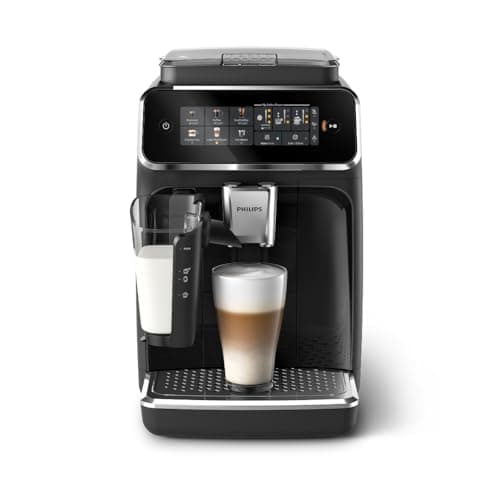
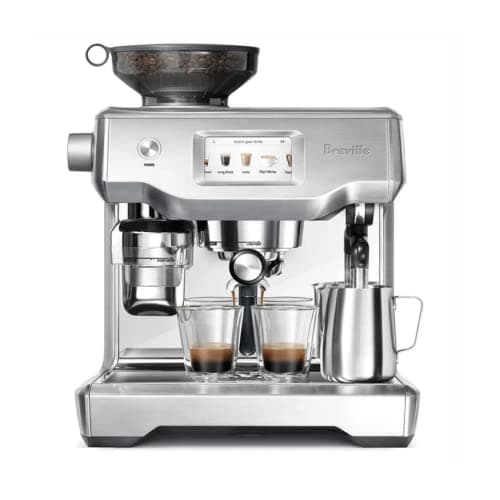
The Breville Oracle Touch and the Philips 3300 Series LatteGo make the same promise — press a button, get a milk drink, no skill required — and keep it in completely different ways at completely different prices. The Oracle Touch is an automated real-portafilter machine: under its touchscreen sits a genuine dual boiler and a 58mm portafilter, and the machine auto-grinds, doses and tamps 22 grams into it, then textures milk hands-free with its Auto MilQ wand. The Philips 3300 is a fully-automatic bean-to-cup: a sealed brew group and a two-piece LatteGo milk carafe grind, brew and froth on one touch, with nothing for you to handle. One automates a barista's hardware; the other seals it away. The whole question on this page is which automation is worth paying for.
The honest framing is that the Oracle Touch's premium buys a higher ceiling, not just a fancier interface. Because it brews through a real 58mm portafilter on a PID dual boiler and steams with a proper wand, it makes noticeably better espresso and genuine microfoam than any sealed bean-to-cup can — it is closer to a cafe machine that happens to run itself. The Philips 3300 does not try to reach that ceiling; it aims squarely at being the most sensible one-touch machine at a mainstream price, and its trump card is a milk system with no tubes that rinses in seconds and keeps the machine in daily use. Read the 3300 in full in our Philips 3300 LatteGo review, and see where the Oracle Touch sits among prosumer machines in our best dual boiler espresso machines roundup.
So this is not really a like-for-like fight; it is a question of how much automation, and of what, you actually want to pay for. If you want cafe-grade milk drinks with no learning curve and the budget to match, the Oracle Touch is the most complete answer there is. If you want reliable, effortless milk drinks with the lowest daily hassle at a fraction of the price, the Philips 3300 is the value pick. Both are honest machines; they just draw the line between convenience and capability in very different places, and that line is the decision.
Same promise, different machine: automated portafilter vs sealed bean-to-cup
Both machines are one-touch, but they are not the same kind of machine, and that is the crux. The Oracle Touch is a semi-automatic dual boiler with automation bolted on: it uses a real 58mm portafilter and a proper steam wand, and the automation grinds, doses, tamps and steams for you — so the barista hardware is all there, just driven by a touchscreen. The Philips 3300 is a true super-automatic bean-to-cup: everything happens inside a sealed brew group, and there is no portafilter or manual wand to touch at all. That difference is why one costs several times the other, and it is the same convenience-versus-capability fork our semi-automatic vs super-automatic guide lays out — except here both ends have been automated, so the choice is really how much real espresso hardware you want hiding under the one-touch surface. If you want the machine to be a genuine espresso setup that runs itself, that is the Oracle Touch; if you want a sealed appliance that just makes coffee, that is the 3300.
The espresso ceiling: a real 58mm dual boiler vs a sealed brew unit
This is where the price gap earns its keep, or does not, depending on you. The Oracle Touch brews through a genuine 58mm portafilter on a PID-controlled dual boiler, dosing a full 22 grams, so it can make espresso close to what a skilled hand pulls on a prosumer machine — the automation does the technique, but the hardware has the headroom. The Philips 3300 grinds with cool-running ceramic burrs across twelve steps and brews into a sealed unit with a fixed dose and fixed tamp, so its shot is engineered to be reliably acceptable with any bean rather than exceptional with one. Both descriptions are honest: the 3300 makes genuinely good coffee, better than most people manage by hand with a cheap setup, but it cannot reach the Oracle's ceiling because the sealed group cannot be pushed. So the real question is not which is “better” in the abstract — it is whether you will taste and value the difference enough to pay several times more for it, or whether reliably good is exactly enough.
Milk and cleanup: Auto MilQ microfoam vs no-tube LatteGo
Milk splits the same way, and cleanup is the quiet decider. The Oracle Touch's Auto MilQ wand textures real microfoam hands-free to a temperature and foam level you set, using an actual steam wand — so it can pour latte-art-grade milk with no skill, the closest a machine gets to a barista. The Philips 3300's LatteGo carafe froths and pours automatically too, and its trick is different but genuinely clever: it has no tubes and no internal channels, just two clip-together parts you rinse under the tap in seconds or drop in the dishwasher. That matters more than it sounds, because the frother you dread cleaning is the one you stop using — LatteGo removes exactly the friction that makes people abandon a bean-to-cup. So the Oracle makes better, more barista-like milk, while the Philips makes very good milk with the least daily hassle in the category. If you make milk drinks every day and prize easy cleanup, that is a real point for the 3300; if you want the best possible microfoam with no practice, the Oracle wins it. Both sit among our best espresso machines for lattes.
Is the premium worth it? Price, use and how we score
Be honest about how you will use it. The Oracle Touch costs several times what the 3300 does, and most of that spend is capability — a real portafilter, a dual boiler, a proper wand — that only pays off if you want cafe-grade results and will notice them. If your honest use is a reliable cappuccino or two each morning, the Philips 3300, our value pick from the best super-automatic espresso machines roundup, delivers that with far less money, footprint and cleanup, and you will not miss the ceiling you were never going to use. If you want the closest thing to a cafe that runs itself, and the budget is not the constraint, the Oracle Touch is the most complete one-touch machine there is. We did not bench-test either machine. Our scores are editorial judgments drawn from Breville's and Philips' published specifications and aggregated owner reports, weighed against a consistent rubric; our methodology explains exactly how we score without a lab, and where hands-on time would tell you more than a spec sheet we say so rather than invent a number.
How we picked
We did not lab-test this gear
Everyone in this category says they tested twenty machines. We have not pulled shots on every product here, and we say so. What we did instead: compiled the published specifications, cross-checked the manufacturer manuals, computed the running cost (wattage to energy, grams-per-shot to cost-per-cup), weighed aggregated owner reports, and scored each product against a published rubric. The scores are judgments from documented research — not measurements we took, because we do not have a test lab and we will not pretend we do. Where hands-on time would tell you more than a spec sheet, we flag it. Where a number came from someone else's work, we name them in Sources.