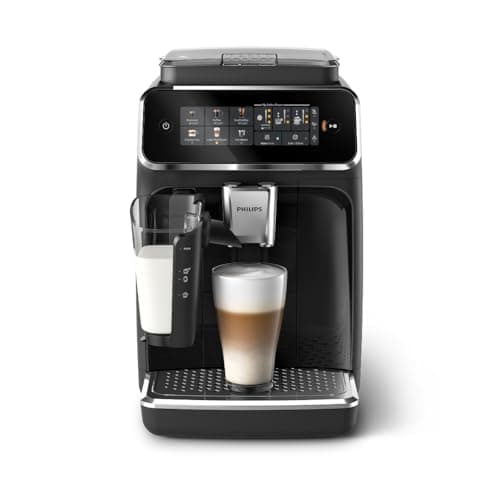
The Philips 3300 Series LatteGo is our value pick among super-automatic espresso machines, and the reason is almost entirely one part: the milk system. LatteGo is a two-piece carafe with no tubes and no internal channels at all, so after you pull a cappuccino you rinse those two parts under the tap in a few seconds, or drop them in the dishwasher. That one design decision is what really determines whether a bean-to-cup machine is still on your counter six months after you bought it — a frother you dread cleaning is a frother you stop using — and it is the thing the 3300 gets most right.
Underneath the milk carafe, the 3300 is a straightforward one-touch machine done sensibly. A ceramic burr grinder with twelve steps of adjustment feeds an automatic brew unit; you load whole beans and water, press a button, and the machine grinds, doses, tamps, brews and ejects the puck on its own. It makes six one-touch drinks — espresso, coffee and the common milk drinks — and it uses Philips' AquaClean filter, rated for up to five thousand cups before you have to descale. Nothing here is exotic. What it is, is complete: a full-feature bean-to-cup machine with the fewest daily annoyances at the price, which is exactly why it is our overall value recommendation and the machine we point most people toward first in our best super-automatic roundup.
Now the honest framing you will not get from the box. The espresso is good rather than great: a super-automatic uses a fixed dose and a fixed tamp, and its small built-in grinder and brew unit are tuned to be acceptable with every bean rather than exceptional with one, so you should not expect a cafe-grade shot. The feature set is deliberately modest, too — a shorter drink menu than pricier machines, no saved user profiles to store each person's preferred strength and length, and a brew group that is sealed and does not pull out for hand-cleaning. If you want a longer menu and per-person profiles, the milk-focused De'Longhi Magnifica Evo is the obvious cross-shop, and both sit inside our wider espresso machinescoverage. None of the 3300's limits is a defect; it is the deal you accept for the simplest milk system in the category at this price.
The LatteGo milk system, and why it decides everything
If you take one thing from this review, make it this: on a super-automatic, the milk system is the part that decides whether you keep using the machine, and LatteGo is the best answer in this price class. Most automatic frothers pull milk up a thin tube, through a chamber and out a spout, and every one of those internal surfaces has to be flushed or it sours — which is why so many bean-to-cup machines end up making black coffee only, their owners quietly done with the cleaning ritual. LatteGo has no tube and no internal channel. It is two clip-together plastic parts; milk runs down an open, wide channel where air is whipped in, and when you are finished you pull the carafe off, split the two halves and rinse them under the tap in seconds, or put them in the dishwasher. That is the whole trick, and it is a very good one. It is also the single biggest reason the 3300 is our value pick: it removes the exact friction that makes people abandon a super-automatic, and it does it at the cheap end of the range.
The grinder and the shot: good, not great
The 3300 grinds with a ceramic burr grinder set across twelve steps, and ceramic is the right material for the job at this level: it runs cool, so it does not scorch the grounds, and it wears slowly, so the grind stays consistent for years. Twelve steps is also more real adjustment than several rivals give you, which lets you nudge the machine toward a darker or lighter roast. Here is the honest ceiling, though, and it applies to every super-automatic rather than this one specifically: the built-in grinder is small, the brew unit uses a fixed dose and a fixed tamp, and the shot is engineered to be acceptable with any bean you pour in rather than dialed in for one. So the espresso the 3300 makes is genuinely good — better than most people make by hand with a cheap setup — but it will not out-brew a decent manual machine paired with a decent grinder, and it is not trying to. You are buying reliable, hands-off, every-morning coffee, not a shot to obsess over. If obsessing over the shot is the point for you, that is a signal to look at a manual machine like the Breville Bambino and a separate grinder instead.
What you give up versus a pricier bean-to-cup
The 3300 earns its value rating by leaving things out, and you should know what they are before you buy. First, the drink menu is short: six one-touch recipes cover espresso, coffee and the everyday milk drinks, but step-up machines offer longer lists with specialty and iced options. Second, there are no saved user profiles— the machine remembers a last setting, but it will not store a separate strength and cup size for each person in the house, so a two-coffee-preference household resets the dial each morning. Third, the brew group is sealed. Philips builds the 3300 with a fixed brewing unit that you cannot pull out to rinse under a tap, unlike machines with a removable brew group; the machine keeps itself clean with automatic rinse cycles instead, which works, but it means the deepest internal cleaning is done for you rather than by you. None of these is a dealbreaker for a single person or a couple who want one reliable drink each. They are exactly the reasons to spend more, though, if you want a longer menu and per-person memory — which is why the De'Longhi Magnifica Evo is the machine to weigh against this one, and why the whole field is laid out in our super-automatic roundup.
Living with it: cleaning, descaling and running cost
Day to day, the 3300 is low-effort. The two parts that touch milk go in the dishwasher, the machine runs an automatic rinse through the coffee path when you switch it on and off, and the drip tray and puck container empty in one motion. The maintenance headline is the AquaClean water filter, rated for up to 5,000 cups before you need to descale — you swap the filter cartridge on the machine's prompt and, if you keep up with it, Philips says you can go that long between full descales. That matters more than it sounds, because descaling is the chore most bean-to-cup owners skip until scale ruins the boiler, and pushing the interval out keeps the machine healthy with less thought. Budget for the ongoing bits every super-automatic needs: replacement AquaClean cartridges, descaler for when it is finally due, and the occasional grease for the brew unit. Beans and water aside, that is the real cost of living with the 3300, and it is modest.
What we did not test
We have not run this machine on a bench for months, and we do not claim to have. This review compiles Philips' published specifications for the EP3341/50, cross-checks the milk-system, grinder and filter claims against Philips' own product documentation, and weighs aggregated owner reports against our scoring rubric. The ceramic burr grinder, the twelve grind steps, the two-piece LatteGo design, the six one-touch drinks and the up-to-5,000-cup AquaClean rating all come from Philips' materials, listed in Sources. Where hands-on time would tell you more than a spec sheet — exactly how the milk texture compares with a manual wand, how quiet SilentBrew feels in a real kitchen, how the shot tastes with a specific bean — we say so rather than invent a number. Our scores are judgments from that documented research, not lab measurements; we do not have a lab, and our methodology says exactly that.