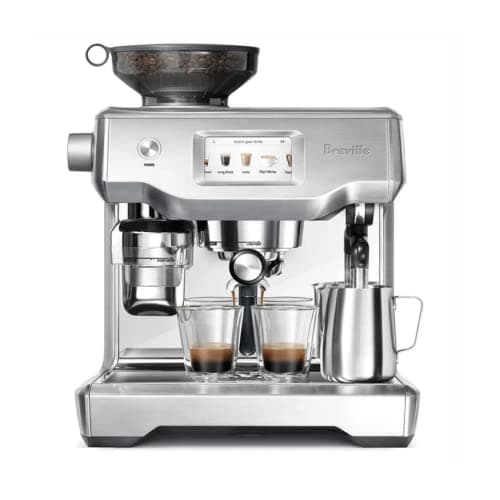
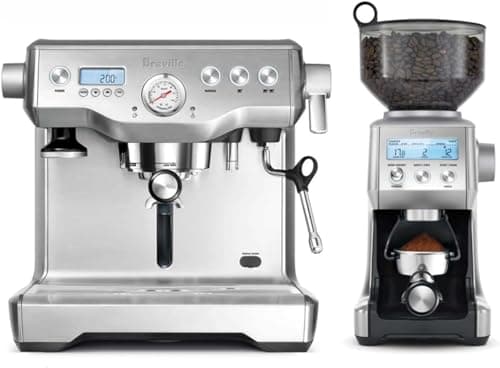
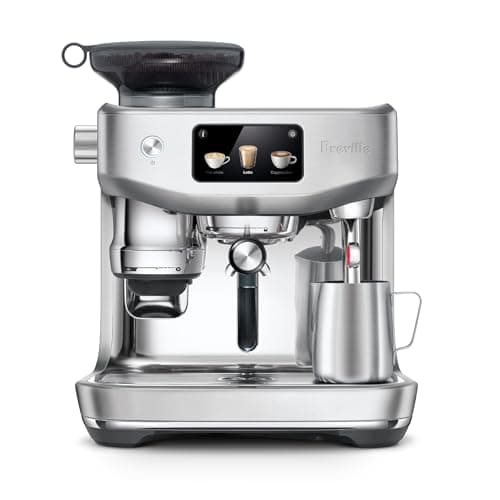
For almost everyone, buy the Breville Oracle Jet. It gives you the entire Oracle idea — a machine that grinds, doses and tamps 22 grams into a genuine 58mm portafilter and textures your milk hands-free — and it is at brew temperature in seconds rather than minutes. Buy the Breville Oracle Touch for exactly one reason: it has two real boilers, so it pulls a shot and steams milk at the same moment, which matters if you make three or four milk drinks back to back. If neither the automation nor the touchscreen is the appeal, the Breville Dual Boiler gives you the same simultaneous brew-and-steam for meaningfully less, and asks you to prep the puck yourself.
These two machines get cross-shopped because they are, deliberately, the same machine in most respects. Breville uses "Oracle" to mean one specific thing: an espresso machine that prepares the puck for you inside a real portafilter, with no lever to pull and no hand tamper in the box. Both of these do that. Both dose to Breville's stated 22 gram target. Both run a touchscreen that stores drinks and walks you through them. Both carry the Auto MilQ wand, which drops a temperature probe into your jug and textures milk to a temperature and foam level you set, then stops on its own. Both brew through 58mm — the commercial standard, with a real accessory market behind it.
So the comparison is not a feature war. It comes down to one engineering decision Breville made differently on each machine: how the water gets hot. The Oracle Touch runs two separate boilers with PID control, one for brewing and one for steam. The Oracle Jet replaces them with Breville's ThermoJet system — a fast-heating element in the water path plus a ThermoJet heated group head you can trim in one-degree increments.
That swap buys speed and costs simultaneity, and both effects are large. Breville rates ThermoJet at seconds to extraction temperature; TechRadar, which ran the Jet for months alongside the Oracle Touch it replaced in their office, put the practical figure at around 30 seconds from switch-on against three or more minutes for the Touch. In daily use that is the difference between planning around a warm-up and not thinking about the machine at all. But because brewing and steaming share one heating path on the Jet, they happen in sequence. Breville's mitigation is Auto Queue, which starts texturing the milk the instant the shot finishes, so a single latte needs no input from you — and a sequence is still a sequence. Four cappuccinos in a row take noticeably longer than on the Touch.
Here is the honest summary of who each one is for. If you make one or two drinks a morning — which is most households — the Jet is the better machine to own, because you feel the fast heat-up every single day and you feel the sequential steaming almost never. If you are the person making coffee for four people before work, or you entertain and routinely build a round of milk drinks, the Touch's dual boilers are worth the wait and the money. Our full Oracle Jet review and Oracle Touch review cover each machine on its own terms.
The spec differences that actually exist
Most of these two machines is shared, so this table only lists what genuinely differs. Specs are Breville's published figures for the exact listings above, with the measured heat-up times from TechRadar's side-by-side.
| | Oracle Jet (BES985) | Oracle Touch (BES990) |
|---|
| Heating | ThermoJet + heated group head | Two stainless boilers, PID |
| Heat-up (measured) | ~30 seconds | 3+ minutes |
| Brew and steam at once | No — sequential, with Auto Queue | Yes |
| Group temp adjustment | Yes, 1-degree increments | No |
| Cold brew / cold espresso | Yes, both | No |
| Grinder | 45 settings, Baratza-designed burrs | Integrated conical |
| Auto grind, dose, tamp | Yes — 22 g, 58mm | Yes — 22 g, 58mm |
| Hands-free milk | Auto MilQ | Auto MilQ |
How to decide in one question
Count the milk drinks you make in a row on a normal morning. If the answer is one or two, buy the Jet: you will feel the thirty-second heat-up every day and the sequential steaming almost never, and Auto Queue handles a single latte with no input from you. If the answer is three or more, buy the Touch: a dual boiler is the only real fix for a queue, and on the Jet each drink waits for the machine to swap between brew and steam temperature.
That is genuinely the whole decision. Everything else — the screen, the burrs, the automated puck, the 58mm platform — is close enough between the two that it should not move you. The two secondary tiebreakers, if you are still balanced: the Jet adds cold brew and cold espresso programs and one-degree group-head control, and at the prices above it costs less. The Touch has years more owner history, which is worth something on a machine with this many subsystems.
What neither machine does
Neither gives you a pressure gauge, and neither offers pressure or flow profiling. You get a shot timer that turns green or red — useful feedback, but not a variable you steer. If shaping the shot is the thing you want to learn, both of these machines are the wrong tool at any price, and the hands-on machines in our best prosumer espresso machines roundup are what you are looking for.
Neither out-grinds a dedicated grinder either. The integrated grinders here are good, and their real contribution is consistency rather than ceiling: the dose is measured rather than timed, so changing beans does not quietly change your recipe. But a standalone grinder at a fraction of the price difference between these two machines will grind more uniformly than either. Our best espresso grinders page covers that, and it is worth reading before you conclude an all-in-one is the economical route.
And neither is a machine you learn espresso on, which is the deliberate point of the Oracle line. The grinding, dosing and tamping that decide whether a shot channels are handled for you. That is the feature. It is also why a Bambino Plus plus a serious grinder, a scale and a bottomless portafilter costs far less, teaches you what these machines are doing on your behalf, and can out-grind both.
The grinder mess, since both reviewers raised it
On the Jet specifically, the one unanimous complaint from hands-on reviewers is mess. TechRadar found it "could be a little messy, occasionally leaving stray grounds on the portafilter and even on the worktop." Tom's Guide found the same thing more precisely: a consistent sprinkle of loose grounds on top of the finished puck, and more on the drip tray whenever the machine was moved. Neither thought it changed the coffee. Both mentioned it because on a machine at this price you notice it daily. Worth knowing, not worth deciding on.
How we picked
We did not lab-test this gear
Everyone in this category says they tested twenty machines. We have not pulled shots on every product here, and we say so. What we did instead: compiled the published specifications, cross-checked the manufacturer manuals, computed the running cost (wattage to energy, grams-per-shot to cost-per-cup), weighed aggregated owner reports, and scored each product against a published rubric. The scores are judgments from documented research — not measurements we took, because we do not have a test lab and we will not pretend we do. Where hands-on time would tell you more than a spec sheet, we flag it. Where a number came from someone else's work, we name them in Sources.