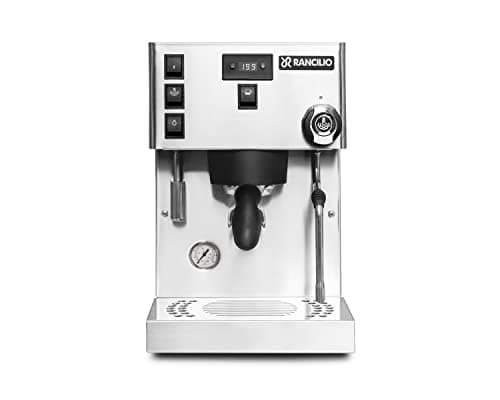
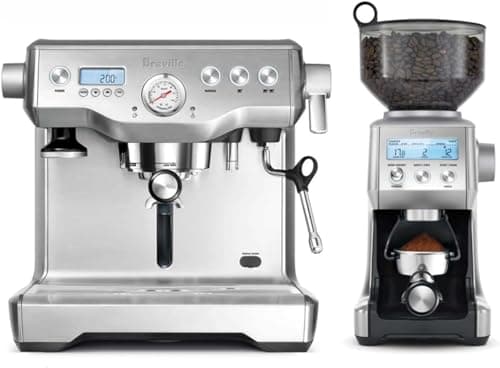
The Breville Dual Boiler and the Rancilio Silvia Pro X are both genuine, PID-controlled dual boilers around the same enthusiast tier — each brews and steams at the same instant with the temperature locked to the degree — and almost everything else about them points in the opposite direction. The Breville is the feature-rich, programmable machine that packs the most capability per dollar and, in its usual Dynamic Duo form, throws a grinder in the box. The Rancilio is the heavier, all-metal, more serviceable Italian machine with steam power closer to a cafe and a build meant to be maintained for a decade. Same category on paper, two completely different relationships with the object on your counter.
That split is the whole decision, so it is worth naming it plainly before the specs. The Breville is about capability and value: two stainless boilers with independent PID, a heated 58mm group, low-pressure pre-infusion, a shot clock, and — because it is usually sold as the Dynamic Duo bundled with the Smart Grinder Pro — a matched grinder out of the box, all for less than most Italian machines cost bare. It is designed to give you everything you need to start pulling great shots the day it arrives. The Rancilio is about build and steam: a 1-liter steam boiler and a 300ml brew boiler on independent to-the-degree PIDs, a genuine 58mm commercial portafilter, and a heavier, more metal chassis built to be serviced rather than replaced. It gives you fewer features and no grinder, and asks you to bring the skill — repaying you with a machine that feels permanent. Read the two in full in our Breville Dual Boiler review and our Rancilio Silvia Pro X review; this page is about which of the two suits you.
Because both are genuine dual boilers, the thing that usually separates espresso machines at this level — whether they can hold brew temperature and steam at once — is a tie. Both do it, and both do it well; our single vs double boiler guide explains why that architecture matters if you are still deciding whether you need it at all. What that tie means in practice is that this is not a fight about who makes better espresso in a vacuum — dialed in properly, both make excellent shots. It is a fight about what you want from the machine: turnkey features and a grinder in the box, or heirloom build and cafe-grade steam you will keep and service for years. See how both rank against the wider field in our best dual boiler espresso machines roundup.
One thing is true of both, and it matters more than anything that separates them: espresso is more sensitive to grind than to almost any other variable, so the grinder is half the setup on either machine. The Breville solves this in the box with the bundled Smart Grinder Pro; the Rancilio includes no grinder at all, so you must budget for a serious one on top of the price. Whichever way this comparison sends you, price the grinder before you spend a cent — our best grinders for espresso is the page to read first, because a dual boiler fed by a weak grinder loses to a single boiler fed by a great one.
Value and features vs build and permanence
Start with the difference that decides most of these purchases, because it is not about the coffee — it is about the object. The Breville is engineered to give you the most for your money: independent PID on both boilers, a heated group, low-pressure pre-infusion, a shot clock, programmable shot volumes, and a grinder bundled in the Dynamic Duo, all for less than a comparable Italian machine costs bare. It is feature-rich, quiet, and easy to live with, and nothing about the shot it pulls is a compromise. The catch is the chassis: there is more plastic than you would find on the Rancilio, the pump and interface are less mechanically romantic, and it is built to be used hard rather than unscrewed and rebuilt for twenty years. The Silvia Pro X inverts every one of those priorities. It is heavier, more metal, and genuinely serviceable — parts and diagrams exist, and Rancilio's commercial lineage shows in how permanent it feels — but it gives you fewer features, no grinder, and no hand-holding, at a higher price. So the underlying question is not “which makes better espresso” — both make excellent shots when dialed in — but “what do I want from the machine.” A feature-rich, grinder-included package that does everything for less, or a heavier, serviceable benchmark you maintain and keep. Both are legitimate answers.
Steam and milk: strong and quiet vs cafe-grade authority
Both machines are true dual boilers, so both brew and steam at the same instant with no waiting — that capability is a tie, and it is exactly why either one is a real step up from a single boiler. Where they differ is the ceiling and the character of the steam. The Breville's wand is genuinely capable: it textures microfoam quickly and handles milk drinks back to back, and it does so quietly and undramatically, which suits a lot of kitchens. The Silvia Pro X carries a larger dedicated 1-liter steam boiler, and it shows — steam authority here is closer to a commercial machine, so it textures fast, recovers quickly, and holds up drink after drink when you are making several milk drinks in a row for a crowd. If your milk work is one or two lattes a morning, both are more than enough and the Breville's quieter, easier experience may actually suit you better. If you steam a lot, entertain, or simply want the strongest, most cafe-like steam at this tier, the Rancilio has the edge that its bigger boiler implies. Neither froths the milk for you, so both reward learning to texture by hand— the Rancilio just gives you more steam to work with once you have.
The grinder question — one bundles it, one does not
This is the practical difference that changes the real price, and it is easy to overlook. The Breville is usually sold as the Dynamic Duo, bundled with the Smart Grinder Pro, so it arrives as a complete, matched setup — machine and grinder ready to go, with the single most common first-year mistake (starving a great machine with a cheap grinder) already solved. The Silvia Pro X ships as the machine only, with no grinder, so you must add a serious espresso grinder on top, and on a machine this capable the grinder matters as much as the machine itself. That reframes the value comparison entirely: the Breville's price already includes the grinder, while the Rancilio's does not, so the true gap between the two setups is wider than the machine stickers suggest. If you already own a serious grinder, that gap narrows and the Rancilio's build starts to look more compelling; if you are buying your whole setup at once, the Dynamic Duo's all-in-one value is hard to argue with. Either way, price the grinder into the decision — our best grinders for espresso is the place to start, and it is the upgrade most likely to improve your cup regardless of which machine you choose.
Ease and daily rhythm: turnkey vs a machine you manage
The last real difference is how much the machine asks of you day to day. The Breville is the more turnkey of the two: programmable shot volumes, a friendly interface, a quicker warm-up and a smaller, lighter footprint make it genuinely easy to live with, and the bundled grinder means there is nothing else to buy before you pull your first shot. The Silvia Pro X is more of a machine you manage — a longer warm-up before the metal is thermally settled, a bigger and heavier body on the counter, and no automation or guided recipes to lean on. For an enthusiast who enjoys the ritual, that is a feature: the Pro X rewards attention and technique, and it feels like a serious instrument. For someone who wants great coffee with less fuss, the Breville's ease is the more sensible choice, and it gives up nothing in the cup to get there. Be honest about which of those two you are, because both machines are excellent for their intended owner and mildly frustrating for the other. If neither quite fits, the wider field in our best dual boiler roundup includes automated and heat-exchanger options that split the difference in other ways.
What we did not test
We have not run either of these machines on a bench for months, and we will not pretend otherwise. This comparison compiles published manufacturer and retailer specifications, cross-checks the manuals, and weighs aggregated owner reports against our scoring rubric. The specs on both sides — the Breville's dual PID boilers, heated 58mm group, pre-infusion and bundled Smart Grinder Pro; the Rancilio's 1-liter steam and 300ml brew boilers, independent to-the-degree PIDs, 58mm commercial portafilter and adjustable pre-infusion — come from the documentation listed in Sources. Our scores are editorial judgments from that documented research, not measured numbers: there is no side-by-side temperature-stability chart and no timed back-to-back steaming log here, because we do not have a lab. Where hands-on time would genuinely tell you more than a spec sheet — exactly how the two machines' steam recovery compares across a long milk session, or how the bundled Smart Grinder Pro measures up against a serious standalone grinder paired with the Rancilio — we say so rather than invent a number. The claim we are most confident in is the architectural one: both are genuine dual boilers with independent PID, so both deliver real simultaneous brew-and-steam with steady temperature, and the choice between them is about build, steam and value rather than whether one can hold a shot temperature that the other cannot.