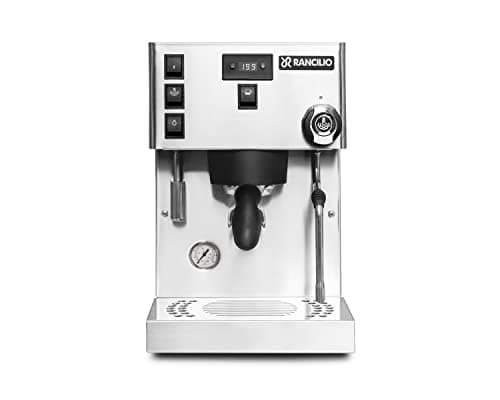
The Rancilio Silvia Pro X is the machine the single-boiler Rancilio Silviaowner graduates to. It keeps the honest, no-nonsense character of the original — a machine that rewards good technique and punishes sloppy grinding — and adds the two things the single boiler could never do: independently PID-controlled brew temperature, and a dedicated steam boiler powerful enough to texture milk like a cafe. Where the classic Silvia asks you to temperature-surf a heat-ready light and wait for one boiler to swing between brewing and steaming, the Pro X simply holds both jobs at once, to the degree. It is the enthusiast's step up, and it feels like one the moment you use it.
The architecture is a genuine dual boiler, and the numbers tell the story. A 1-liter steam boiler and a separate 300ml brew boiler each run on their own PID, so you can pull a shot and steam milk at the same instant with the brew temperature locked and the steam pressure cafe-strong. That 1-liter steam boiler is the headline: steam authority on the Pro X is closer to a commercial machine than to anything else at this size, so it textures microfoam fast and holds up drink after drink rather than running out of puff on the second cup. Add adjustable low-pressure pre-infusion to settle the puck before the pump ramps, a front-mounted shot timer for real control, and a genuine 58mm commercial portafilter, and you have a machine built to reward technique for years. If you want to understand exactly why that second boiler changes the experience, our single vs double boiler guide walks through the mechanism.
Build is the other half of the story, and it is where the Rancilio earns its price. This is a heavier, more metal, more serviceable machine than the plastic-bodied Breville dual boilers — the kind of machine you maintain rather than replace. Parts and diagrams exist, the construction is meant to be opened and serviced, and Rancilio's long lineage in commercial cafe equipment shows in how permanent the Pro X feels on the counter. That is the trade you are making at this tier: you pay more, and in return you get an all-metal platform designed to run for a decade and beyond. See exactly how it stacks up against its rivals in our best dual boiler espresso machines roundup, where it takes the build-and-steam crown.
What the Pro X is notis easy or feature-loaded, and you should go in clear-eyed. It has no grinder in the box, no automation, no touchscreen and no hand-holding — just a superbly built platform that expects you to bring the skill and, above all, the grind. That last point is not optional: a dual boiler this capable fed by a poor grinder will lose to a humble single boiler fed by a great one, because temperature stability only matters once the grind is right. Budget for a serious espresso grinderon top of the machine price, and know that the Pro X assumes you can already dial in and steam by hand. Bring those skills and it is arguably the most satisfying machine at this tier; lack them and it will frustrate you, and you would be better served one step down — our best espresso machines under $1,000 covers where most people should honestly start.
What the Pro X adds over the single-boiler Silvia
If you know the classic Silvia, the Pro X is easiest to understand as everything that machine taught you, with its two biggest limitations removed. On the single-boiler Silvia, one boiler heats to brew temperature or steam temperature but not both, so you temperature-surf the ready light, pull your shot, then wait for the boiler to climb to steam before you can froth milk — and without a factory PID, holding a precise brew temperature is a skill you learn by feel. The Pro X answers both. It splits the job across a 300ml brew boiler and a 1-liter steam boiler, each on its own PID, so brew temperature is held to the degree automatically and steam is ready the instant you are, with no waiting and no surfing. Add the genuine pre-heat and adjustable pre-infusion and the daily rhythm changes completely: the classic Silvia is a machine you manage, and the Pro X is a machine that manages the variables so you can focus on the grind and the pour. That is the upgrade you are paying for, and it is a real one for anyone who has outgrown the single boiler.
Steam power and build: where the money goes
Two things justify the Pro X's price, and it is worth being specific about both. The first is steam. That 1-liter dedicated steam boiler gives the Pro X steam authority closer to a commercial machine than to any plastic-bodied home dual boiler — it textures microfoam quickly and, crucially, recovers fast enough to make several milk drinks back to back without fading, which is exactly the job a second boiler exists to do. The second is build. The Pro X is a heavier, all-metal, genuinely serviceable machine, made to be maintained rather than binned; parts and diagrams are available and the construction reflects Rancilio's long history building commercial cafe gear. Against the Breville dual boilers, which are engineered superbly for value but use more plastic and are built to be used rather than rebuilt, the Pro X is the one you keep and service for a decade. That is the whole trade at this tier — you pay more and get less in the way of features and convenience, and in return you get build and steam that feel permanent. Our best dual boiler roundup weighs that trade directly against the value-benchmark Breville.
The grinder is not optional — and neither is the skill
Be honest with yourself before you spend, because the Pro X is unforgiving of two gaps. First, it ships with no grinder, and on a machine this capable the grinder matters as much as the machine itself. A dual boiler fed by a weak grinder makes worse coffee than a single boiler fed by a great one, because no amount of temperature stability can rescue an inconsistent grind — so a serious espresso grinder is not an accessory here, it is half your setup, and you must price it in from the start. Our best grinders for espressois the place to begin. Second, the Pro X has no automation to catch your mistakes: no auto-tamp, no hands-free milk, no touchscreen recipes. It assumes you can already grind to espresso fineness, prep a puck and steam milk by hand. That is a feature for the right buyer — the enthusiast who wants a superbly built platform to practice on for years — and a wall for the wrong one. If you are still learning those skills, you will get more enjoyment and better coffee from a friendlier machine one tier down; see our best espresso machines under $1,000.
What we did not test
We have not run this machine on a bench for months, and we will not pretend otherwise. This review compiles Rancilio's published specifications and retailer documentation, cross-checks the manual, and weighs aggregated owner reports against our scoring rubric. The specs — the 1-liter steam boiler and 300ml brew boiler, the independent to-the-degree PIDs, the 58mm commercial portafilter and the adjustable low-pressure pre-infusion — come from Rancilio and retailer documentation, listed in Sources. Our scores are editorial judgments from that documented research, not measured numbers: there is no temperature-stability chart or timed back-to-back steaming log behind them, because we do not have a lab. Where hands-on time would genuinely tell you more than a spec sheet — exactly how steady the brew boiler holds across a long session, or how the Pro X's steam recovery compares in practice with a Breville dual boiler — we say so rather than invent a number. The claim we are most confident in is the architectural one: this is a genuine dual boiler with independent PID on both circuits and a large dedicated steam boiler, and every published spec and owner account we found supports that it delivers commercial-flavored steam with real simultaneous brew-and-steam.
How we picked
We did not lab-test this gear
Everyone in this category says they tested twenty machines. We have not pulled shots on every product here, and we say so. What we did instead: compiled the published specifications, cross-checked the manufacturer manuals, computed the running cost (wattage to energy, grams-per-shot to cost-per-cup), weighed aggregated owner reports, and scored each product against a published rubric. The scores are judgments from documented research — not measurements we took, because we do not have a test lab and we will not pretend we do. Where hands-on time would tell you more than a spec sheet, we flag it. Where a number came from someone else's work, we name them in Sources.