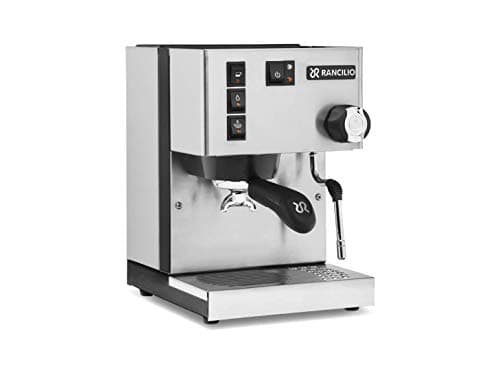
For the better part of two decades the Rancilio Silvia has been the machine enthusiasts point to when they want to explain what “built like a cafe machine” actually means in a home kitchen. Its appeal is not a feature list. It is a philosophy: Rancilio took the heavy commercial parts from the espresso machines behind cafe counters — a chromed brass group head, an insulated brass boiler, a full-motion stainless steam wand and a genuine 58mm portafilter— and packed them into a home-sized stainless body designed to be opened, serviced, modified and kept for many years. Buy one and you are not buying an appliance. You are buying a benchmark.
What that benchmark is made of is the whole story. The Silvia is built around a commercial brass group head bolted in constant contact with a small insulated brass boiler, so the heavy metal that holds your shot temperature is the same metal the boiler heats. That is why owners describe the machine as rock-steady once it is warm: the brass acts as a thermal battery, evening out the swings a lighter aluminum or thermoblock machine cannot. Behind it sits a 2 L reservoir, a vibratory pump and a single-piece stainless body that is meant to be unscrewed and maintained rather than thrown away. Parts are stocked, exploded diagrams are everywhere, and there is a deep, patient community that has documented every gasket. This is a machine you keep and repair, not one you replace.
The honest limits are the flip side of that same commercial DNA. There is no PID from the factory, so out of the box you either learn to temperature-surf or fit an aftermarket controller. There is no grinder in the box, and on a machine this capable the grinder matters as much as the machine itself. The full-motion steam wand is the real thing from Rancilio's cafe line, which means it rewards practice rather than doing the work for you, and the small single boiler makes you wait between pulling a shot and steaming milk. And it costs meaningfully more than the obvious alternative: for a broadly similar single-boiler, 58mm recipe you can spend a good deal less on a Gaggia Classic, so it is worth reading our Rancilio Silvia vs Gaggia Classic comparison before you commit. None of this is a defect. It is the deal, and for the right owner it is a very good one.
The brass boiler and chromed brass group are also why the Silvia is our top conventional pump machine in best espresso machines without plastic — which is honest about the one polymer part it does still have, the water reservoir.
Commercial brass, in a home body
The reason the Silvia earns the word “benchmark” is thermal mass. Its group head is a heavy chunk of chromed brass bolted directly to the boiler, so the metal that receives your portafilter is heated by the same body of water that brews the shot. Brass holds heat far better than the lighter aluminum or thermoblock assemblies in cheaper machines, which is why owners describe a warmed-up Silvia as unusually stable shot to shot — the metal smooths out the temperature swings you would otherwise taste. That same commercial group also carries a genuine 58mm portafilter, the diameter used behind most cafe counters. That number is not vanity: it unlocks an entire ecosystem of standard, cafe-grade parts — precision baskets, competition tampers, distribution tools and a bottomless portafilterthat shows you exactly where a puck is channeling. Nothing about the Silvia's hardware boxes you in; it hands you the commercial standard and lets you grow into it.
No factory PID: what temperature surfing means
Here is the limit nobody should hide from you: the Silvia does not ship with a PID. A PID is a controller that holds the boiler at a precise, steady brew temperature. Without one, the machine's thermostat lets the boiler swing through a band, and the trick owners use is called temperature surfing— you watch the heat-ready light, wait for it to cycle, and pull your shot in the predictable window that follows so the water lands in the right range. It sounds fiddly, and for the first week it is; then it becomes muscle memory, and plenty of people brew excellent espresso this way for years without adding anything. But the Silvia is also one of the most PID-friendly machines ever made: fitting a digital controller is the single most popular modification in home espresso, the machine is built to accept one, and doing so gives you cafe-steady brew temperature with no more surfing. That is the whole philosophy in one example — the factory version is honest and capable, and the door to more is left deliberately open. If you want that precision built in and never want to touch a screwdriver, that is a fair reason to look elsewhere.
The steam wand and the single-boiler wait
The Silvia's steam wand is lifted straight from Rancilio's commercial line: a full-motion, articulating stainless wand that puts out real steam pressure. It does not froth milk for you. It gives you a jet of steam and asks you to position the pitcher, introduce air and roll the milk into glossy microfoam yourself — and once that clicks, you can pour latte art with it. Getting there takes practice, a cold pitcher and patience. The other honest caveat is the single boiler. The Silvia heats one small 0.3 L boiler to brew temperature for the shot and then to a much higher temperature for steam, so there is a genuine wait between the two: pull your espresso first, switch to steam, give the boiler time to climb, then texture. It is a rhythm, not a race, and it is completely workable for one or two drinks. If you are making milk drinks for a crowd, back to back, that wait is the Silvia's real friction point — and only a heat-exchanger or dual-boiler machine much further up the range removes it.
What it costs, and what it costs next
The Silvia is a superb machine attached to an honest total-cost story you should hear before you buy. It is deliberately sold bare, and the most important thing to understand is that the grinder matters as much as the machine. A single boiler can only extract what the grind gives it, so a consistent, espresso-capable grinder is not optional — it is half your setup, and you should budget for it up front. Read our best grinders for espresso before you spend a cent on accessories. That extra cost is also why the comparison with a Gaggia Classic is unavoidable: the two share the same core single-boiler, 58mm recipe, and the Silvia asks meaningfully more money for heavier commercial parts and a longer service life. Whether that premium is worth it depends entirely on how long you intend to keep the machine and how much the brass thermal mass matters to you. See where it lands against the rest of the field in our best espresso machines under $1,000 roundup, then weigh it head to head in the comparison linked above.
What we did not test
We have not run this machine on a bench for months, and we do not claim to have. This review compiles Rancilio's published specifications, cross-checks the component and materials claims against the manufacturer's documentation, and weighs aggregated owner reports and the long, well-documented modding record against our scoring rubric. The group-head and boiler materials, portafilter size and reservoir capacity come from Rancilio's own materials, listed in Sources. Where hands-on time would tell you more than a spec sheet — exactly how long the warm-up needs to feel truly stable, how forgiving the temperature-surf window is day to day, how a specific PID kit installs — we say so rather than invent a number. Our scores are judgments from that documented research, not lab measurements; we do not have a lab, and our methodology says exactly that.