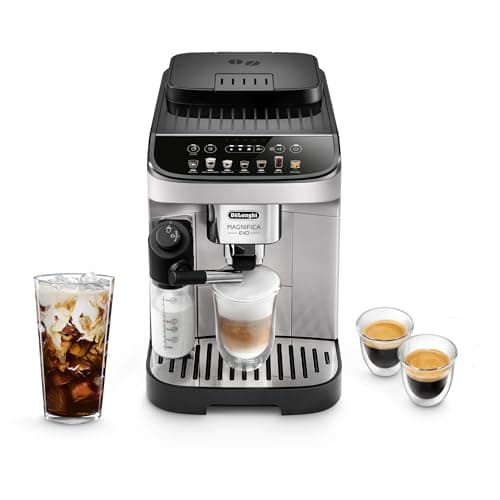
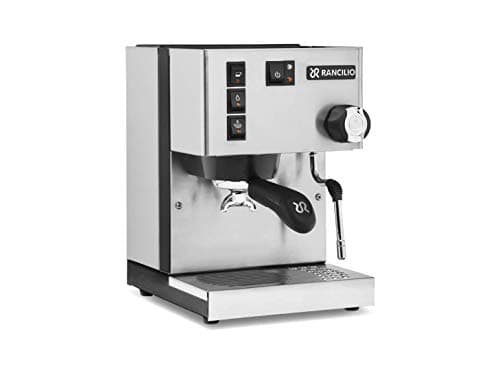
The Rancilio Silvia and the De'Longhi Magnifica Evo both make espresso, and that is nearly the only thing they share. The Silvia is a heavy slab of commercial-grade metal — a chromed brass group head, an insulated brass boiler, a genuine 58mm portafilter and a full-motion steam wand — a machine you warm up, learn, temperature-surf and pair with a separate grinder. The Magnifica Evo is a sealed bean-to-cup super-automatic that grinds, doses, tamps, brews and froths a milk drink at the press of a single button. One asks you to become a barista; the other asks you to press a button. These are not two versions of the same idea. They are two completely different relationships with espresso.
Naming that split is the whole decision. The Silvia is about craft and permanence: it hands you commercial parts on the cafe-standard 58mm platform, a wand that textures real microfoam once you learn it, and a body built to be serviced, modded and kept for a decade — but it gives you nothing for free. You bring the warm-up, the technique and, crucially, a good grinder. The Magnifica Evo is about convenience and consistency: it removes every step, so a latte takes about ninety seconds and no skill, and the LatteCrema carafe stores in the fridge between drinks. Read the two in full in our Rancilio Silvia review and our De'Longhi Magnifica Evo review; this page is about which relationship suits you.
There is one thing worth flagging up front because it changes the real cost of the Silvia: it does not include a grinder, and a single boiler can only extract what the grind gives it. On a machine this capable the grinder matters as much as the machine, so the honest Silvia budget is machine plus a serious burr grinder from our best grinders for espresso. The Magnifica Evo bakes its grinder in. That difference — buy-and-build versus all-in-one — sits underneath everything else here, so keep it in mind as we go.
Two relationships with espresso: a machine you learn vs a machine you press
Before any spec, decide which relationship you want, because it decides everything else. The Silvia is a semi-automaticmachine: it gives you a group head, a portafilter and a wand, and you supply the grind, the dose, the tamp, the temperature timing and the milk technique. That is the appeal for the person who wants espresso to be a craft — the machine is a capable, permanent instrument, and the skill is yours to build. The Magnifica Evo is a super-automatic bean-to-cup: a built-in grinder and sealed brew group do the whole process, so the machine is an appliance that hands you a finished drink. This is the fundamental fork every buyer faces, and our semi-automatic vs super-automatic guide lays it out in full. Neither answer is better in the abstract. The Silvia rewards attention and punishes neglect; the Magnifica asks for neither. Pick the relationship first and the machine follows.
Where the coffee comes from: a 58mm brass single boiler vs a sealed brew group
The two make espresso in fundamentally different ways, and each has an honest ceiling. The Silvia's heavy brass group and insulated brass boiler act as a thermal battery, so once fully warmed it holds shot temperature unusually steady, and its genuine 58mm portafilteris the cafe standard — it takes precision baskets, competition tampers and a bottomless portafilter, so the top end is high and the machine grows with your skill. The catch is that it gives you nothing automatically: it has no PID from the factory, so you temperature-surf the ready light or fit a controller, and it needs a real warm-up before the brass is stable. The Magnifica Evo grinds fresh across 13 settings and brews into a sealed group, so every cup is consistent and hot with no dialing in — but a fixed dose and fixed tamp mean it is tuned to be reliably good with any bean rather than exceptional with one, and you cannot push it the way you push a 58mm machine. So the split is honest: the Silvia has the far higher ceiling and asks you to reach it; the Magnifica raises the floor and seals the top. Which matters depends entirely on whether you want to chase a great shot or just reliably drink a good one.
Milk, and the grinder question
On milk, the two are opposites again. The Silvia carries a full-motion commercial steam wand with real steam pressure: it does not froth for you, but once you learn to steam by hand it textures glossy microfoam and pours latte art, with a single boiler that makes you wait between brewing and steaming. The Magnifica's LatteCrema carafe textures and pours milk automatically on one touch, handles plant milks, and stores in the fridge — effortless, if not hand-poured microfoam. The bigger practical difference is the grinder. The Magnifica has one built in; the Silvia has none, and that is not an optional extra. A single boiler can only extract what the grind gives it, so a consistent espresso grinder from our best grinders for espressois genuinely half the Silvia setup and belongs in the budget from day one. A Silvia fed by a poor grinder will lose to a Magnifica fed by its own built-in one — which reframes the price comparison entirely, because the Silvia's real cost is the machine plus that grinder.
Total cost, effort, and how we score
Add it up honestly. The Magnifica Evo is a mid-range bean-to-cup that competes in our best super-automatic espresso machines roundup, and its price is close to all-in — grinder and milk system included. The Silvia costs meaningfully more than a Gaggia Classic for a similar single-boiler recipe, and then you add a serious grinder on top, so the true buy-in is higher and the daily effort is real: warm-up, dialing in, hand-steaming, and the wait between shot and steam. What you get for that effort is a machine you can service and keep for a decade and a shot you control completely. What you give up for the Magnifica's one-touch ease is that control and permanence. We did not bench-test either machine. Our scores are editorial judgments drawn from Rancilio's and De'Longhi's published specifications and aggregated owner reports, weighed against a consistent rubric; our methodology explains exactly how we score without a lab, and where hands-on time would tell you more than a spec sheet we say so rather than invent a number.
How we picked
We did not lab-test this gear
Everyone in this category says they tested twenty machines. We have not pulled shots on every product here, and we say so. What we did instead: compiled the published specifications, cross-checked the manufacturer manuals, computed the running cost (wattage to energy, grams-per-shot to cost-per-cup), weighed aggregated owner reports, and scored each product against a published rubric. The scores are judgments from documented research — not measurements we took, because we do not have a test lab and we will not pretend we do. Where hands-on time would tell you more than a spec sheet, we flag it. Where a number came from someone else's work, we name them in Sources.