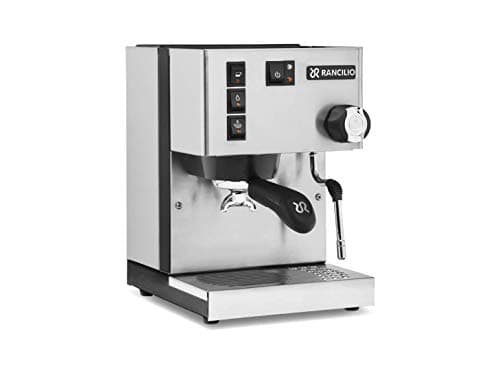
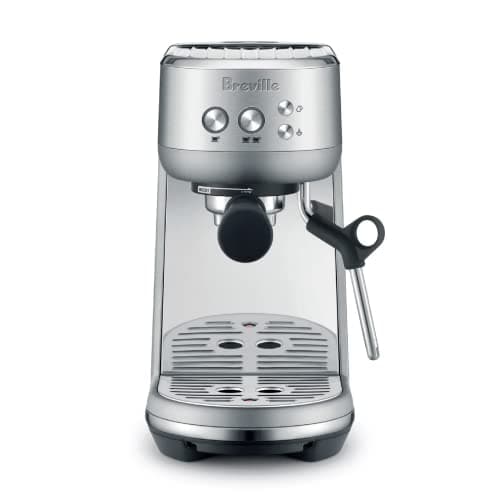
The Breville Bambino and the Rancilio Silvia are both compact, single-boiler espresso machines you can pull a real shot on — and almost everything else about them points in the opposite direction. The Bambino is the fast, forgiving, plastic-bodied machine that heats in seconds, pours from a one-touch button and hides in a corner of the counter. The Silvia is a heavy slab of commercial-grade metal with a brass group head, a genuine 58mm portafilter and a full-motion steam wand — a machine you warm up, learn, temperature-surf and keep for a decade. Same category on paper, two completely different relationships with espresso.
That split is the whole decision, so it is worth naming it plainly before the specs. The Bambino is the cheapest fast route to genuinely good espresso: Breville's ThermoJet system reaches brew temperature in about three seconds, the machine ships with real single-wall baskets so it can grow with your technique, and the footprint is roughly the width of a paperback. It is designed to remove friction. The Silvia removes nothing and adds craft: it takes commercial parts from Rancilio's cafe line and asks you to bring the skill, the warm-up and the patience, repaying you with a machine that feels permanent. Read the two in full in our Breville Bambino review and our Rancilio Silvia review; this page is about which of the two suits you.
One thing is true of both, and it matters more than anything that separates them: neither includes a grinder, and espresso is more sensitive to grind than to almost any other variable. Pairing either machine with a cheap blade grinder throws away most of what you paid for. Budget for a real burr grinder from the start — our best grinders for espresso is the page to read before you spend a cent on either machine. Whichever way this comparison sends you, the grinder is half the setup.
Heat-up and daily rhythm: seconds vs a warm-up ritual
Start with the difference you feel every single morning. The Bambino uses Breville's ThermoJet heater, which reaches espresso temperature in roughly three seconds — the machine is genuinely ready before you have finished grinding, and there is no waiting-around tax on a weekday. The Silvia is the opposite by design. Its heavy brass group head and insulated brass boiler are exactly what make it thermally stable once hot, but that same mass takes real time to come fully up to temperature; experienced owners give it well beyond the point the ready light first turns on, and many fit a timer or a smart plug so the machine is warm when they wake. That is not a defect — it is the price of the thermal battery that keeps the Silvia steady shot to shot. But it reframes the two machines: the Bambino is a grab-and-go appliance, and the Silvia is a ritual you warm up. If your espresso happens in a rushed ten-minute window, the Bambino fits that life far better. If you like a slow, deliberate start and will let the machine heat while you wake up, the Silvia's warm-up stops being a chore and starts being part of the routine.
Milk and steam: assisted-simple vs a commercial wand to learn
Both machines steam milk from a single boiler, so both make you pause between pulling a shot and steaming, and neither froths the milk for you. What differs is the wand and the ceiling. The Bambino's steam wand is genuinely strong for the footprint and pairs with an auto-purge that simplifies the switch between brew and steam, so it is an approachable place to learn to texture milk — and if you want the milk done automatically at the push of a button, that is the Bambino Plus rather than this BES450. The Silvia carries a full-motion, articulating stainless wand lifted straight from Rancilio's commercial line: more steam authority, a wider working range, and a genuinely high ceiling for glossy microfoam and latte art — but it rewards practice rather than doing the work for you, and the small 0.3 L boiler means a real wait to climb from brew heat to steam heat. So the split is honest: the Bambino is the easier, quicker milk experience for one or two drinks, while the Silvia is the better wand to grow into if learning to steam properly is part of the appeal. Neither is built to run milk drinks back to back for a crowd; that job belongs to a heat-exchanger or dual boiler much further up the range.
Build, size and the long game
This is where the two machines stop pretending to be in the same conversation. The Bambino is mostly plastic-bodied and about 7.7 inches wide, on the 54mm Breville portafilter standard — it is light, small and honestly not built to be opened and serviced for twenty years; it is built to be affordable, compact and easy to live with now. The Silvia is a single-piece stainless body wrapped around commercial brass, on the 58mm cafe standard, explicitly designed to be unscrewed, maintained, modded and kept. Parts are stocked, exploded diagrams are everywhere, and a bolt-on PID is the single most common home-espresso upgrade there is. That 58mm number is not vanity either: it unlocks the full ecosystem of cafe-grade baskets, tampers, distribution tools and a bottomless portafilterthat many first machines cannot take. So the question underneath “which do I buy” is really “what do I want from the object” — a small, fast, forgiving machine that saves counter space and money, or a heavy, serviceable benchmark you learn on and keep. Both are legitimate answers.
The grinder decides both — budget for it first
Whichever machine wins for you, do not let the choice distract from the part that actually decides your cup. Neither the Bambino nor the Silvia includes a grinder, and a single boiler can only extract what the grind gives it — so a consistent, espresso-capable burr grinder is not an accessory, it is half your setup. This is genuinely more important than the machine decision: a Silvia fed by a poor grinder will lose to a Bambino fed by a good one. Read our best grinders for espresso and budget for the grinder before you spend anything on tampers, scales or a nicer portafilter. If you are early in the journey and weighing your very first machine against the wider field of first-time picks, our best espresso machines for beginners roundup shows where the Bambino and the Silvia sit among the all-in-ones and other starter options. We did not bench-test either machine; our methodology explains how we score from documented specs and aggregated owner reports instead.
How we picked
We did not lab-test this gear
Everyone in this category says they tested twenty machines. We have not pulled shots on every product here, and we say so. What we did instead: compiled the published specifications, cross-checked the manufacturer manuals, computed the running cost (wattage to energy, grams-per-shot to cost-per-cup), weighed aggregated owner reports, and scored each product against a published rubric. The scores are judgments from documented research — not measurements we took, because we do not have a test lab and we will not pretend we do. Where hands-on time would tell you more than a spec sheet, we flag it. Where a number came from someone else's work, we name them in Sources.