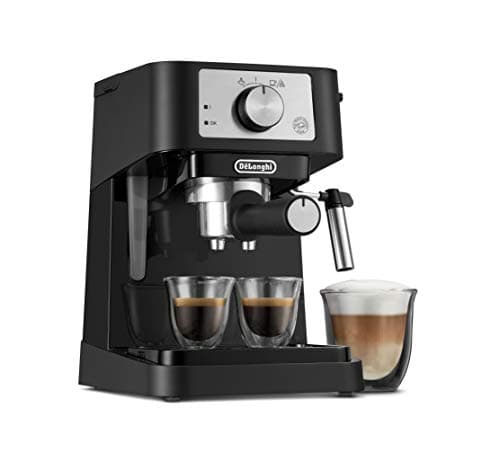
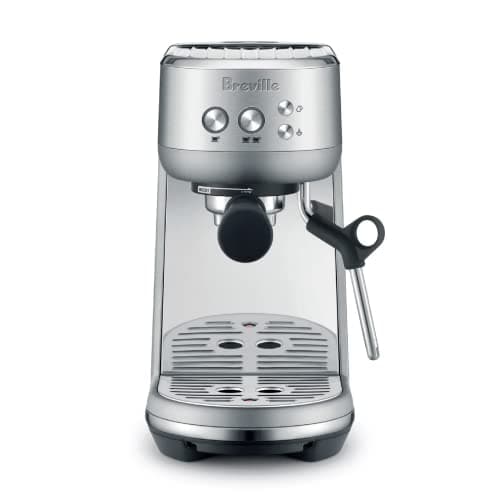
The Breville Bambino and the De'Longhi Stilosa are both “entry” espresso machines, but they are not really the same class of thing — they sit a clear tier apart. The Stilosa is rock-bottom: a mostly plastic body, a pressurized (dual-wall) basket that manufactures a crema-like foam out of almost any coffee, and a sleeved panarello frother that whips milk into quick bubbles. It is a genuine 15-bar pump machine, not a pod toy, and that is exactly enough to answer one question cheaply: do you actually like this hobby? The Bambino answers a different question — it is the machine you keep once the answer is yes.
Spend up to the Bambino and the money buys structure, not trim. You get Breville's ThermoJet heater that reaches espresso temperature in roughly three seconds, digital temperature control with low-pressure pre-infusion, and a real 54mm single-wall (non-pressurized) basket that can pull true, cafe-adjacent espresso instead of a basket-faked foam. Its steam wand is still manual, but it is a capable, assisted wand with an auto-purge, so you can learn to texture microfoam rather than settle for froth. Neither machine includes a grinder, and that matters more for the Bambino than the Stilosa — but we will come back to that, because it changes the math on both.
So this is not a close call on the merits, only on the wallet. The Stilosa wins on one axis: price, and it is a real win — it is the cheapest genuine pump machine worth buying. The Bambino wins on espresso quality, steam, heat-up and longevity. If you want the full field around them, both live in our best espresso machines under $200 and best machines for beginners; for the deep dives, see the Breville Bambino review and the De'Longhi Stilosa review.
The head-to-head, point by point
Espresso quality:the Bambino wins clearly — its real 54mm single-wall basket, digital temperature control and pre-infusion let a good grind extract properly, where the Stilosa's pressurized basket manufactures a crema-like foam and hides the grind entirely. Steam:the Bambino again — a capable manual wand you can learn microfoam on, versus the Stilosa's panarello that froths on its own terms. Heat-up:not close — ThermoJet brings the Bambino to temperature in seconds, while the Stilosa's small boiler makes you wait for a ready light and can drift as you work. Build and longevity: the Bambino is the machine you keep and improve; the Stilosa is mostly plastic with almost no upgrade path on the machine itself. Price:the Stilosa's one and only win, and a real one — it is the cheapest genuine pump machine worth buying. We did not bench-test either machine; our methodology explains how we score from documented specs, decoded manuals and aggregated owner reports.
The basket is the whole story
If you understand one difference between these two machines, make it the basket, because it decides almost everything about the cup. The Stilosa ships with a pressurized(double-walled) basket: a second wall hides a single pinhole, water pools behind it and is forced out in a thin, aerated jet, so you get a thick foam that looks like crema no matter what coffee went in — supermarket pre-ground, a cheap grinder, even a pod. That is a genuine gift for a beginner, and it is also a bit of a trick, because the foam is produced by the basket's back-pressure rather than by a well-extracted puck. The Bambino ships with those forgiving pressurized baskets too, but crucially it also includes real single-wall(non-pressurized) baskets, where the coffee puck itself creates the resistance. Those demand a good, even grind and a proper tamp — and they reward you with the actual cafe-style extraction the Stilosa cannot reach. In one sentence: the Stilosa fakes crema to make espresso easy; the Bambino lets you make espresso real once you are ready. That is the tier gap in a nutshell.
Steam: panarello froth vs a wand you can learn on
Milk is the other place the tier shows. The Stilosa's wand is a panarello— a sleeved frother that pulls in air through a side hole to whip milk into foam quickly and forgivingly. It makes a warm, airy foam that is fine on a cappuccino, but it adds air on its own terms, so you get froth rather than the tight, glossy microfoamthat latte art needs. The Bambino's wand is manual too, but it is a proper steam wand with a strong output for the footprint and an auto-purge to keep it clean, so you can genuinely learn to texture milk and pour. If milk drinks matter, the panarello is the weakest part of the Stilosa and one of the first things stepping up fixes. There is an honest limit on the Bambino as well: it is a single boiler, so you pull your shot and then steam, with a short purge in between — the same one-drink-at-a-time rhythm the Stilosa has, only faster and with far more control over the result.
Both need a grinder — but not the same grinder
Neither machine comes with a grinder, and espresso is more sensitive to grind than to almost anything else — but the two machines want very different things from you here. Because the Stilosa's pressurized basket manufactures its own pressure, it runs happily on pre-ground coffee or an ESE pod, so you can genuinely start with no grinder at all. The flip side is the mistake people make: pairing the Stilosa with an expensivegrinder is largely wasted money, because the pressurized basket hides most of what a great grind would give you. The Bambino is the opposite. Its single-wall basket only reaches its potential with a real burr grinder, and a cheap blade grinder wastes the machine entirely — so budget for grinding from the start, and see our best grinders for espresso. This changes the honest cost comparison: the Stilosa can be a complete setup on its own, while the Bambino is really a two-purchase decision. If total spend is the constraint, weigh the machine plus a grinder together, and compare the wider field in our best under $200 roundup.
Which should you buy
- Buy the De'Longhi Stilosa ifyou want the cheapest genuine way to find out whether home espresso is for you, you are happy to start with pre-ground or a modest grinder, and a good-enough cappuccino is a win. It is the lowest-risk door into the hobby — the full picture is in the Stilosa review.
- Buy the Breville Bambino ifyou already suspect espresso will stick, you want true single-wall extraction, near-instant heat-up and a wand you can learn on, and you are willing to add a real grinder. It is the machine that grows with you — see the Bambino review for the deep dive.
- Still deciding? Both sit in our best machines for beginners and best under $200 roundups, ranked against the wider field so you can see exactly where each one lands.
How we picked
We did not lab-test this gear
Everyone in this category says they tested twenty machines. We have not pulled shots on every product here, and we say so. What we did instead: compiled the published specifications, cross-checked the manufacturer manuals, computed the running cost (wattage to energy, grams-per-shot to cost-per-cup), weighed aggregated owner reports, and scored each product against a published rubric. The scores are judgments from documented research — not measurements we took, because we do not have a test lab and we will not pretend we do. Where hands-on time would tell you more than a spec sheet, we flag it. Where a number came from someone else's work, we name them in Sources.