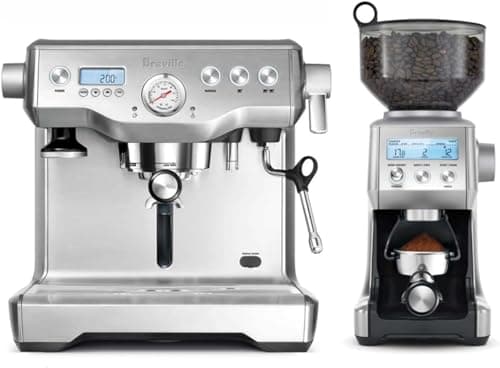
The Breville Dual Boiler is the machine that made a genuine, PID-controlled dual boiler something a home enthusiast could actually afford, and years later it is still the one we would hand most first-time prosumer buyers. It gives you the part of the prosumer experience that actually changes your coffee — two separate boilers, each held to its own temperature, so you can pull a shot and steam milk at the same instant without waiting for a single boiler to swing up to steam heat and back down again — without asking you to spend two or three times as much for the privilege. Enthusiasts usually just call it the “BDB,” and it earns the shorthand: this is the value benchmark the whole dual-boiler tier is measured against.
One thing worth stating plainly up front, because it changes how you read the price: the Breville Dual Boiler commonly ships as the “Dynamic Duo”bundle, the machine packaged together with Breville's Smart Grinder Pro (the model number on the bundle is BEP920, versus BES920 for the machine alone). That matters more than it sounds. A dual boiler is only ever as good as the grind feeding it, and pairing the machine with a matched, dedicated grinder out of the box removes the single most common first-year mistake — discovering, after you have spent the money, that a cheap grinder is the real bottleneck in your cup. If you buy the Dynamic Duo, you walk in with both halves of the setup already matched.
Underneath, the hardware is the real thing rather than a marketing dual boiler. Two stainless steel boilers run on independent PID control, the 58mm group head is heated and PID-managed in its own right, and low-pressure pre-infusion gently wets and settles the puck before the pump ramps to nine bars — the same architecture as machines costing far more. You get an adjustable brew temperature, a shot clock on the front, and a steam wand strong enough to build proper microfoam for a latte or flat white while a shot is running. For a huge number of people, that combination is simply the finish line. If you want to understand why a second boiler matters before you commit, our single vs double boiler guide walks through the mechanism, and our best dual boiler espresso machines roundup shows exactly where the BDB lands against its rivals.
The honest catch is one of build, not capability, and it is worth naming before you spend. The BDB is Breville rather than Milan: there is more plastic in places a Ranciliois steel, and it is not the machine an obsessive rebuilds part-by-part for twenty years. It is built to be used hard, not restored for decades. If your priority is heirloom, fully-serviceable commercial build, that is a different machine at a different price. But if you want the most dual-boiler capability per dollar — and, in Dynamic Duo form, a grinder already matched to it — nothing else at this tier comes close. If you are still on your first machine, a strong single boiler and a serious espresso grinder is the smarter place to start; the BDB is the upgrade you buy once you have outgrown that.
What the second boiler actually buys you
A dual boiler is the upgrade you buy after you have already learned to pull a decent shot, not before — and the reason to want one is specific. On a single boiler, one tank heats to brew temperature orsteam temperature, but not both at once, so you pull your shot and then wait for the boiler to climb to steam heat before you can texture milk. The Breville Dual Boiler ends that wait: one boiler holds brew water at a precise, PID-controlled temperature while a second, hotter boiler makes steam, so you extract an espresso and froth milk at the same instant, every time. Add the heated, PID-managed 58mm group and low-pressure pre-infusion and you get the thing enthusiasts actually chase — temperature stability so steady the machine stops being the variable in your cup. That is worth being honest about, though: if you only ever make one or two milk drinks in a row, the few seconds a good single boiler spends switching to steam genuinely do not matter, and you would get more in the cup by spending the difference on a better grinder. The BDB earns its keep when you make milk drinks back to back, when you have chased temperature consistency far enough to know the machine is your last variable, or when you have simply decided this is the hobby.
The Dynamic Duo bundle: why the grinder in the box matters
The single most useful thing about the way this machine is usually sold is that it comes as the Dynamic Duo — the BDB packaged with Breville's Smart Grinder Pro. It is easy to under-rate that, so we will be blunt: a dual boiler fed by a weak grinder makes worse coffee than a strong single boiler fed by a great one. Temperature stability only matters once the grind is right, and no boiler on earth can fix a grinder that cannot hold a consistent espresso setting. By bundling a purpose-built grinder, the Dynamic Duo package removes the most common and most expensive first-year mistake in one move — buying a lovely machine and starving it with pre-ground coffee or a blade grinder. The Smart Grinder Pro is good rather than class-leading; committed espresso addicts will eventually want to step up to a single-dose flat-burr grinder, and that is fine. But as a matched starting point that lets the machine actually show what it can do from day one, it is exactly the right call, and it is the reason we would point most people at the Dynamic Duo listing rather than the bare machine. If you already own a serious grinder, our best grinders for espresso guide shows what the BDB deserves at the top of its range.
Build: Breville, not Milan — and honest about it
Here is where you should set your expectations correctly, because it is the one real trade-off. The Breville Dual Boiler is engineered brilliantly for its price, but it is built to be used rather than rebuilt. There is more plastic than you would find on an all-metal Rancilioor an Italian E61 machine, the pump and interface are quieter and less mechanically romantic, and it is not the kind of machine you unscrew and restore part by part for a lifetime. None of that shows up in the cup — the shot the BDB pulls is genuinely excellent, and its 58mm group takes the same cafe-grade baskets, tampers and WDT tools the enthusiast machines use — but it does show up in how long you should expect to own it and how repairable it is a decade from now. If you want an heirloom you service forever, that is a Rancilio Silvia Pro X or an E61 machine, and you will pay for it. If you want the most dual-boiler capability per dollar in a package that will serve years of daily drinks, the BDB is the answer, and it sits at the value-benchmark spot in our best dual boiler roundup for exactly that reason. Not ready for prosumer money at all? Our best machines under $1,000 covers the tier where most people should honestly start.
What we did not test
We have not run this machine on a bench for months, and we will not pretend otherwise. This review compiles Breville's published specifications, cross-checks the manual, and weighs aggregated owner reports against our scoring rubric. The specs — the dual stainless boilers with independent PID, the heated 58mm group, the 22g dose, the low-pressure pre-infusion and the Smart Grinder Pro in the Dynamic Duo bundle — come from Breville's own documentation, listed in Sources. Our scores are editorial judgments from that documented research, not measured numbers: there is no temperature-stability chart or timed back-to-back steaming log behind them, because we do not have a lab. Where hands-on time would genuinely tell you more than a spec sheet — exactly how tightly the brew boiler holds temperature across a long milk-drink session, or how the Smart Grinder Pro compares in the cup with a single-dose upgrade — we say so rather than invent a number. The claim we are most confident in is also the simplest: this is an architecturally genuine dual boiler with independent PID, and every published spec and owner account we found supports that it delivers real simultaneous brew-and-steam with the temperature held steady.
How we picked
We did not lab-test this gear
Everyone in this category says they tested twenty machines. We have not pulled shots on every product here, and we say so. What we did instead: compiled the published specifications, cross-checked the manufacturer manuals, computed the running cost (wattage to energy, grams-per-shot to cost-per-cup), weighed aggregated owner reports, and scored each product against a published rubric. The scores are judgments from documented research — not measurements we took, because we do not have a test lab and we will not pretend we do. Where hands-on time would tell you more than a spec sheet, we flag it. Where a number came from someone else's work, we name them in Sources.