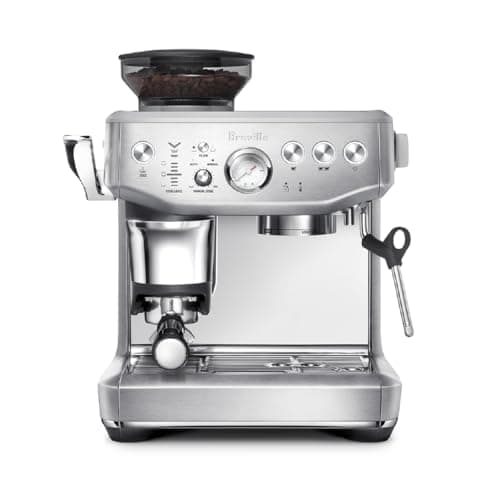
The Breville Barista Express Impress is an all-in-one espresso machine — a conical burr grinder, 54mm brew group and steam wand built into one body, so you go from whole beans to a shot without a separate grinder on the counter. In the simplest terms, it is the hugely popular Barista Expresswith one idea layered on top: the "Impress" puck-prep system, which assists the two steps a beginner is most likely to get wrong — dosing the right amount of coffee and tamping it evenly. Almost everything else that matters carries straight over: the integrated grinder, the 54mm portafilter, the manual steam wand and the ThermoCoil heater held at brew temperature by a PID.
The Impress system is the whole reason to look at this machine over the plain Express. You grind into the portafilter, then pull a lever: an assisted mechanism applies a consistent, repeatable tamp — a constant pressure of roughly 22 pounds, finished with a small twist to polish the puck — so you are not guessing how hard to press or fighting a tilted tamp. The intelligent dosing measures the shot you just pulled and nudges the next dose up or down toward an 18-gram target, so the grinder learns your beans instead of leaving you to eyeball it. If tamping is the step that intimidates you, our guide to tamping espresso shows exactly what the machine is doing for you, and why doing it consistently matters so much to the cup.
Here is the honest part, and it is the same story as the rest of the Barista line: the espresso the Impress pulls is very close to the plain Express's. They share the same 54mm brew system, the same style of integrated conical burr grinder and the same PID-held ThermoCoil, so the shot in the cup is not where the extra money goes — the assisted puck prep is. Two things worth being clear about before you buy: this is the ThermoCoil machine, not the near-instant ThermoJet one, so it wants a short warm-up rather than being ready in seconds; and the built-in grinder, while genuinely convenient, is still a step below a good standalone unit, so if grind quality is your priority a dedicated espresso grinder will out-grind it. Buy the Impress for consistency you do not have to learn, not for a different espresso.
What the Impress system actually does
The headline over the plain Express is the "Impress" puck-prep system, and it addresses the two steps that sink most beginner shots: how much coffee you dose, and how evenly you tamp it. On the dosing side, the machine has an intelligent dose function — it remembers the shot you just pulled and nudges the next grind up or down toward an 18-gram target, so instead of guessing and re-grinding you converge on the right dose over a couple of shots. On the tamping side, you pull a lever and an assisted mechanism presses the puck with a consistent force — roughly 22 pounds — and finishes with a small rotational twist to polish the surface. The point is repeatability: a level, evenly compressed puck every time, without the wrist technique and the feel that a hand tamp demands. It does not make the espresso taste different on a perfect shot; it removes the bad shots you would otherwise get while you are still learning. Our how to tamp espresso guide walks through the manual skill the Impress is standing in for, so you can judge whether you would rather learn it or hand it to the machine.
Same cup as the Barista Express
Here is the part the marketing will not lead with: the Impress and the plain Express pull very similar espresso. They share the same 54mm portafilter and brew logic, the same style of integrated conical burr grinder, and the same PID-held ThermoCoil, so the shot in the cup is not where the extra money goes. The Impress adds assisted dosing and tamping on the front end; it does not change the group head, the pump behavior or the heater. For most buyers that means the decision is really about how much you value consistent puck prep you do not have to learn. If you are happy to dose by weight and tamp by hand — or you want to learn to — the plain Barista Express is the smarter spend and the cup will be the same. For the full side-by-side, see our Barista Express vs Impress comparison; or see where both sit against the wider field in our best espresso machines under $1,000 roundup.
ThermoCoil, not ThermoJet: what that means for speed
It is worth being precise about heating, because the Barista line splits here. The Impress uses the Express's ThermoCoilheater, held at brew temperature by a PID — stable and consistent, but it wants a short warm-up before it is ready. It is not the near-instant machine in the range. If a fast, no-waiting heat-up is what you are after, that is the Barista Pro, which swaps in ThermoJet and comes to temperature in seconds. So think of the two upgrades as answering different questions: the Impress answers "how do I get a consistent puck without learning to tamp," and the Pro answers "how do I stop waiting for the machine." They do not overlap, and neither of them makes the espresso itself better than the plain Express does.
The built-in grinder, honestly
The integrated grinder is the whole point of an all-in-one: no separate box on the counter, and you grind fresh straight into the portafilter, which on the Impress feeds directly into the assisted dose-and-tamp routine. It is a real conical burr grinder with 25 settings, and for a lot of people it is all the grinder they will ever need. But be clear-eyed about the trade-off — a machine grinder has to fit inside the body and hit a price, so it is not the equal of a dedicated espresso grinder, and you cannot upgrade it on its own later. The assisted tamp makes the puck consistent, but the grind is still what decides how good the shot can be, so if grind quality is the thing you care about most, the honest path is a smaller machine paired with a proper standalone unit from our best grinders for espresso. The all-in-one trades a little grind ceiling for a lot of convenience; whether that is the right trade is the real question behind buying any Barista machine.
Who it is for
- Buy the Barista Express Impress if you want an all-in-one, you are nervous about dosing and tamping, and you would rather the machine make your puck consistent than spend a few weeks learning to do it by hand. That assisted consistency is exactly what the premium over the plain Express buys.
- Buy the plain Barista Express instead ifyou are on a budget or you want to learn the craft — it pulls a near-identical shot for less, tamping is a short skill, and a basket-matched tamper costs little.
- Buy the Barista Pro instead ifwhat you actually hate is waiting — its ThermoJet heat-up is the fast machine in the range, though it leaves the tamping to you.
- Skip all three ifgrind quality and flexibility matter more than single-box simplicity — a compact machine plus a dedicated grinder is the better long-term setup.
What we did not test
We have not run this machine for months on a bench, and we do not claim to have. This review compiles Breville's published specifications for the Barista Express Impress, cross-checks them against the Barista Express it is based on, and weighs aggregated owner reports against our scoring rubric. The Impress assisted tamp and intelligent dosing, the 54mm brew system, the integrated conical burr grinder, the ThermoCoil heating and the manual steam wand all come from Breville's own materials, listed in Sources. Where hands-on time would tell you more than a spec sheet — exactly how the assisted lever feels over months, how consistently the intelligent dose converges across different beans, how the grinder holds its setting — we say so rather than invent a figure. Our scores are judgments from that documented research, not lab measurements; we do not have a lab, and our methodology says exactly that. Prices are never quoted from memory; the live price renders from our pipeline with the date it was checked.